
Review the key concepts, formulae, and examples before starting your quiz.
🔑Concepts
The objective is to construct an angle equal to a given angle using only a ruler and a compass, without knowing the actual numerical degree measure.
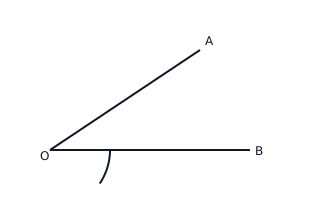
The first step involves drawing a ray and then drawing an arc on the original angle with center . This same radius is used to draw an arc on the new ray starting from its endpoint .
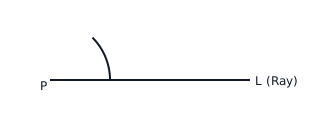
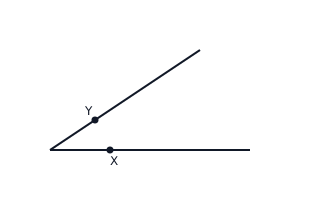
The compass is then adjusted to the width between the points where the arc intersects the arms of the original angle. This width is transferred to the new construction to locate the second point on the copy.
Finally, the intersection point is joined to the origin of the ray. This ensures the two angles are congruent based on the SSS (Side-Side-Side) criterion of the triangles formed by the arcs.
📐Formulae
Measure of Original Angle = Measure of Copied Angle
Radius of Arc_{1} (Original) = Radius of Arc_{1} (Copy)
Distance between intersection points P and Q = Distance between intersection points X and Y
(The underlying geometric principle of SSS congruence)
💡Examples
Problem 1:
Given an angle of unknown measure, construct a copy of this angle named using a ruler and compass.
Solution:
- Draw a ray which will serve as the base of the new angle. 2. Place the compass pointer at vertex of the given angle and draw an arc of any radius that cuts the arms and at points and respectively. 3. Without changing the compass radius, place the pointer at point (the new vertex) and draw an arc that cuts the ray at a point . 4. Now, place the compass pointer at point and adjust the width so the pencil touches point . 5. With this width, move the compass pointer to point on your new drawing and draw an arc that intersects the first arc at a point . 6. Use a ruler to draw a ray starting from and passing through . The resulting (or ) is the copy of .
Explanation:
The solution uses the compass to transfer the distance from the vertex to the arms and the distance between the arms themselves. By maintaining the same radius and the same arc-width, we ensure the two angles are congruent.
Problem 2:
If , describe the steps to construct without using a protractor for the construction.
Solution:
- Draw ray . 2. At vertex , draw an arc intersecting and at and . 3. At vertex , draw the same arc intersecting at . 4. Measure the distance with the compass. 5. From point , draw an arc with radius to intersect the previous arc at point . 6. Draw ray through . Since the construction replicates the exact arc length between the arms at a fixed distance from the vertex, will measure exactly .
Explanation:
This demonstrates that even when the degree measure is known, the compass-and-ruler method relies on transferring geometric lengths (arcs and chords) rather than numerical degree values.
Problem 3:
Construct a copy of a given obtuse angle using only a compass and a straightedge.
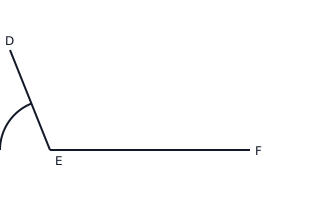
Solution:
- Draw a ray .
- On the original , place the compass pointer at and draw an arc cutting at and at .
- Without changing the compass width, place the pointer at and draw an arc cutting at .
- Adjust the compass to the distance .
- With the pointer at , draw an arc intersecting the previous arc at point .
- Draw ray . is the required copy of .
Explanation:
By keeping the radii of the arcs and the chord lengths identical, we create two congruent triangles, ensuring .
Problem 4:
If you are given an angle of , describe the construction of another angle that is exactly twice the size of the given angle.
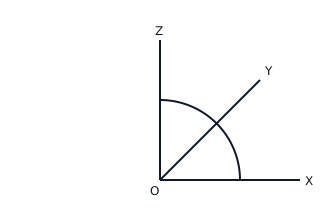
Solution:
- Construct a copy of the angle on a base ray to get .
- Treat the new ray as the base for a second copy.
- Using the same compass width used for the first arc, draw another arc from starting from ray .
- Measure the chord length of the original arc and mark it off starting from the point on ray .
- Draw the final ray . will be .
Explanation:
This method uses the 'copying an angle' technique twice consecutively (adjacent to each other) to perform angle addition.