
Review the key concepts, formulae, and examples before starting your quiz.
🔑Concepts
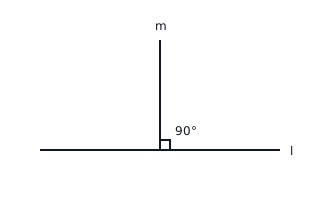
A perpendicular line is a line that intersects another line at a right angle, which is exactly . When two lines and are perpendicular, we write .
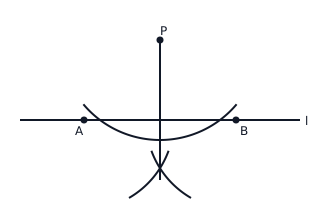
To construct a perpendicular from a point not on the line , we use a compass to draw an arc that intersects the line at two points, and . Then, from and , we draw two intersecting arcs with the same radius to find a point . The line is perpendicular to .
A Perpendicular Bisector is a line that not only meets a segment at but also divides it into two equal halves. Every point on the perpendicular bisector is equidistant from the endpoints of the segment.
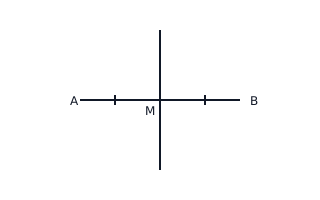
When constructing a perpendicular bisector of segment , the compass radius must be greater than half the length of , i.e., , so that the arcs from and can intersect.
📐Formulae
Angle of Perpendicularity:
Midpoint condition for Perpendicular Bisector:
Radius requirement for construction:
Equation of perpendicularity: (Note: For advanced context, though is the Grade 6 focus)
💡Examples
Problem 1:
Construct a perpendicular bisector of a line segment of length using a ruler and compasses.
Solution:
- Draw a line segment using a ruler.
- With as center and a radius more than (half of ), draw two arcs, one above and one below .
- With as center and the same radius, draw two arcs cutting the previous arcs at points and .
- Join and .
- The line intersects at point . Here, and .
Explanation:
To bisect a segment, the compass radius must be greater than the length (i.e., ) so that the arcs from both ends can actually intersect.
Problem 2:
Draw a line and a point on it. Construct a perpendicular to through using compasses.
Solution:
- Draw a line and mark a point on it.
- With as center and any convenient radius, draw an arc that cuts the line at two points, and .
- With as center and a radius greater than , draw an arc above the line.
- With as center and the same radius as in step 3, draw another arc cutting the previous arc at point .
- Join . The line is the required perpendicular to line at point .
Explanation:
By creating points and equidistant from , we ensure is the midpoint. Any point equidistant from and must lie on the perpendicular passing through the midpoint .
Problem 3:
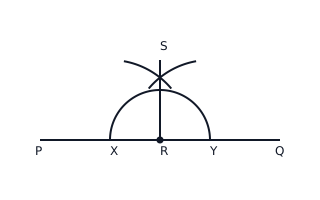
Draw a line segment of length . Take any point on it. Through , construct a perpendicular to using a ruler and compasses.
Solution:
- Draw a line segment .
- Mark a point on .
- With as center and a convenient radius, draw an arc intersecting at two points, and .
- With as center and radius greater than , draw an arc above the line.
- With as center and the same radius, draw another arc intersecting the previous arc at point .
- Join . is the required perpendicular to .
Explanation:
This method uses the property that the perpendicular to a line at a point is the locus of points equidistant from two points on the line that are equidistant from the given point .
Problem 4:
Given a line and a point outside it, construct a line passing through such that .
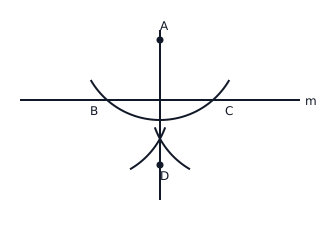
Solution:
- Draw line and mark point outside it.
- With as center and a radius large enough to intersect at two points, draw an arc cutting at and .
- Using and as centers and a radius more than half of , draw two arcs on the opposite side of that intersect at point .
- Join . Line (line ) is perpendicular to line .
Explanation:
Since and are both equidistant from and , the line joining them must be the perpendicular bisector of the segment , which means is perpendicular to line .