
Review the key concepts, formulae, and examples before starting your quiz.
🔑Concepts
The inverse function exists if and only if the original function is a one-to-one (bijective) function. This means each element in the range is mapped from exactly one element in the domain.

Graphically, the function and its inverse are reflections of each other in the line . If a point lies on the graph of , then the point must lie on the graph of .
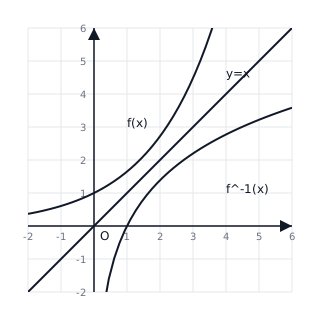
To find the algebraic expression for an inverse function, follow these steps: 1. Let . 2. Interchange the variables and . 3. Solve the resulting equation for in terms of . 4. Replace with .
The domain of becomes the range of , and the range of becomes the domain of . This relationship is crucial when dealing with restricted domains, such as for quadratic functions where only one branch is used to ensure the function is one-to-one.
📐Formulae
💡Examples
Problem 1:
Given the function , find the inverse function .
Solution:
- Let
- Swap and :
- Solve for :
- Therefore,
Explanation:
We follow the algebraic steps of interchanging the dependent and independent variables and rearranging to make the subject.
Problem 2:
Find the inverse of the rational function where .
Solution:
- Let
- Swap and :
- Multiply by :
- Expand:
- Collect terms on one side:
- Factor out :
- Solve for :
Explanation:
For rational functions, cross-multiplying and factoring the term is the standard technique to isolate the variable.
Problem 3:
If the domain of is and the range is , state the domain and range of .
Solution:
For : Domain: Range:
Explanation:
The domain and range of a function and its inverse are interchanged. Since the range of is , that becomes the domain of . Since the domain of is , that becomes the range of .
Problem 4:
Given the function for the restricted domain , find the inverse function and sketch both functions on the same axes.
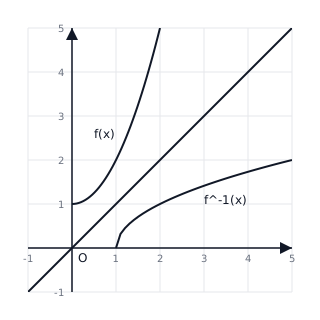
Solution:
- Let .
- Interchange and : .
- Solve for : (taking the positive root because the domain of is ).
- Therefore, for .
Explanation:
Since the original function is restricted to , the inverse is only the positive square root branch. The graph of starts at and moves upwards, while starts at and moves to the right.
Problem 5:
For the function , determine the expression for and state its domain.
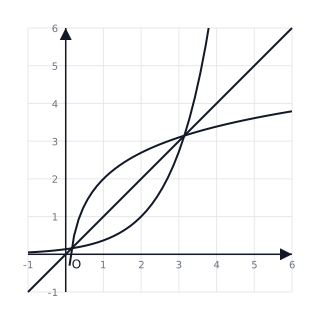
Solution:
- Let .
- Swap and : .
- Take the natural log of both sides: .
- .
- .
- . Since the range of is , the domain of is .
Explanation:
The exponential function is always positive, so its range is . This range becomes the domain for the logarithmic inverse function.