
Review the key concepts, formulae, and examples before starting your quiz.
🔑Concepts
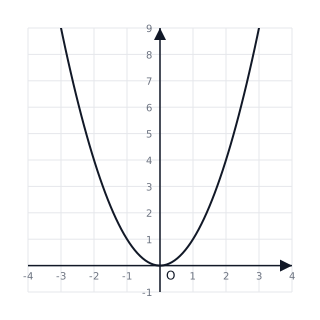
An even function exhibits symmetry about the -axis, satisfying . This means the point on the graph is reflected to . Common examples include and .
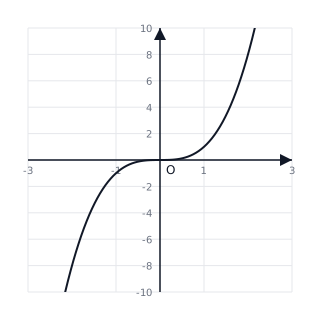
An odd function exhibits rotational symmetry of about the origin, satisfying . This means the point is reflected through the origin to . Examples include and .
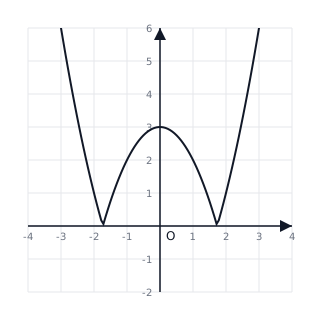
The transformation reflects any portion of the graph where (below the -axis) across the -axis to the positive region, making the entire range non-negative.
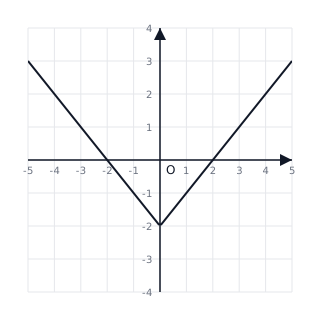
The transformation discards the portion of the graph where and replaces it with a reflection of the portion where across the -axis. This ensures the resulting function is always even.
📐Formulae
💡Examples
Problem 1:
Determine algebraically whether the function is even, odd, or neither.
Solution:
To test for symmetry, we find : Since , we have .
Explanation:
Because , the function satisfies the condition for an odd function. It possesses rotational symmetry about the origin.
Problem 2:
Given the function , describe the transformation required to obtain the graph of .
Solution:
- Horizontal translation: Shift left by unit ().
- Vertical stretch: Stretch vertically by a scale factor of ().
- Vertical translation: Shift down by units ().
Explanation:
Transformations inside the function argument affect (horizontal), while transformations outside affect (vertical). Following the order of operations, we handle the horizontal shift, then the vertical stretch, and finally the vertical shift.
Problem 3:
Let . Sketch the graph of and state its -intercept.
Solution:
For , . For , we reflect the part where across the -axis, resulting in . The -intercept is found at : So the -intercept is .
Explanation:
The transformation creates a mirror image of the right side of the graph onto the left side, making the resulting function even.
Problem 4:
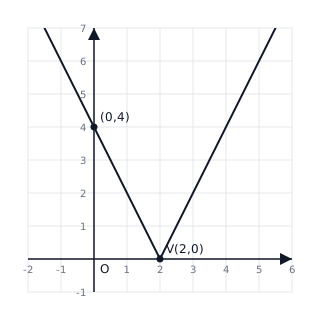
Sketch the graph of and find the coordinates of its vertex and -intercept.
Solution:
- Start with the linear function . Its -intercept is at . Its -intercept is at .
- Apply the absolute value transformation . The portion of the line below the -axis (where ) is reflected upwards.
- The vertex of the V-shape is the former -intercept at .
- The new -intercept is , resulting in the point .
Explanation:
The modulus transformation acts as a reflection in the -axis for all negative outputs of the function.
Problem 5:
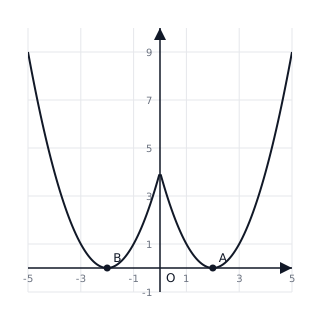
Given , sketch the graph of .
Solution:
- The original graph is a parabola with a vertex at .
- To graph , we keep the portion of the graph where . This includes the vertex at and the -intercept at .
- We ignore the original graph for and instead reflect the portion across the -axis.
- This results in a 'W-shaped' curve with vertices at and .
Explanation:
The transformation creates an even function by mirroring the right side of the graph onto the left.