
Review the key concepts, formulae, and examples before starting your quiz.
🔑Concepts
A function is a rule that assigns each element in the domain to exactly one element in the codomain . Graphically, this is verified by the Vertical Line Test: if any vertical line intersects a graph more than once, it is not a function.
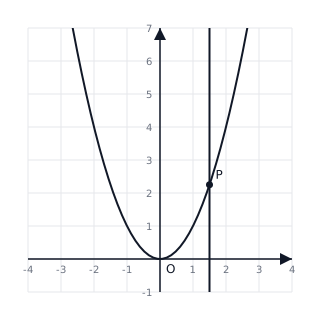
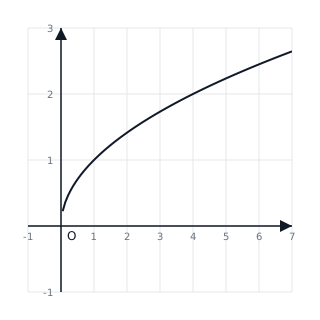
The domain is the set of all possible input values (). Key restrictions include: values under a square root must be non-negative () and denominators must be non-zero ().
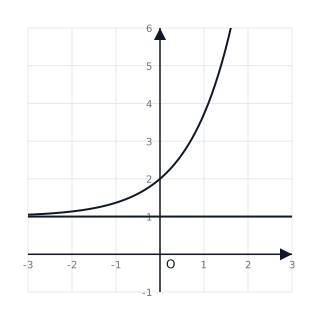
The range is the set of all possible output values (). For a function , the range is typically because the exponential function has a horizontal asymptote at .
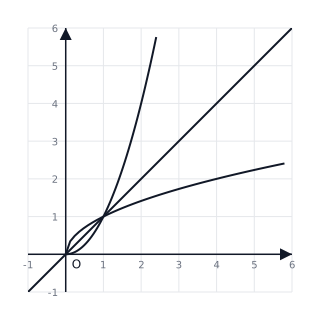
The graph of an inverse function is the reflection of the graph of in the line . A function has an inverse if and only if it is one-to-one (passes the horizontal line test).
📐Formulae
💡Examples
Problem 1:
Given , find the domain and range of .
Solution:
For the domain, the denominator cannot be zero: . Thus, the domain is . To find the range, we look for the horizontal asymptote. As , . Thus, . The range is .
Explanation:
The domain is restricted by the vertical asymptote at . The range is restricted by the horizontal asymptote at .
Problem 2:
Let . Find the expression for and state its domain.
Solution:
- Replace with : .
- Swap and : .
- Solve for : . So, . The domain of is the range of . Since , . Thus, the domain of is .
Explanation:
To find the inverse, we swap variables and solve for . The domain of the logarithmic inverse is restricted to values that make the argument positive.
Problem 3:
If and , find and its domain.
Solution:
. For the domain, must be defined, so . Even though the simplified expression looks like it accepts all , the domain is restricted by the inner function . Domain: .
Explanation:
Composition requires the input to be valid for the inner function first.
Problem 4:
Identify the domain and range of the function using its graph.
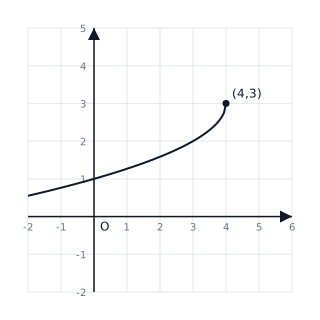
Solution:
- For the domain, the expression inside the square root must be non-negative:
- For the range, since , then . Adding 3 gives: Thus, Domain is and Range is .
Explanation:
The graph starts at the endpoint and moves to the left and downwards. The -values are all numbers less than or equal to 4, and the -values are all numbers less than or equal to 3.
Problem 5:
Given the function , find the equations of the asymptotes and the domain/range.
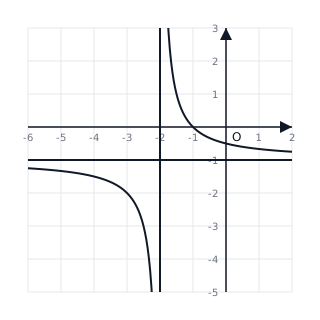
Solution:
- Vertical Asymptote: Set denominator to zero:
- Horizontal Asymptote: As , :
- Domain:
- Range:
Explanation:
The graph is a hyperbola translated 2 units left and 1 unit down. The domain and range exclude the values where the asymptotes are located.