krit.club logo

Functions - Logarithms – logarithmic function

Grade 12IB_AA

Review the key concepts, formulae, and examples before starting your quiz.

🔑Concepts

•

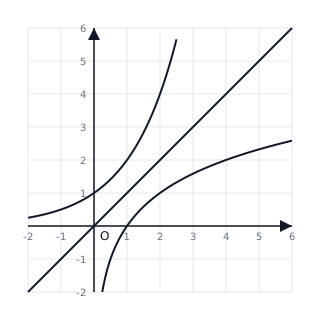
The logarithmic function f(x)=log⁡a(x)f(x) = \log_a(x) (where a>0,a≠1a > 0, a \neq 1) is the inverse of the exponential function g(x)=axg(x) = a^x. This inverse relationship means the graph of log⁡a(x)\log_a(x) is the reflection of axa^x across the line y=xy = x.

Graph showing the reflectional symmetry between the exponential function 2^x and the logarithmic function log2(x) over the line y=x.
•

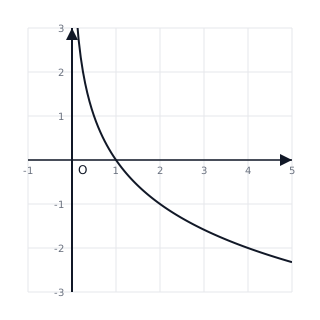
The domain of f(x)=log⁡a(x)f(x) = \log_a(x) is x∈(0,∞)x \in (0, \infty) and the range is y∈Ry \in \mathbb{R}. The function has a vertical asymptote at x=0x = 0. For a>1a > 1, the function is strictly increasing; for 0<a<10 < a < 1, it is strictly decreasing.

Graph of a logarithmic function with base between 0 and 1 showing a decreasing trend and a vertical asymptote at x=0.
•

The natural logarithmic function f(x)=ln⁡(x)f(x) = \ln(x) uses the irrational base e≈2.718e \approx 2.718. It is the inverse of f(x)=exf(x) = e^x and is fundamental in calculus for representing rates of change.

•

Logarithmic equations can be solved by converting the equation to exponential form: log⁡a(x)=y  ⟺  ay=x\log_a(x) = y \iff a^y = x. Always check solutions against the original domain, as the argument of a logarithm must be strictly positive.

📐Formulae

log⁡a(xy)=log⁡ax+log⁡ay\log_a(xy) = \log_a x + \log_a y

log⁡a(xy)=log⁡ax−log⁡ay\log_a\left(\frac{x}{y}\right) = \log_a x - \log_a y

log⁡a(xk)=klog⁡ax\log_a(x^k) = k \log_a x

log⁡ax=log⁡bxlog⁡ba\log_a x = \frac{\log_b x}{\log_b a}

log⁡aa=1 and log⁡a1=0\log_a a = 1 \text{ and } \log_a 1 = 0

ln⁡ex=x and eln⁡x=x\ln e^x = x \text{ and } e^{\ln x} = x

💡Examples

Problem 1:

Solve the equation log⁡2(x)+log⁡2(x−2)=3\log_2(x) + \log_2(x - 2) = 3 for xx.

Solution:

log⁡2(x(x−2))=3x(x−2)=23x2−2x=8x2−2x−8=0(x−4)(x+2)=0\begin{aligned} \log_2(x(x - 2)) &= 3 \\ x(x - 2) &= 2^3 \\ x^2 - 2x &= 8 \\ x^2 - 2x - 8 &= 0 \\ (x - 4)(x + 2) &= 0 \end{aligned} This gives x=4x = 4 or x=−2x = -2. However, we must check the domain: x>0x > 0 and x−2>0x - 2 > 0 (meaning x>2x > 2). Therefore, x=4x = 4 is the only valid solution.

Explanation:

Use the product rule to combine the logarithms into a single term, then convert the logarithmic equation into its exponential form. Finally, solve the resulting quadratic and verify the solutions against the original domain constraints.

Problem 2:

Given f(x)=ln⁡(3x−6)f(x) = \ln(3x - 6), find the domain and the equation of the vertical asymptote.

Solution:

The argument of the natural log must be strictly positive: 3x−6>03x - 6 > 0 3x>63x > 6 x>2x > 2 The domain is x∈(2,∞)x \in (2, \infty). The vertical asymptote occurs where the argument is zero: 3x−6=0  ⟹  x=23x - 6 = 0 \implies x = 2

Explanation:

For any logarithmic function log⁡(g(x))\log(g(x)), the domain is found by solving g(x)>0g(x) > 0. The vertical asymptote is the vertical line x=cx = c where g(c)=0g(c) = 0.

Problem 3:

Solve for xx: 5x=125^x = 12, giving your answer in terms of natural logarithms.

Solution:

ln⁡(5x)=ln⁡(12)xln⁡5=ln⁡12x=ln⁡12ln⁡5\begin{aligned} \ln(5^x) &= \ln(12) \\ x \ln 5 &= \ln 12 \\ x &= \frac{\ln 12}{\ln 5} \end{aligned}

Explanation:

Take the natural logarithm of both sides to bring the exponent down using the power rule, then isolate xx by dividing.

Problem 4:

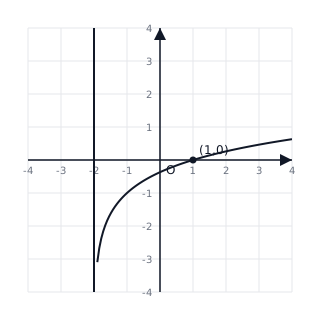
Sketch the graph of f(x)=log⁡3(x+2)−1f(x) = \log_3(x + 2) - 1. Identify the vertical asymptote and the xx-intercept.

Graph of log3(x+2)-1 with a vertical asymptote at x=-2 and x-intercept at (1,0).

Solution:

  1. Asymptote: The argument must be positive: x+2>0  ⟹  x>−2x + 2 > 0 \implies x > -2. The vertical asymptote is x=−2x = -2.
  2. x-intercept: Set f(x)=0f(x) = 0. 0=log⁡3(x+2)−10 = \log_3(x + 2) - 1 1=log⁡3(x+2)1 = \log_3(x + 2) 31=x+2  ⟹  x=13^1 = x + 2 \implies x = 1. The xx-intercept is (1,0)(1, 0).
  3. y-intercept: f(0)=log⁡3(2)−1≈−0.37f(0) = \log_3(2) - 1 \approx -0.37.

Explanation:

The graph is a transformation of y=log⁡3(x)y = \log_3(x) shifted 2 units left and 1 unit down.

Problem 5:

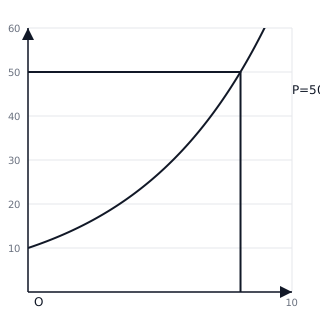
The power PP (in watts) generated by a system is modeled by P(t)=10e0.2tP(t) = 10 e^{0.2t}, where tt is time in hours. Find the time tt when the power reaches 50 watts.

An exponential growth curve showing the intersection point at P=50 and t approximately 8.05.

Solution:

  1. Set P(t)=50P(t) = 50: 50=10e0.2t50 = 10 e^{0.2t}
  2. Divide by 10: 5=e0.2t5 = e^{0.2t}
  3. Take the natural logarithm of both sides: ln⁡(5)=ln⁡(e0.2t)\ln(5) = \ln(e^{0.2t})
  4. Use the property ln⁡(ex)=x\ln(e^x) = x: ln⁡(5)=0.2t\ln(5) = 0.2t
  5. Solve for tt: t=ln⁡(5)0.2=5ln⁡(5)≈8.05t = \frac{\ln(5)}{0.2} = 5\ln(5) \approx 8.05 hours.

Explanation:

The natural logarithm is used to isolate a variable located in the exponent of a base ee expression.