
Review the key concepts, formulae, and examples before starting your quiz.
🔑Concepts
For a polynomial of degree in the form , Vieta's formulas state that the sum of the roots is always . This relationship connects the roots to the second-highest degree coefficient.
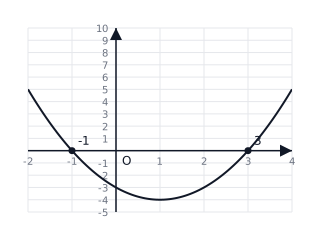
For a cubic equation with roots , the 'sum of products taken two at a time' is given by . This relates to the linear term coefficient.
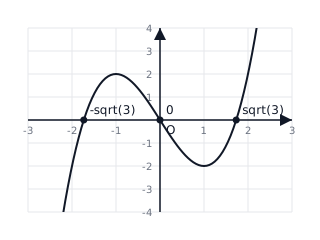
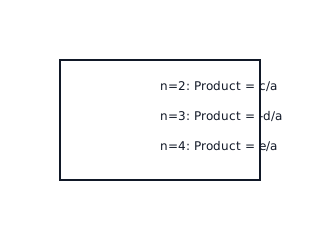
The product of roots for a polynomial depends on its degree . For a cubic (), the product . Generally, for degree , the product is .
Algebraic identities are frequently used with Vieta's formulas to find sums of squares or reciprocals . This method avoids solving for individual roots.

📐Formulae
💡Examples
Problem 1:
Given the quadratic equation , where one root is three times the other root, find the value of .
Solution:
Let the roots be and . Using Vieta's formulas:
- Sum of roots: . This gives , so .
- Product of roots: . Substituting , we get , which simplifies to .
- Therefore, .
Explanation:
We identify the roots in terms of a single variable based on the given ratio, then apply the sum and product relationships to solve for the unknown coefficient.
Problem 2:
Find the sum of the squares of the roots for the cubic equation .
Solution:
Let the roots be . From the coefficients: Sum: . Sum of pairs: . We need to find . Using the identity: .
Explanation:
By using the coefficients of the cubic, we determine the elementary symmetric sums and then apply the algebraic identity for the sum of squares.
Problem 3:
If the roots of are , find the value of .
Solution:
The expression can be rewritten by finding a common denominator: From Vieta's formulas: Sum of pairs Product Substituting these values:
Explanation:
We manipulate the required expression into a form involving the known sum and product relationships derived from the cubic polynomial coefficients.
Problem 4:
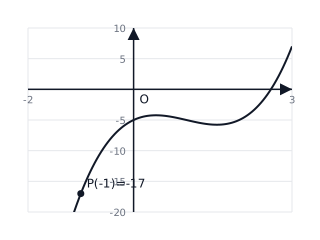
A cubic equation has roots . Determine the value of .
Solution:
Let . The roots are . We know . We want to find . Note that . Calculate . Therefore, . .
Explanation:
This example uses the factor theorem. Instead of calculating , we substitute into the polynomial, which is equivalent to the scaled product of the shifted roots.
Problem 5:
For the quadratic equation , the roots are and . Find the value of and if and .
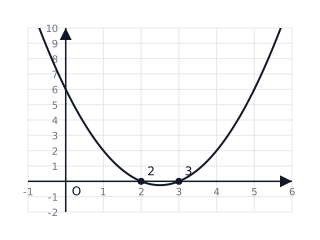
Solution:
From Vieta's formulas: Given . Use the identity: Substitute the known values: So, and .
Explanation:
We use the relationship between coefficients and the sum/product of roots. The sum of squares identity allows us to find the product once the sum is known.