krit.club logo

Functions - Rational functions – Partial fractions (HL)

Grade 12IB_AA

Review the key concepts, formulae, and examples before starting your quiz.

🔑Concepts

•

Partial fractions involve decomposing a complex rational expression of the form P(x)Q(x)\frac{P(x)}{Q(x)} into a sum of simpler fractions. For a proper fraction where the degree of the denominator is 3 and it has three distinct linear factors, we use the form Ax−a+Bx−b+Cx−c\frac{A}{x-a} + \frac{B}{x-b} + \frac{C}{x-c}.

Diagram
•

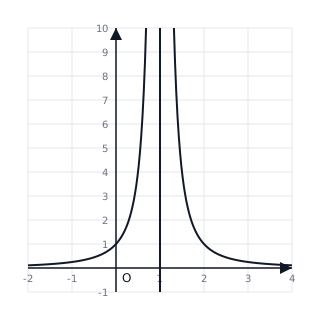
When the denominator contains a repeated linear factor such as (x−a)2(x-a)^2, the decomposition must include terms for every power of the factor up to its multiplicity: Ax−a+B(x−a)2\frac{A}{x-a} + \frac{B}{(x-a)^2}. Visualizing the area under such functions helps understand their asymptotic behavior near the pole x=ax=a.

Graph of 1/(x-1)^2 showing a vertical asymptote at x=1, illustrating the behavior of repeated factor terms.
•

For improper fractions where the degree of P(x)≥P(x) \ge degree of Q(x)Q(x), long division must be performed first. The resulting expression will be a polynomial (the quotient) plus a proper rational fraction (the remainder over the divisor).
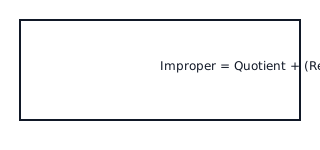
Formula box for decomposing improper rational functions.
•

The coefficients A,B,C,…A, B, C, \dots can be found using the method of equating coefficients (after clearing the denominator) or by substituting specific values of xx (the 'cover-up' method) that zero out certain terms.

Diagram

📐Formulae

px+q(x−a)(x−b)=Ax−a+Bx−b\frac{px + q}{(x-a)(x-b)} = \frac{A}{x-a} + \frac{B}{x-b}

px2+qx+r(x−a)(x−b)(x−c)=Ax−a+Bx−b+Cx−c\frac{px^2 + qx + r}{(x-a)(x-b)(x-c)} = \frac{A}{x-a} + \frac{B}{x-b} + \frac{C}{x-c}

px+q(x−a)2=Ax−a+B(x−a)2\frac{px + q}{(x-a)^2} = \frac{A}{x-a} + \frac{B}{(x-a)^2}

P(x)Q(x)=Quotient+RemainderQ(x)\frac{P(x)}{Q(x)} = \text{Quotient} + \frac{\text{Remainder}}{Q(x)}

💡Examples

Problem 1:

Express 5x−1(x+1)(x−2)\frac{5x - 1}{(x+1)(x-2)} in partial fractions.

Solution:

Assume 5x−1(x+1)(x−2)=Ax+1+Bx−2\frac{5x - 1}{(x+1)(x-2)} = \frac{A}{x+1} + \frac{B}{x-2}. Multiply both sides by the denominator (x+1)(x−2)(x+1)(x-2): 5x−1=A(x−2)+B(x+1)5x - 1 = A(x-2) + B(x+1) Let x=2x = 2: 5(2)−1=B(2+1)  ⟹  9=3B  ⟹  B=35(2) - 1 = B(2+1) \implies 9 = 3B \implies B = 3 Let x=−1x = -1: 5(−1)−1=A(−1−2)  ⟹  −6=−3A  ⟹  A=25(-1) - 1 = A(-1-2) \implies -6 = -3A \implies A = 2 Therefore: 5x−1(x+1)(x−2)=2x+1+3x−2\frac{5x - 1}{(x+1)(x-2)} = \frac{2}{x+1} + \frac{3}{x-2}

Explanation:

Since the denominator has two distinct linear factors, we use the standard decomposition for Case 1. We solve for constants by substituting the roots of the linear factors into the identity.

Problem 2:

Decompose x2+1(x−1)2\frac{x^2 + 1}{(x-1)^2} into partial fractions.

Solution:

First, note that the degree of the numerator (22) is equal to the degree of the denominator (22). This is an improper fraction. Perform division or rewrite the numerator: x2+1=(x−1)2+2x−1x^2 + 1 = (x-1)^2 + 2x - 1 x2+1(x−1)2=1+2x−1(x−1)2\frac{x^2+1}{(x-1)^2} = 1 + \frac{2x-1}{(x-1)^2} Now decompose 2x−1(x−1)2\frac{2x-1}{(x-1)^2} using Case 2: 2x−1(x−1)2=Ax−1+B(x−1)2\frac{2x-1}{(x-1)^2} = \frac{A}{x-1} + \frac{B}{(x-1)^2} 2x−1=A(x−1)+B2x - 1 = A(x-1) + B Let x=1x = 1: 2(1)−1=B  ⟹  B=12(1) - 1 = B \implies B = 1. Equate coefficients of xx: A=2A = 2. Thus: x2+1(x−1)2=1+2x−1+1(x−1)2\frac{x^2+1}{(x-1)^2} = 1 + \frac{2}{x-1} + \frac{1}{(x-1)^2}

Explanation:

Because the degrees are equal, we must first extract the constant (quotient) from the improper fraction. Then, we handle the repeated linear factor (x−1)2(x-1)^2 by including terms for both (x−1)(x-1) and (x−1)2(x-1)^2 in the decomposition.

Problem 3:

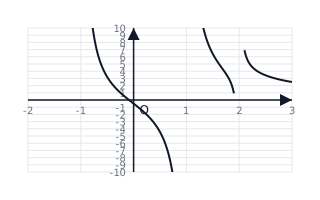
Express 6x2−11x−1(x−1)(x−2)(x+1)\frac{6x^2 - 11x - 1}{(x-1)(x-2)(x+1)} as a sum of partial fractions.

Graph of the function showing three vertical asymptotes at x=-1, x=1, and x=2.

Solution:

  1. Set up the identity: 6x2−11x−1(x−1)(x−2)(x+1)=Ax−1+Bx−2+Cx+1\frac{6x^2 - 11x - 1}{(x-1)(x-2)(x+1)} = \frac{A}{x-1} + \frac{B}{x-2} + \frac{C}{x+1}
  2. Multiply by the common denominator: 6x2−11x−1=A(x−2)(x+1)+B(x−1)(x+1)+C(x−1)(x−2)6x^2 - 11x - 1 = A(x-2)(x+1) + B(x-1)(x+1) + C(x-1)(x-2)
  3. Substitute roots:
  • Let x=1x=1: 6(1)2−11(1)−1=A(1−2)(1+1)  ⟹  −6=−2A  ⟹  A=36(1)^2-11(1)-1 = A(1-2)(1+1) \implies -6 = -2A \implies A=3
  • Let x=2x=2: 6(2)2−11(2)−1=B(2−1)(2+1)  ⟹  24−22−1=3B  ⟹  1=3B  ⟹  B=136(2)^2-11(2)-1 = B(2-1)(2+1) \implies 24-22-1 = 3B \implies 1 = 3B \implies B=\frac{1}{3}
  • Let x=−1x=-1: 6(−1)2−11(−1)−1=C(−1−1)(−1−2)  ⟹  6+11−1=6C  ⟹  16=6C  ⟹  C=836(-1)^2-11(-1)-1 = C(-1-1)(-1-2) \implies 6+11-1 = 6C \implies 16 = 6C \implies C=\frac{8}{3}
  1. Final result: 3x−1+13(x−2)+83(x+1)\frac{3}{x-1} + \frac{1}{3(x-2)} + \frac{8}{3(x+1)}

Explanation:

This example demonstrates the decomposition of a proper rational function with three distinct linear factors in the denominator using the method of substituting roots.

Problem 4:

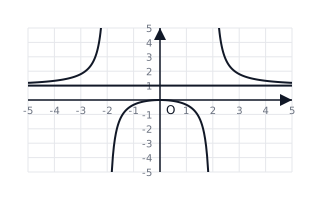
Decompose the improper fraction x2x2−4\frac{x^2}{x^2 - 4} into partial fractions.

Graph of x^2/(x^2-4) showing the horizontal asymptote y=1 resulting from the quotient of division.

Solution:

  1. Perform long division since the degrees are equal: x2x2−4=1+4x2−4\frac{x^2}{x^2 - 4} = 1 + \frac{4}{x^2 - 4}
  2. Factor the denominator of the remainder: 4(x−2)(x+2)=Ax−2+Bx+2\frac{4}{(x-2)(x+2)} = \frac{A}{x-2} + \frac{B}{x+2}
  3. Solve for AA and BB: 4=A(x+2)+B(x−2)4 = A(x+2) + B(x-2)
  • Let x=2x=2: 4=4A  ⟹  A=14 = 4A \implies A=1
  • Let x=−2x=-2: 4=−4B  ⟹  B=−14 = -4B \implies B=-1
  1. Combine results: 1+1x−2−1x+21 + \frac{1}{x-2} - \frac{1}{x+2}

Explanation:

Since the degree of the numerator is equal to the degree of the denominator, we first use polynomial division to get a constant term, then apply partial fractions to the remaining proper fraction.