
Review the key concepts, formulae, and examples before starting your quiz.
🔑Concepts
An exponential function is defined by the form , where and . The base determines the growth () or decay () of the function, while represents the horizontal asymptote .
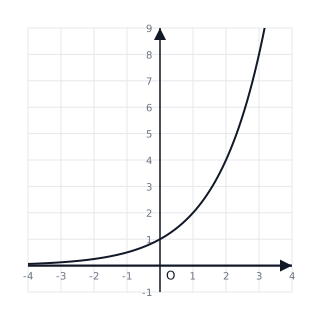
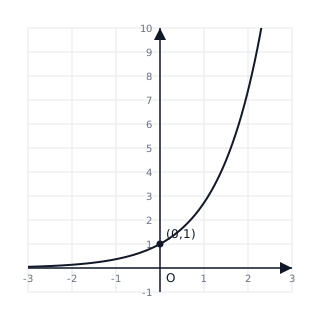
The natural exponential function uses the base . This base is fundamental in modeling continuous growth and decay, such as compound interest and radioactive decay, typically written as .
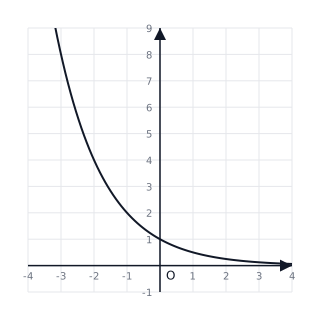
Exponential decay occurs when the base is between and . As increases, the value of approaches the horizontal asymptote from above.
Vertical translations shift the entire graph and its asymptote. For , the horizontal asymptote is at and the -intercept is at .
📐Formulae
💡Examples
Problem 1:
Given the function , find the horizontal asymptote, the -intercept, and the -intercept.
Solution:
- Horizontal Asymptote: The constant term added to the exponential part is . Thus, the horizontal asymptote is .
- -intercept: Set . The -intercept is .
- -intercept: Set . The -intercept is .
Explanation:
To find intercepts, we alternate setting and to zero. The horizontal asymptote is determined by the vertical shift of the parent exponential function.
Problem 2:
A population of bacteria grows according to the model , where is time in hours. Find the initial population and the population after 10 hours.
Solution:
- Initial population: Set .
- Population after 10 hours: Using a calculator: Population bacteria.
Explanation:
The coefficient represents the initial value . The exponent represents the continuous growth rate of .
Problem 3:
Solve for :
Solution:
Write both sides with the same base : Equate the exponents:
Explanation:
When solving exponential equations without logarithms, try to express both sides as powers of the same base and then set the exponents equal to each other.
Problem 4:
Sketch the graph of and state the equation of its horizontal asymptote and the -intercept.
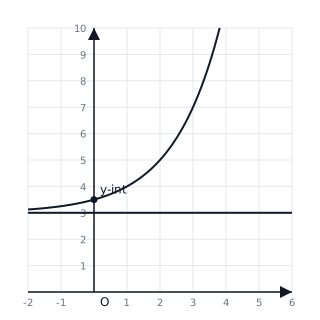
Solution:
- Asymptote: The constant term is , so the horizontal asymptote is .
- y-intercept: Set : The -intercept is .
- Horizontal Shift: The term shifts the graph of one unit to the right.
Explanation:
To graph an exponential function, first identify the horizontal asymptote, then calculate the -intercept and one or two additional points to determine the shape.
Problem 5:
Determine the value of for the function if the graph passes through the point .
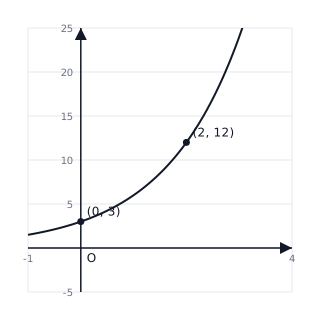
Solution:
- Substitute the point into the equation:
- Divide by :
- Take the natural logarithm of both sides:
- Solve for :
Explanation:
When given a point on an exponential curve, substitute the coordinates to solve for the unknown parameter using logarithms.