
Three Dimensional Geometry - Equation of a line through a given point and parallel to a given vector
Review the key concepts, formulae, and examples before starting your quiz.
🔑Concepts
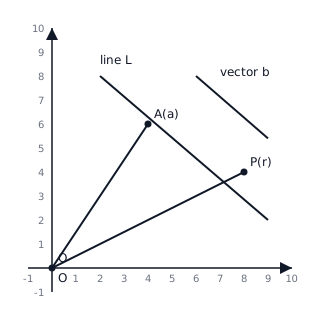
The vector equation of a line passing through a point with position vector and parallel to a given vector is , where is a real scalar. This represents any point on the line as being reached by starting at the origin, moving to , and then moving some multiple of .
The Cartesian equation is derived by setting the components of equal to those of . This results in , where are coordinates of the fixed point and are the direction ratios of the parallel vector.
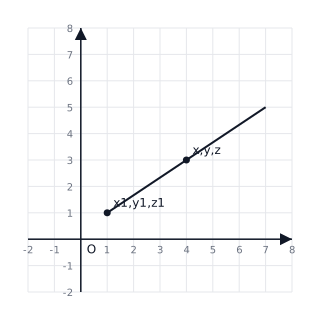
Direction Cosines vs. Direction Ratios: If the parallel vector is a unit vector, its components represent the direction cosines . Otherwise, they are direction ratios which are proportional to the direction cosines.
Conversion: To convert from Cartesian to Vector form, identify the point from the numerators (watch for signs) and the direction vector components from the denominators.
📐Formulae
💡Examples
Problem 1:
Find the vector and Cartesian equations of the line that passes through the point and is parallel to the vector .
Solution:
- Position vector of the given point:
- Parallel vector:
- Vector Equation:
- Cartesian Equation: Here and . Substituting into the formula:
Explanation:
We identify the position vector from the point and use the given vector directly. For the Cartesian form, we ensure the signs in the numerator are correct based on the point's coordinates (e.g., becomes ).
Problem 2:
The Cartesian equation of a line is . Find the vector equation of the line.
Solution:
- Comparing the given equation with , we get: and .
- The point on the line is , so .
- The direction ratios are , so the parallel vector is .
- Vector Equation:
Explanation:
To convert from Cartesian to vector form, identify the fixed point by looking at the constants subtracted from and identify the direction vector from the denominators.
Problem 3:
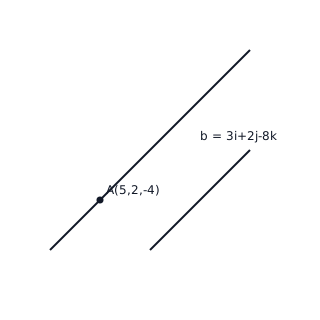
Find the vector equation of a line passing through the point and which is parallel to the vector .
Solution:
Given: Point Parallel vector The vector equation of the line is given by: Substituting the values:
Explanation:
We identify the position vector of the given point and the given parallel vector, then plug them directly into the standard vector form equation.
Problem 4:
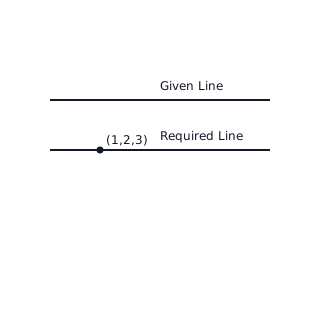
Find the Cartesian equation of the line passing through the point and parallel to the line .
Solution:
The given line is parallel to the vector . Since our required line is parallel to this line, it will have the same direction ratios: The line passes through . The Cartesian equation is: Substituting the values:
Explanation:
Parallel lines share the same direction ratios. We extract the denominators from the given line and use the provided point coordinates to form the new equation.