
Review the key concepts, formulae, and examples before starting your quiz.
🔑Concepts
Two lines are parallel if their direction vectors are proportional. In vector form, parallel lines are represented as and . Both lines share the same (or parallel) direction vector .
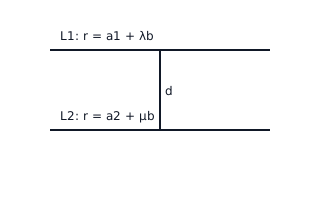
The shortest distance between parallel lines is the perpendicular distance from any point on line to line . It is calculated using the cross product of the direction vector and the vector connecting the two position vectors .
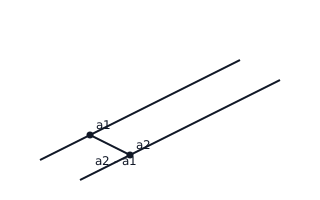
If the lines are given in Cartesian form and , the direction ratios are identical, confirming they are parallel.
The formula involves the magnitude of the cross product: . Note that the order or does not change the result due to the absolute value.
📐Formulae
💡Examples
Problem 1:
Find the distance between the parallel lines and .
Solution:
Step 1: Identify vectors from the equations:
Step 2: Calculate :
Step 3: Calculate the cross product :
Step 4: Calculate magnitudes:
Step 5: Apply the distance formula: units.
Explanation:
First, we extract the position vectors of points on the lines and the common direction vector. We find the vector connecting the two points, calculate its cross product with the direction vector to find the perpendicular component, and divide by the magnitude of the direction vector to normalize the result.
Problem 2:
Calculate the magnitude of the vector and subtract the scalar value from its x-component calculation.
Solution:
To demonstrate the subtraction of components: The new x-component is .
Explanation:
This example demonstrates vertical arithmetic for component subtraction as per the required formatting.
Problem 3:
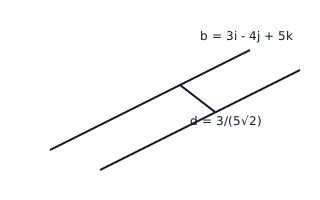
Determine the distance between the parallel lines and .
Solution:
- Identify vectors:
- Calculate :
- Calculate :
- Find Magnitudes:
- Final Distance: units.
Explanation:
To find the distance, we first find the vector connecting a point on each line, then find the component of that vector perpendicular to the common direction vector using the cross product.
Problem 4:
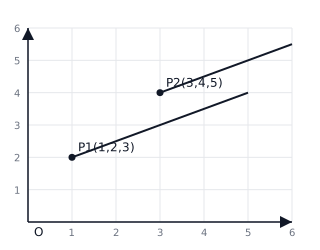
Find the distance between the parallel lines given by and .
Solution:
- Convert to vector form:
- Calculate :
- Calculate :
- Calculate Magnitudes:
- Distance: units.
Explanation:
Since the denominators (direction ratios) are the same for both lines, they are parallel. We pick points and from the equations to form the vector difference and apply the distance formula.