
Review the key concepts, formulae, and examples before starting your quiz.
🔑Concepts
Direction Cosines of a Line: If a line passes through the origin and makes angles , , and with the positive directions of the , , and axes respectively, then , , and are called the direction cosines of the line, denoted by , , and .
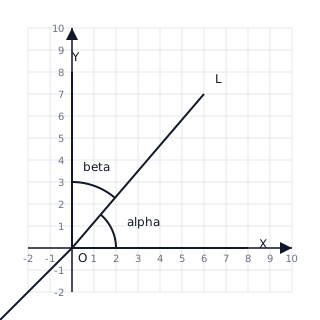
Direction Ratios: Any three numbers , , and which are proportional to the direction cosines , , of a line are called its direction ratios. They satisfy the relation , , and .
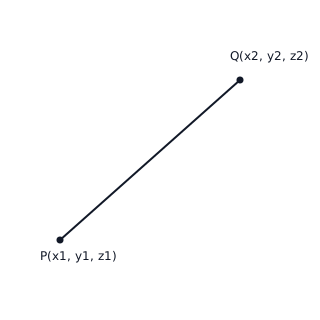
Line Joining Two Points: For a line passing through two points and , the direction ratios are proportional to , , and . The direction cosines are obtained by dividing these by the distance .
Relation between DC's: The sum of the squares of the direction cosines of any line is always equal to 1, i.e., .
📐Formulae
💡Examples
Problem 1:
Find the direction cosines of a line that makes equal angles with the three positive coordinate axes.
Solution:
Let the angles made by the line with the and axes be and . Since the angles are equal, . Thus, . Using the identity : Therefore, the direction cosines are .
Explanation:
Because the angles are identical, the direction cosines must be identical. We solve for the common value using the fundamental identity that the sum of squares of DCs is 1.
Problem 2:
If a line has direction ratios , determine its direction cosines.
Solution:
Given the direction ratios . Step 1: Calculate the magnitude . . Step 2: Calculate using the ratios. The direction cosines are .
Explanation:
Direction cosines are found by dividing each direction ratio by the square root of the sum of the squares of the ratios, which normalizes the vector to unit length.
Problem 3:
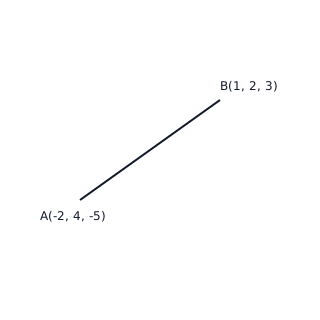
Find the direction cosines of the line passing through the points and .
Solution:
- Find the direction ratios by calculating the differences in coordinates:
- Calculate the distance :
- Calculate direction cosines :
Explanation:
Direction cosines of a line segment joining two points are found by dividing the differences of their respective coordinates by the distance between the two points.
Problem 4:
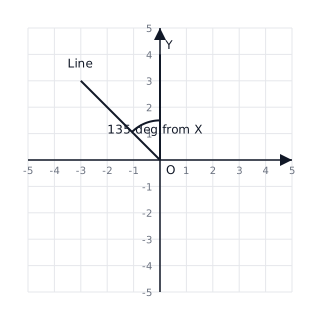
If a line makes angles , , with the , and axes respectively, find its direction cosines.
Solution:
The direction cosines are given by , , . Given . The direction cosines are .
Explanation:
Direct application of the definition of direction cosines using the given angles with the coordinate axes.