krit.club logo

Three Dimensional Geometry - Cartesian and vector equation of a plane

Grade 12CBSE

Review the key concepts, formulae, and examples before starting your quiz.

🔑Concepts

•

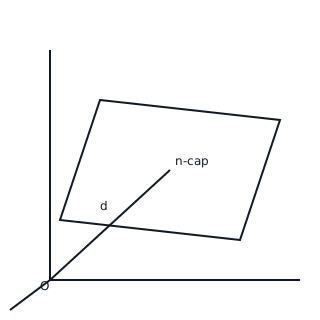
The normal form of a plane equation represents the plane at a perpendicular distance dd from the origin, where n^\hat{n} is the unit normal vector. In vector form, it is r⃗⋅n^=d\vec{r} \cdot \hat{n} = d, and in Cartesian form, lx+my+nz=dlx + my + nz = d where l,m,nl, m, n are direction cosines.

A plane in 3D space with a normal vector from the origin showing distance d.
•

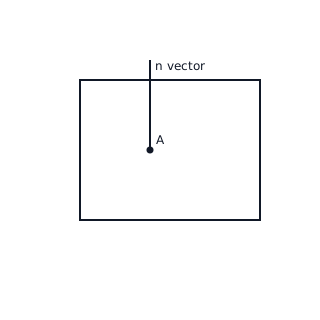
The equation of a plane passing through a fixed point AA with position vector a⃗\vec{a} and perpendicular to a given vector n⃗\vec{n} is (r⃗−a⃗)⋅n⃗=0(\vec{r} - \vec{a}) \cdot \vec{n} = 0. In Cartesian coordinates, if the point is (x1,y1,z1)(x_1, y_1, z_1) and normal ratios are (A,B,C)(A, B, C), it is A(x−x1)+B(y−y1)+C(z−z1)=0A(x-x_1) + B(y-y_1) + C(z-z_1) = 0.

A plane containing point A with a perpendicular normal vector n.
•

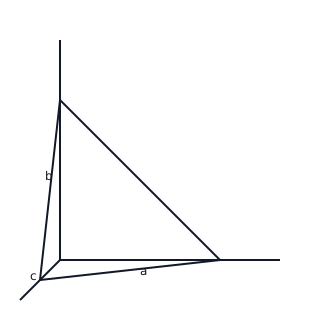
The intercept form of the plane equation is xa+yb+zc=1\frac{x}{a} + \frac{y}{b} + \frac{z}{c} = 1, where a,b,ca, b, c are the intercepts made by the plane on the X,Y,X, Y, and ZZ axes respectively.

Diagram showing a plane cutting the coordinate axes at points a, b, and c.
•

The angle θ\theta between two planes is defined as the angle between their normals. For planes r⃗⋅n1⃗=d1\vec{r} \cdot \vec{n_1} = d_1 and r⃗⋅n2⃗=d2\vec{r} \cdot \vec{n_2} = d_2, cos⁡θ=∣n1⃗⋅n2⃗∣∣n1⃗∣∣n2⃗∣\cos \theta = \frac{|\vec{n_1} \cdot \vec{n_2}|}{|\vec{n_1}||\vec{n_2}|}.

📐Formulae

Vector equation of a plane in normal form: r⃗⋅n^=d\vec{r} \cdot \hat{n} = d, where n^\hat{n} is the unit normal vector.

Cartesian equation of a plane in normal form: lx+my+nz=dlx + my + nz = d, where l,m,nl, m, n are direction cosines.

Vector equation of a plane passing through a⃗\vec{a} and perpendicular to n⃗\vec{n}: (r⃗−a⃗)⋅n⃗=0(\vec{r} - \vec{a}) \cdot \vec{n} = 0

Cartesian equation of a plane through (x1,y1,z1)(x_1, y_1, z_1) with normal direction ratios (A,B,C)(A, B, C): A(x−x1)+B(y−y1)+C(z−z1)=0A(x - x_1) + B(y - y_1) + C(z - z_1) = 0

Intercept form: xa+yb+zc=1\frac{x}{a} + \frac{y}{b} + \frac{z}{c} = 1

Angle θ\theta between two planes r⃗⋅n1⃗=d1\vec{r} \cdot \vec{n_1} = d_1 and r⃗⋅n2⃗=d2\vec{r} \cdot \vec{n_2} = d_2: cos⁡θ=∣n1⃗⋅n2⃗∣∣n1⃗∣∣n2⃗∣\cos \theta = \frac{|\vec{n_1} \cdot \vec{n_2}|}{|\vec{n_1}| |\vec{n_2}|}

Distance of point (x1,y1,z1)(x_1, y_1, z_1) from plane Ax+By+Cz+D=0Ax + By + Cz + D = 0: d=∣Ax1+By1+Cz1+D∣A2+B2+C2d = \frac{|Ax_1 + By_1 + Cz_1 + D|}{\sqrt{A^2 + B^2 + C^2}}

💡Examples

Problem 1:

Find the vector and Cartesian equations of the plane which passes through the point (5,2,−4)(5, 2, -4) and is perpendicular to the line with direction ratios (2,3,−1)(2, 3, -1).

Solution:

  1. Let the given point be A(5,2,−4)A(5, 2, -4), so its position vector is a⃗=5i^+2j^−4k^\vec{a} = 5\hat{i} + 2\hat{j} - 4\hat{k}.
  2. The normal vector n⃗\vec{n} is given by the direction ratios: n⃗=2i^+3j^−k^\vec{n} = 2\hat{i} + 3\hat{j} - \hat{k}.
  3. The vector equation is (r⃗−a⃗)⋅n⃗=0(\vec{r} - \vec{a}) \cdot \vec{n} = 0, which simplifies to r⃗⋅n⃗=a⃗⋅n⃗\vec{r} \cdot \vec{n} = \vec{a} \cdot \vec{n}.
  4. Calculate a⃗⋅n⃗=(5)(2)+(2)(3)+(−4)(−1)=10+6+4=20\vec{a} \cdot \vec{n} = (5)(2) + (2)(3) + (-4)(-1) = 10 + 6 + 4 = 20.
  5. Vector Equation: r⃗⋅(2i^+3j^−k^)=20\vec{r} \cdot (2\hat{i} + 3\hat{j} - \hat{k}) = 20.
  6. For Cartesian equation, substitute r⃗=xi^+yj^+zk^\vec{r} = x\hat{i} + y\hat{j} + z\hat{k}: 2x+3y−z=202x + 3y - z = 20.

Explanation:

We use the point-normal form of the plane equation. The direction ratios of the perpendicular line serve as the components of the normal vector n⃗\vec{n}.

Problem 2:

Find the distance of the point (2,5,−3)(2, 5, -3) from the plane r⃗⋅(6i^−3j^+2k^)=4\vec{r} \cdot (6\hat{i} - 3\hat{j} + 2\hat{k}) = 4.

Solution:

  1. Convert the plane equation to Cartesian form: 6x−3y+2z−4=06x - 3y + 2z - 4 = 0.
  2. Identify coordinates of the point: (x1,y1,z1)=(2,5,−3)(x_1, y_1, z_1) = (2, 5, -3).
  3. Identify plane coefficients: A=6,B=−3,C=2,D=−4A = 6, B = -3, C = 2, D = -4.
  4. Apply the distance formula: d=∣6(2)−3(5)+2(−3)−4∣62+(−3)2+22d = \frac{|6(2) - 3(5) + 2(-3) - 4|}{\sqrt{6^2 + (-3)^2 + 2^2}}.
  5. d=∣12−15−6−4∣36+9+4=∣−13∣49=137d = \frac{|12 - 15 - 6 - 4|}{\sqrt{36 + 9 + 4}} = \frac{|-13|}{\sqrt{49}} = \frac{13}{7}.
  6. The distance is 137\frac{13}{7} units.

Explanation:

The distance is calculated by substituting the point coordinates into the general Cartesian form of the plane and dividing by the magnitude of the normal vector.

Problem 3:

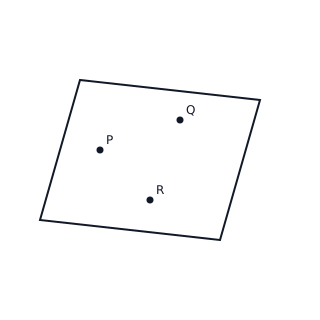
Find the equation of the plane passing through the points P(1,1,0)P(1, 1, 0), Q(1,2,1)Q(1, 2, 1), and R(−2,2,−1)R(-2, 2, -1) in Cartesian form.

A plane defined by three distinct points P, Q, and R.

Solution:

The general equation of a plane passing through (x1,y1,z1)(x_1, y_1, z_1) is: A(x−x1)+B(y−y1)+C(z−z1)=0A(x - x_1) + B(y - y_1) + C(z - z_1) = 0 Using point P(1,1,0)P(1, 1, 0): A(x−1)+B(y−1)+C(z−0)=0— (i)A(x - 1) + B(y - 1) + C(z - 0) = 0 \quad \text{--- (i)} Since it passes through Q(1,2,1)Q(1, 2, 1) and R(−2,2,−1)R(-2, 2, -1): A(1−1)+B(2−1)+C(1)=0  ⟹  B+C=0— (ii)A(1 - 1) + B(2 - 1) + C(1) = 0 \implies B + C = 0 \quad \text{--- (ii)} A(−2−1)+B(2−1)+C(−1)=0  ⟹  −3A+B−C=0— (iii)A(-2 - 1) + B(2 - 1) + C(-1) = 0 \implies -3A + B - C = 0 \quad \text{--- (iii)} From (ii), C=−BC = -B. Substituting in (iii): −3A+B−(−B)=0  ⟹  −3A+2B=0  ⟹  B=32A-3A + B - (-B) = 0 \implies -3A + 2B = 0 \implies B = \frac{3}{2}A Then C=−32AC = -\frac{3}{2}A. Substituting BB and CC in (i): A(x−1)+32A(y−1)−32Az=0A(x - 1) + \frac{3}{2}A(y - 1) - \frac{3}{2}Az = 0 Dividing by A/2A/2: 2(x−1)+3(y−1)−3z=0  ⟹  2x+3y−3z−5=02(x - 1) + 3(y - 1) - 3z = 0 \implies 2x + 3y - 3z - 5 = 0

Explanation:

To find the plane through three points, we use the point-normal form and solve for the direction ratios using the remaining two points. Alternatively, the determinant form can be used.

Problem 4:

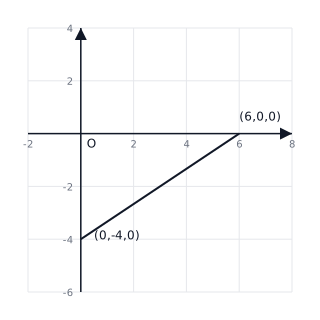
Find the intercepts made by the plane 2x−3y+4z=122x - 3y + 4z = 12 on the coordinate axes.

Graphical representation of the intercepts of the plane on the XY projection.

Solution:

The given equation is 2x−3y+4z=122x - 3y + 4z = 12. To find the intercept form xa+yb+zc=1\frac{x}{a} + \frac{y}{b} + \frac{z}{c} = 1, divide the entire equation by 1212: 2x12−3y12+4z12=1212\frac{2x}{12} - \frac{3y}{12} + \frac{4z}{12} = \frac{12}{12} x6+y−4+z3=1\frac{x}{6} + \frac{y}{-4} + \frac{z}{3} = 1 Comparing with the standard intercept form: a=6,b=−4,c=3a = 6, b = -4, c = 3. The intercepts are 6,−4,6, -4, and 33 on the x,y,x, y, and zz axes respectively.

Explanation:

The intercepts of a plane are found by transforming the linear equation into the intercept form by making the constant term on the RHS equal to 1.