krit.club logo

Three Dimensional Geometry - Cartesian equation and vector equation of a line

Grade 12CBSE

Review the key concepts, formulae, and examples before starting your quiz.

🔑Concepts

•

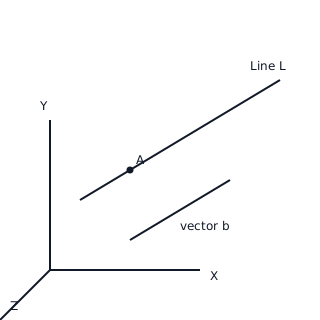
A line in 3D space is uniquely determined if it passes through a given point and has a given direction, or if it passes through two given points. In vector notation, a line through point AA with position vector a⃗\vec{a} and parallel to vector b⃗\vec{b} is represented as r⃗=a⃗+λb⃗\vec{r} = \vec{a} + \lambda \vec{b}, where λ\lambda is a scalar parameter.

A line in 3D coordinate system parallel to a direction vector b passing through point A.
•

The Cartesian equation of a line passing through (x1,y1,z1)(x_1, y_1, z_1) with direction ratios a,b,ca, b, c is x−x1a=y−y1b=z−z1c\frac{x - x_1}{a} = \frac{y - y_1}{b} = \frac{z - z_1}{c}. This represents the intersection of two planes and expresses the coordinates of any point on the line in terms of a single parameter.

•

The shortest distance between two skew lines is the length of the line segment perpendicular to both lines. If the lines are parallel, the distance remains constant and is calculated using the cross product of the direction vector and the displacement vector between any two points on the lines.
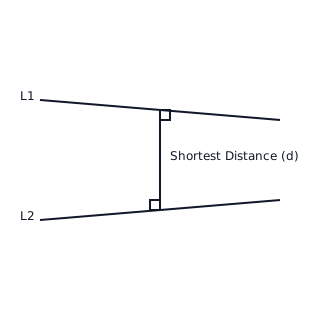
Two lines L1 and L2 with a common perpendicular segment representing the shortest distance d.
•

Two lines are perpendicular if the dot product of their direction vectors is zero: a1a2+b1b2+c1c2=0a_1 a_2 + b_1 b_2 + c_1 c_2 = 0. They are parallel if their direction ratios are proportional: a1a2=b1b2=c1c2\frac{a_1}{a_2} = \frac{b_1}{b_2} = \frac{c_1}{c_2}.

📐Formulae

Vector equation of a line: r⃗=a⃗+λb⃗\vec{r} = \vec{a} + \lambda \vec{b}

Cartesian equation of a line: x−x1a=y−y1b=z−z1c\frac{x - x_1}{a} = \frac{y - y_1}{b} = \frac{z - z_1}{c}

Vector equation (two-point form): r⃗=a⃗+λ(b⃗−a⃗)\vec{r} = \vec{a} + \lambda(\vec{b} - \vec{a})

Cartesian equation (two-point form): x−x1x2−x1=y−y1y2−y1=z−z1z2−z1\frac{x-x_1}{x_2-x_1} = \frac{y-y_1}{y_2-y_1} = \frac{z-z_1}{z_2-z_1}

Angle between lines: cos⁡θ=∣b1⃗⋅b2⃗∣b1⃗∣∣b2⃗∣∣\cos \theta = \left| \frac{\vec{b_1} \cdot \vec{b_2}}{|\vec{b_1}| |\vec{b_2}|} \right|

Cartesian Angle: cos⁡θ=∣a1a2+b1b2+c1c2a12+b12+c12a22+b22+c22∣\cos \theta = \left| \frac{a_1 a_2 + b_1 b_2 + c_1 c_2}{\sqrt{a_1^2+b_1^2+c_1^2} \sqrt{a_2^2+b_2^2+c_2^2}} \right|

Shortest distance (Skew lines): d=∣(b1⃗×b2⃗)⋅(a2⃗−a1⃗)∣b1⃗×b2⃗∣∣d = \left| \frac{(\vec{b_1} \times \vec{b_2}) \cdot (\vec{a_2} - \vec{a_1})}{|\vec{b_1} \times \vec{b_2}|} \right|

Shortest distance (Parallel lines): d=∣b⃗×(a2⃗−a1⃗)∣∣b⃗∣d = \frac{|\vec{b} \times (\vec{a_2} - \vec{a_1})|}{|\vec{b}|}

💡Examples

Problem 1:

Find the vector and Cartesian equations of the line passing through the point (5,2,−4)(5, 2, -4) and which is parallel to the vector 3i^+2j^−8k^3\hat{i} + 2\hat{j} - 8\hat{k}.

Solution:

  1. Identify the given point vector: a⃗=5i^+2j^−4k^\vec{a} = 5\hat{i} + 2\hat{j} - 4\hat{k}.
  2. Identify the direction vector: b⃗=3i^+2j^−8k^\vec{b} = 3\hat{i} + 2\hat{j} - 8\hat{k}.
  3. Substitute into the vector equation formula r⃗=a⃗+λb⃗\vec{r} = \vec{a} + \lambda \vec{b}: r⃗=(5i^+2j^−4k^)+λ(3i^+2j^−8k^)\vec{r} = (5\hat{i} + 2\hat{j} - 4\hat{k}) + \lambda(3\hat{i} + 2\hat{j} - 8\hat{k})
  4. Identify coordinates (x1,y1,z1)=(5,2,−4)(x_1, y_1, z_1) = (5, 2, -4) and direction ratios (a,b,c)=(3,2,−8)(a, b, c) = (3, 2, -8).
  5. Substitute into the Cartesian formula: x−53=y−22=z+4−8\frac{x - 5}{3} = \frac{y - 2}{2} = \frac{z + 4}{-8}

Explanation:

This problem demonstrates the direct conversion from given geometric parameters (a point and a direction) to both standard equation forms in 3D geometry.

Problem 2:

Calculate the shortest distance between the lines given by r⃗=(i^+j^)+λ(2i^−j^+k^)\vec{r} = (\hat{i} + \hat{j}) + \lambda(2\hat{i} - \hat{j} + \hat{k}) and r⃗=(2i^+j^−k^)+μ(3i^−5j^+2k^)\vec{r} = (2\hat{i} + \hat{j} - \hat{k}) + \mu(3\hat{i} - 5\hat{j} + 2\hat{k}).

Solution:

  1. Extract points and directions: a1⃗=(1,1,0)\vec{a_1} = (1, 1, 0), b1⃗=(2,−1,1)\vec{b_1} = (2, -1, 1); a2⃗=(2,1,−1)\vec{a_2} = (2, 1, -1), b2⃗=(3,−5,2)\vec{b_2} = (3, -5, 2).
  2. Find a2⃗−a1⃗=(2−1)i^+(1−1)j^+(−1−0)k^=i^−k^\vec{a_2} - \vec{a_1} = (2-1)\hat{i} + (1-1)\hat{j} + (-1-0)\hat{k} = \hat{i} - \hat{k}.
  3. Calculate cross product b1⃗×b2⃗\vec{b_1} \times \vec{b_2}: b1⃗×b2⃗=∣i^j^k^2−113−52∣=i^(−2+5)−j^(4−3)+k^(−10+3)=3i^−j^−7k^\vec{b_1} \times \vec{b_2} = \begin{vmatrix} \hat{i} & \hat{j} & \hat{k} \\ 2 & -1 & 1 \\ 3 & -5 & 2 \end{vmatrix} = \hat{i}(-2 + 5) - \hat{j}(4 - 3) + \hat{k}(-10 + 3) = 3\hat{i} - \hat{j} - 7\hat{k}
  4. Calculate magnitude: ∣b1⃗×b2⃗∣=32+(−1)2+(−7)2=9+1+49=59|\vec{b_1} \times \vec{b_2}| = \sqrt{3^2 + (-1)^2 + (-7)^2} = \sqrt{9 + 1 + 49} = \sqrt{59}.
  5. Calculate dot product: (b1⃗×b2⃗)⋅(a2⃗−a1⃗)=(3)(1)+(−1)(0)+(−7)(−1)=3+7=10(\vec{b_1} \times \vec{b_2}) \cdot (\vec{a_2} - \vec{a_1}) = (3)(1) + (-1)(0) + (-7)(-1) = 3 + 7 = 10.
  6. Apply formula: d=∣1059∣d = \left| \frac{10}{\sqrt{59}} \right|.

Explanation:

To find the distance between skew lines, we determine the vector that is perpendicular to both lines (using cross product) and project the vector joining points on both lines onto this common perpendicular.

Problem 3:

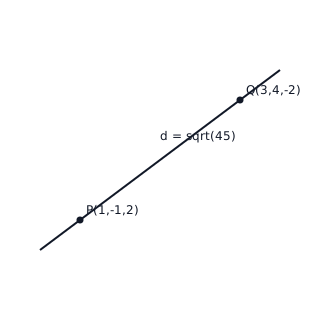
Find the Cartesian equation of the line passing through the points P(1,−1,2)P(1, -1, 2) and Q(3,4,−2)Q(3, 4, -2). Also, find the coordinates of any point on this line that is at a distance of 45\sqrt{45} units from PP.

A line segment PQ in 3D space with point P and Q labeled with their coordinates.

Solution:

  1. Direction ratios of the line PQPQ are: a=3−1=2,b=4−(−1)=5,c=−2−2=−4a = 3-1=2, b = 4-(-1)=5, c = -2-2=-4.
  2. Cartesian equation passing through (1,−1,2)(1, -1, 2): x−12=y+15=z−2−4=λ\frac{x-1}{2} = \frac{y+1}{5} = \frac{z-2}{-4} = \lambda.
  3. A general point RR is (2λ+1,5λ−1,−4λ+2)(2\lambda+1, 5\lambda-1, -4\lambda+2).
  4. Distance PR2=(2λ)2+(5λ)2+(−4λ)2=4λ2+25λ2+16λ2=45λ2PR^2 = (2\lambda)^2 + (5\lambda)^2 + (-4\lambda)^2 = 4\lambda^2 + 25\lambda^2 + 16\lambda^2 = 45\lambda^2.
  5. Given distance is 45\sqrt{45}, so 45λ2=45⇒λ2=1⇒λ=±145\lambda^2 = 45 \Rightarrow \lambda^2 = 1 \Rightarrow \lambda = \pm 1.
  6. For λ=1\lambda = 1, coordinates are (3,4,−2)(3, 4, -2). For λ=−1\lambda = -1, coordinates are (−1,−6,6)(-1, -6, 6).

Explanation:

We first find the direction ratios using the difference of coordinates. Then we use the symmetric form of the line equation. To find a specific point, we use the distance formula in terms of the parameter λ\lambda.

Problem 4:

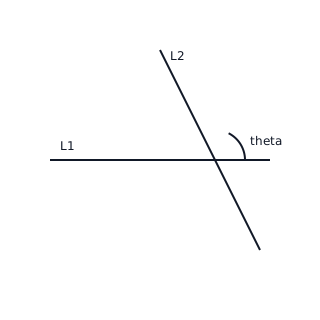
Find the angle between the pair of lines given by x+33=y−15=z+34\frac{x+3}{3} = \frac{y-1}{5} = \frac{z+3}{4} and x+11=y−41=z−52\frac{x+1}{1} = \frac{y-4}{1} = \frac{z-5}{2}.

Two intersecting lines L1 and L2 showing the angle theta between them.

Solution:

  1. Identify direction ratios of first line: b1⃗=(3,5,4)\vec{b_1} = (3, 5, 4).
  2. Identify direction ratios of second line: b2⃗=(1,1,2)\vec{b_2} = (1, 1, 2).
  3. Use the formula: cos⁡θ=∣a1a2+b1b2+c1c2a12+b12+c12a22+b22+c22∣\cos \theta = \left| \frac{a_1 a_2 + b_1 b_2 + c_1 c_2}{\sqrt{a_1^2+b_1^2+c_1^2} \sqrt{a_2^2+b_2^2+c_2^2}} \right|.
  4. cos⁡θ=∣3(1)+5(1)+4(2)32+52+4212+12+22∣=3+5+8506=16300=16103=853\cos \theta = \left| \frac{3(1) + 5(1) + 4(2)}{\sqrt{3^2+5^2+4^2} \sqrt{1^2+1^2+2^2}} \right| = \frac{3+5+8}{\sqrt{50} \sqrt{6}} = \frac{16}{\sqrt{300}} = \frac{16}{10\sqrt{3}} = \frac{8}{5\sqrt{3}}.
  5. θ=cos⁡−1(8315)\theta = \cos^{-1} \left( \frac{8\sqrt{3}}{15} \right).

Explanation:

The angle between two lines is defined by the angle between their direction vectors. We extract the direction ratios from the denominators of the Cartesian equations and apply the cosine dot product formula.