krit.club logo

Three Dimensional Geometry - Distance of a point from a plane

Grade 12CBSE

Review the key concepts, formulae, and examples before starting your quiz.

🔑Concepts

•

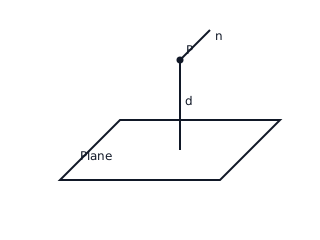
The perpendicular distance of a point PP from a plane is the shortest length from that point to any point on the plane. In vector form, for a point with position vector a⃗\vec{a} and a plane defined by r⃗⋅n⃗=d\vec{r} \cdot \vec{n} = d, the distance is given by the projection of the vector joining a point on the plane to PP onto the normal vector n⃗\vec{n}.

A diagram showing a point P and its perpendicular distance d to a 3D plane, with the normal vector n indicated.
•

In Cartesian coordinates, the distance dd from point (x1,y1,z1)(x_1, y_1, z_1) to the plane Ax+By+Cz+D=0Ax + By + Cz + D = 0 is calculated by substituting the point's coordinates into the plane equation and dividing by the magnitude of the normal vector (A,B,C)(A, B, C).

•

If the plane equation is given in the form Ax+By+Cz=DAx + By + Cz = D, ensure you rewrite it as Ax+By+Cz−D=0Ax + By + Cz - D = 0 before applying the distance formula to avoid sign errors.

•

The distance from the origin (0,0,0)(0, 0, 0) to a plane Ax+By+Cz+D=0Ax + By + Cz + D = 0 simplifies to ∣D∣A2+B2+C2\frac{|D|}{\sqrt{A^2 + B^2 + C^2}}. This represents the length of the normal from the origin to the plane.

📐Formulae

Distance of a point with position vector a⃗\vec{a} from the plane r⃗⋅n⃗=d\vec{r} \cdot \vec{n} = d: p=∣a⃗⋅n⃗−d∣∣n⃗∣p = \frac{|\vec{a} \cdot \vec{n} - d|}{|\vec{n}|}

Distance of a point P(x1,y1,z1)P(x_1, y_1, z_1) from the plane Ax+By+Cz+D=0Ax + By + Cz + D = 0: d=∣Ax1+By1+Cz1+D∣A2+B2+C2d = \frac{|Ax_1 + By_1 + Cz_1 + D|}{\sqrt{A^2 + B^2 + C^2}}

Perpendicular distance from the origin (0,0,0)(0, 0, 0) to the plane Ax+By+Cz+D=0Ax + By + Cz + D = 0: d=∣D∣A2+B2+C2d = \frac{|D|}{\sqrt{A^2 + B^2 + C^2}}

Magnitude of the normal vector n⃗=Ai^+Bj^+Ck^\vec{n} = A\hat{i} + B\hat{j} + C\hat{k}: ∣n⃗∣=A2+B2+C2|\vec{n}| = \sqrt{A^2 + B^2 + C^2}

💡Examples

Problem 1:

Find the distance of the point P(2,5,−3)P(2, 5, -3) from the plane 6x−3y+2z−4=06x - 3y + 2z - 4 = 0.

Solution:

  1. Identify the coordinates of the point: (x1,y1,z1)=(2,5,−3)(x_1, y_1, z_1) = (2, 5, -3).
  2. Identify the coefficients from the plane equation Ax+By+Cz+D=0Ax + By + Cz + D = 0: A=6,B=−3,C=2,D=−4A = 6, B = -3, C = 2, D = -4.
  3. Use the Cartesian distance formula: d=∣Ax1+By1+Cz1+D∣A2+B2+C2d = \frac{|Ax_1 + By_1 + Cz_1 + D|}{\sqrt{A^2 + B^2 + C^2}}.
  4. Substitute the values: d=∣6(2)+(−3)(5)+2(−3)−4∣62+(−3)2+22d = \frac{|6(2) + (-3)(5) + 2(-3) - 4|}{\sqrt{6^2 + (-3)^2 + 2^2}}.
  5. Simplify the numerator: ∣12−15−6−4∣=∣−13∣=13|12 - 15 - 6 - 4| = |-13| = 13.
  6. Simplify the denominator: 36+9+4=49=7\sqrt{36 + 9 + 4} = \sqrt{49} = 7.
  7. Final distance d=137d = \frac{13}{7} units.

Explanation:

This solution applies the Cartesian distance formula by substituting the point's coordinates into the plane's linear expression and dividing by the magnitude of the normal vector (6,−3,2)(6, -3, 2).

Problem 2:

Find the distance of a point with position vector a⃗=2i^+j^−k^\vec{a} = 2\hat{i} + \hat{j} - \hat{k} from the plane r⃗⋅(3i^−4j^+12k^)=9\vec{r} \cdot (3\hat{i} - 4\hat{j} + 12\hat{k}) = 9.

Solution:

  1. Identify a⃗=2i^+j^−k^\vec{a} = 2\hat{i} + \hat{j} - \hat{k}, n⃗=3i^−4j^+12k^\vec{n} = 3\hat{i} - 4\hat{j} + 12\hat{k}, and d=9d = 9.
  2. Calculate the dot product a⃗⋅n⃗\vec{a} \cdot \vec{n}: (2)(3)+(1)(−4)+(−1)(12)=6−4−12=−10(2)(3) + (1)(-4) + (-1)(12) = 6 - 4 - 12 = -10.
  3. Calculate the magnitude of the normal vector ∣n⃗∣|\vec{n}|: 32+(−4)2+122=9+16+144=169=13\sqrt{3^2 + (-4)^2 + 12^2} = \sqrt{9 + 16 + 144} = \sqrt{169} = 13.
  4. Use the vector distance formula: p=∣a⃗⋅n⃗−d∣∣n⃗∣p = \frac{|\vec{a} \cdot \vec{n} - d|}{|\vec{n}|}.
  5. Substitute the values: p=∣−10−9∣13=∣−19∣13=1913p = \frac{|-10 - 9|}{13} = \frac{|-19|}{13} = \frac{19}{13} units.

Explanation:

This approach uses the vector form of the distance formula. We find the scalar projection of the point's position vector onto the normal direction and adjust for the plane's offset from the origin.

Problem 3:

Calculate the distance of the point (3,−2,1)(3, -2, 1) from the plane 2x−y+2z+3=02x - y + 2z + 3 = 0.

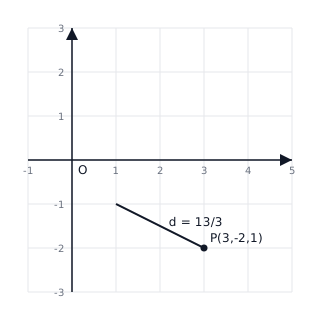
Coordinate plot showing point P(3, -2) and a line segment representing the distance to the plane.

Solution:

  1. Identify coordinates: (x1,y1,z1)=(3,−2,1)(x_1, y_1, z_1) = (3, -2, 1)
  2. Identify plane coefficients: A=2,B=−1,C=2,D=3A = 2, B = -1, C = 2, D = 3
  3. Apply the formula: d=∣2(3)+(−1)(−2)+2(1)+3∣22+(−1)2+22d = \frac{|2(3) + (-1)(-2) + 2(1) + 3|}{\sqrt{2^2 + (-1)^2 + 2^2}}
  4. Simplify the numerator: ∣6+2+2+3∣=∣13∣=13|6 + 2 + 2 + 3| = |13| = 13
  5. Simplify the denominator: 4+1+4=9=3\sqrt{4 + 1 + 4} = \sqrt{9} = 3
  6. Final distance: d=133d = \frac{13}{3} units.

Explanation:

Substitute the point into the general linear equation of the plane and divide by the square root of the sum of the squares of the coefficients of xx, yy, and zz.

Problem 4:

Find the distance between the point Q(0,0,0)Q(0, 0, 0) and the plane r⃗⋅(2i^−3j^+6k^)=14\vec{r} \cdot (2\hat{i} - 3\hat{j} + 6\hat{k}) = 14.

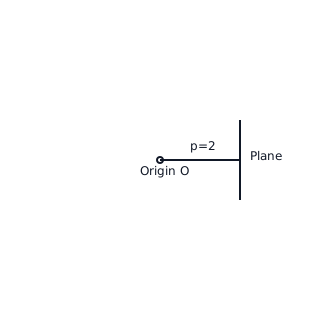
Diagram showing the distance p from the origin to a vertical line representing the plane.

Solution:

  1. The point is the origin, so a⃗=0i^+0j^+0k^\vec{a} = 0\hat{i} + 0\hat{j} + 0\hat{k}.
  2. The plane is r⃗⋅n⃗=d\vec{r} \cdot \vec{n} = d where n⃗=2i^−3j^+6k^\vec{n} = 2\hat{i} - 3\hat{j} + 6\hat{k} and d=14d = 14.
  3. Calculate ∣n⃗∣=22+(−3)2+62=4+9+36=49=7|\vec{n}| = \sqrt{2^2 + (-3)^2 + 6^2} = \sqrt{4 + 9 + 36} = \sqrt{49} = 7.
  4. Distance p=∣0⋅n⃗−14∣7=∣−14∣7=147=2p = \frac{|0 \cdot \vec{n} - 14|}{7} = \frac{|-14|}{7} = \frac{14}{7} = 2 units.

Explanation:

For the origin, the distance is simply the constant term dd divided by the magnitude of the normal vector.