krit.club logo

Three Dimensional Geometry - Coplanar and skew lines, shortest distance between two lines

Grade 12CBSE

Review the key concepts, formulae, and examples before starting your quiz.

🔑Concepts

•

Skew lines are lines in three-dimensional space that are neither parallel nor intersecting. Unlike in 2D geometry, where lines must eventually meet if they are not parallel, skew lines lie in different planes and never cross.
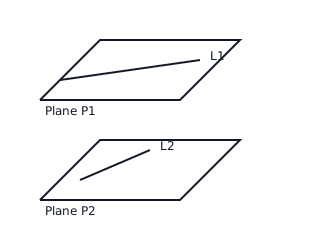
Diagram showing two parallel planes with non-parallel lines L1 and L2 on different levels, representing skew lines.
•

The shortest distance between two skew lines is the length of the line segment that is perpendicular to both lines simultaneously. This unique common perpendicular represents the minimum gap between the lines in 3D space.
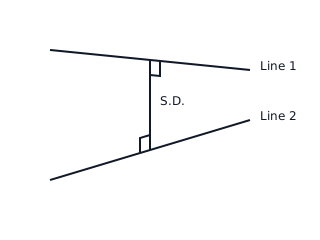
Diagram showing the common perpendicular segment representing the shortest distance between two skew lines.
•

Two lines are said to be coplanar if they lie in the same plane. This occurs if the lines either intersect at a point or are parallel to each other. For two lines to be coplanar, the shortest distance between them must be zero.
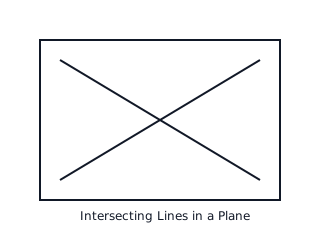
Diagram of two lines intersecting on a single flat surface, showing coplanarity.
•

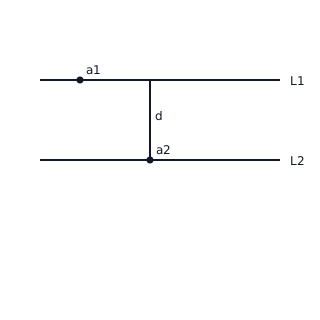
For parallel lines r⃗=a⃗1+λb⃗\vec{r} = \vec{a}_1 + \lambda \vec{b} and r⃗=a⃗2+μb⃗\vec{r} = \vec{a}_2 + \mu \vec{b}, the shortest distance is the perpendicular distance from any point on one line to the other line. Because they share the same direction vector b⃗\vec{b}, the cross product involves b⃗\vec{b} and the vector connecting points on both lines.
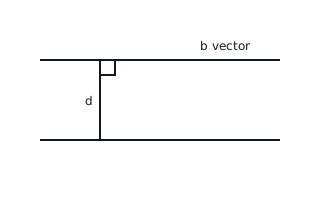
Diagram showing two parallel lines and the perpendicular distance d between them.

📐Formulae

Vector equation of a line: r⃗=a⃗+λb⃗\vec{r} = \vec{a} + \lambda \vec{b}

Cartesian equation of a line: x−x1l=y−y1m=z−z1n\frac{x - x_1}{l} = \frac{y - y_1}{m} = \frac{z - z_1}{n}, where (x1,y1,z1)(x_1, y_1, z_1) is a point on the line and l,m,nl, m, n are direction ratios.

Shortest distance between skew lines r⃗=a⃗1+λb⃗1\vec{r} = \vec{a}_1 + \lambda \vec{b}_1 and r⃗=a⃗2+μb⃗2\vec{r} = \vec{a}_2 + \mu \vec{b}_2: d=∣(b⃗1×b⃗2)⋅(a⃗2−a⃗1)∣b⃗1×b⃗2∣∣d = \left| \frac{(\vec{b}_1 \times \vec{b}_2) \cdot (\vec{a}_2 - \vec{a}_1)}{|\vec{b}_1 \times \vec{b}_2|} \right|

Shortest distance between parallel lines r⃗=a⃗1+λb⃗\vec{r} = \vec{a}_1 + \lambda \vec{b} and r⃗=a⃗2+μb⃗\vec{r} = \vec{a}_2 + \mu \vec{b}: d=∣b⃗×(a⃗2−a⃗1)∣b⃗∣∣d = \left| \frac{\vec{b} \times (\vec{a}_2 - \vec{a}_1)}{|\vec{b}|} \right|

Condition for coplanarity in Cartesian form: ∣x2−x1y2−y1z2−z1a1b1c1a2b2c2∣=0\begin{vmatrix} x_2 - x_1 & y_2 - y_1 & z_2 - z_1 \\ a_1 & b_1 & c_1 \\ a_2 & b_2 & c_2 \end{vmatrix} = 0

Shortest distance for Cartesian skew lines: d=∣x2−x1y2−y1z2−z1a1b1c1a2b2c2∣(b1c2−b2c1)2+(c1a2−c2a1)2+(a1b2−a2b1)2d = \frac{\begin{vmatrix} x_2 - x_1 & y_2 - y_1 & z_2 - z_1 \\ a_1 & b_1 & c_1 \\ a_2 & b_2 & c_2 \end{vmatrix}}{\sqrt{(b_1 c_2 - b_2 c_1)^2 + (c_1 a_2 - c_2 a_1)^2 + (a_1 b_2 - a_2 b_1)^2}}

💡Examples

Problem 1:

Find the shortest distance between the lines L1:r⃗=(i^+2j^+3k^)+λ(i^−3j^+2k^)L_1: \vec{r} = (\hat{i} + 2\hat{j} + 3\hat{k}) + \lambda(\hat{i} - 3\hat{j} + 2\hat{k}) and L2:r⃗=(4i^+5j^+6k^)+μ(2i^+3j^+k^)L_2: \vec{r} = (4\hat{i} + 5\hat{j} + 6\hat{k}) + \mu(2\hat{i} + 3\hat{j} + \hat{k}).

Solution:

  1. Identify vectors: a⃗1=i^+2j^+3k^\vec{a}_1 = \hat{i} + 2\hat{j} + 3\hat{k}, b⃗1=i^−3j^+2k^\vec{b}_1 = \hat{i} - 3\hat{j} + 2\hat{k}, a⃗2=4i^+5j^+6k^\vec{a}_2 = 4\hat{i} + 5\hat{j} + 6\hat{k}, b⃗2=2i^+3j^+k^\vec{b}_2 = 2\hat{i} + 3\hat{j} + \hat{k}.
  2. Calculate a⃗2−a⃗1=(4−1)i^+(5−2)j^+(6−3)k^=3i^+3j^+3k^\vec{a}_2 - \vec{a}_1 = (4-1)\hat{i} + (5-2)\hat{j} + (6-3)\hat{k} = 3\hat{i} + 3\hat{j} + 3\hat{k}.
  3. Find b⃗1×b⃗2=∣i^j^k^1−32231∣=i^(−3−6)−j^(1−4)+k^(3−(−6))=−9i^+3j^+9k^\vec{b}_1 \times \vec{b}_2 = \begin{vmatrix} \hat{i} & \hat{j} & \hat{k} \\ 1 & -3 & 2 \\ 2 & 3 & 1 \end{vmatrix} = \hat{i}(-3 - 6) - \hat{j}(1 - 4) + \hat{k}(3 - (-6)) = -9\hat{i} + 3\hat{j} + 9\hat{k}.
  4. Magnitude ∣b⃗1×b⃗2∣=(−9)2+32+92=81+9+81=171=319|\vec{b}_1 \times \vec{b}_2| = \sqrt{(-9)^2 + 3^2 + 9^2} = \sqrt{81 + 9 + 81} = \sqrt{171} = 3\sqrt{19}.
  5. Scalar product (b⃗1×b⃗2)⋅(a⃗2−a⃗1)=(−9)(3)+(3)(3)+(9)(3)=−27+9+27=9(\vec{b}_1 \times \vec{b}_2) \cdot (\vec{a}_2 - \vec{a}_1) = (-9)(3) + (3)(3) + (9)(3) = -27 + 9 + 27 = 9.
  6. Distance d=∣9319∣=319d = \left| \frac{9}{3\sqrt{19}} \right| = \frac{3}{\sqrt{19}} units.

Explanation:

We use the shortest distance formula for skew lines. We first determine the vector connecting points on both lines and the cross product of the direction vectors to find the common perpendicular direction. The projection of the connecting vector onto the common perpendicular gives the shortest distance.

Problem 2:

Show that the lines x−12=y−23=z−34\frac{x - 1}{2} = \frac{y - 2}{3} = \frac{z - 3}{4} and x−45=y−12=z\frac{x - 4}{5} = \frac{y - 1}{2} = z are coplanar.

Solution:

  1. Extract points and directions: P1(1,2,3)P_1(1, 2, 3), b⃗1=(2,3,4)\vec{b}_1 = (2, 3, 4) and P2(4,1,0)P_2(4, 1, 0), b⃗2=(5,2,1)\vec{b}_2 = (5, 2, 1).
  2. Calculate x2−x1=3,y2−y1=−1,z2−z1=−3x_2 - x_1 = 3, y_2 - y_1 = -1, z_2 - z_1 = -3.
  3. Evaluate the determinant: D=∣3−1−3234521∣D = \begin{vmatrix} 3 & -1 & -3 \\ 2 & 3 & 4 \\ 5 & 2 & 1 \end{vmatrix}.
  4. D=3(3(1)−2(4))−(−1)(2(1)−5(4))+(−3)(2(2)−5(3))D = 3(3(1) - 2(4)) - (-1)(2(1) - 5(4)) + (-3)(2(2) - 5(3)).
  5. D=3(3−8)+1(2−20)−3(4−15)=3(−5)+1(−18)−3(−11)=−15−18+33=0D = 3(3 - 8) + 1(2 - 20) - 3(4 - 15) = 3(-5) + 1(-18) - 3(-11) = -15 - 18 + 33 = 0.
  6. Since D=0D = 0, the lines are coplanar.

Explanation:

To check if two lines are coplanar in Cartesian form, we use the determinant condition. This determinant represents the scalar triple product of the vector joining the two points and the two direction vectors. If the volume of the resulting parallelepiped is zero, the vectors must lie in the same plane.

Problem 3:

Find the shortest distance between the parallel lines L1:r⃗=(i^+2j^−4k^)+λ(2i^+3j^+6k^)L_1: \vec{r} = (\hat{i} + 2\hat{j} - 4\hat{k}) + \lambda(2\hat{i} + 3\hat{j} + 6\hat{k}) and L2:r⃗=(3i^+3j^−5k^)+μ(2i^+3j^+6k^)L_2: \vec{r} = (3\hat{i} + 3\hat{j} - 5\hat{k}) + \mu(2\hat{i} + 3\hat{j} + 6\hat{k}).

Distance d between two parallel lines L1 and L2.

Solution:

  1. Identify the vectors: a⃗1=i^+2j^−4k^\vec{a}_1 = \hat{i} + 2\hat{j} - 4\hat{k} a⃗2=3i^+3j^−5k^\vec{a}_2 = 3\hat{i} + 3\hat{j} - 5\hat{k} b⃗=2i^+3j^+6k^\vec{b} = 2\hat{i} + 3\hat{j} + 6\hat{k}

  2. Calculate a⃗2−a⃗1\vec{a}_2 - \vec{a}_1: a⃗2−a⃗1=(3−1)i^+(3−2)j^+(−5+4)k^=2i^+j^−k^\vec{a}_2 - \vec{a}_1 = (3-1)\hat{i} + (3-2)\hat{j} + (-5+4)\hat{k} = 2\hat{i} + \hat{j} - \hat{k}

  3. Calculate b⃗×(a⃗2−a⃗1)\vec{b} \times (\vec{a}_2 - \vec{a}_1): b⃗×(a⃗2−a⃗1)=∣i^j^k^23621−1∣=i^(−3−6)−j^(−2−12)+k^(2−6)=−9i^+14j^−4k^\vec{b} \times (\vec{a}_2 - \vec{a}_1) = \begin{vmatrix} \hat{i} & \hat{j} & \hat{k} \\ 2 & 3 & 6 \\ 2 & 1 & -1 \end{vmatrix} = \hat{i}(-3-6) - \hat{j}(-2-12) + \hat{k}(2-6) = -9\hat{i} + 14\hat{j} - 4\hat{k}

  4. Find magnitudes: ∣b⃗×(a⃗2−a⃗1)∣=(−9)2+142+(−4)2=81+196+16=293|\vec{b} \times (\vec{a}_2 - \vec{a}_1)| = \sqrt{(-9)^2 + 14^2 + (-4)^2} = \sqrt{81 + 196 + 16} = \sqrt{293} ∣b⃗∣=22+32+62=4+9+36=49=7|\vec{b}| = \sqrt{2^2 + 3^2 + 6^2} = \sqrt{4 + 9 + 36} = \sqrt{49} = 7

  5. Shortest distance d=∣b⃗×(a⃗2−a⃗1)∣∣b⃗∣=2937d = \frac{|\vec{b} \times (\vec{a}_2 - \vec{a}_1)|}{|\vec{b}|} = \frac{\sqrt{293}}{7} units.

Explanation:

Since the direction vectors for both lines are the same (2,3,6)(2, 3, 6), the lines are parallel. We use the formula for the distance between parallel lines involving the cross product of the direction vector and the vector connecting points on each line.

Problem 4:

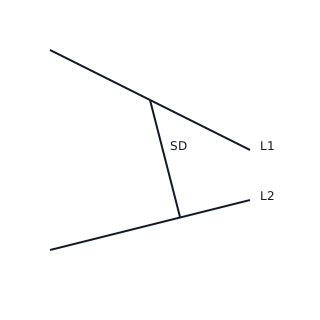
Find the shortest distance between the skew lines whose vector equations are r⃗=(i^+j^)+λ(2i^−j^+k^)\vec{r} = (\hat{i} + \hat{j}) + \lambda(2\hat{i} - \hat{j} + \hat{k}) and r⃗=(2i^+j^−k^)+μ(3i^−5j^+2k^)\vec{r} = (2\hat{i} + \hat{j} - \hat{k}) + \mu(3\hat{i} - 5\hat{j} + 2\hat{k}).

Two skew lines L1 and L2 with a line segment SD representing the shortest distance.

Solution:

  1. Identify the vectors: a⃗1=i^+j^\vec{a}_1 = \hat{i} + \hat{j}, b⃗1=2i^−j^+k^\vec{b}_1 = 2\hat{i} - \hat{j} + \hat{k} a⃗2=2i^+j^−k^\vec{a}_2 = 2\hat{i} + \hat{j} - \hat{k}, b⃗2=3i^−5j^+2k^\vec{b}_2 = 3\hat{i} - 5\hat{j} + 2\hat{k}

  2. Calculate a⃗2−a⃗1=i^−k^\vec{a}_2 - \vec{a}_1 = \hat{i} - \hat{k}

  3. Calculate b⃗1×b⃗2\vec{b}_1 \times \vec{b}_2: b⃗1×b⃗2=∣i^j^k^2−113−52∣=i^(−2+5)−j^(4−3)+k^(−10+3)=3i^−j^−7k^\vec{b}_1 \times \vec{b}_2 = \begin{vmatrix} \hat{i} & \hat{j} & \hat{k} \\ 2 & -1 & 1 \\ 3 & -5 & 2 \end{vmatrix} = \hat{i}(-2+5) - \hat{j}(4-3) + \hat{k}(-10+3) = 3\hat{i} - \hat{j} - 7\hat{k}

  4. Calculate the magnitude ∣b⃗1×b⃗2∣=32+(−1)2+(−7)2=9+1+49=59|\vec{b}_1 \times \vec{b}_2| = \sqrt{3^2 + (-1)^2 + (-7)^2} = \sqrt{9 + 1 + 49} = \sqrt{59}

  5. Calculate (a⃗2−a⃗1)⋅(b⃗1×b⃗2)=(1)(3)+(0)(−1)+(−1)(−7)=3+0+7=10(\vec{a}_2 - \vec{a}_1) \cdot (\vec{b}_1 \times \vec{b}_2) = (1)(3) + (0)(-1) + (-1)(-7) = 3 + 0 + 7 = 10

  6. Shortest distance d=∣1059∣=1059d = \left| \frac{10}{\sqrt{59}} \right| = \frac{10}{\sqrt{59}} units.

Explanation:

To find the shortest distance between skew lines, we determine the vector perpendicular to both lines (the cross product of their direction vectors) and then find the projection of the vector connecting two points on the lines onto this perpendicular vector.