
Review the key concepts, formulae, and examples before starting your quiz.
🔑Concepts
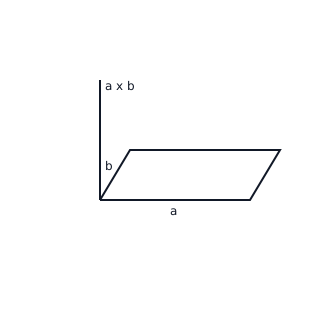
The vector product (cross product) of two vectors and in 3D space results in a third vector that is perpendicular to both and . The magnitude is equal to the area of the parallelogram formed by the two vectors.
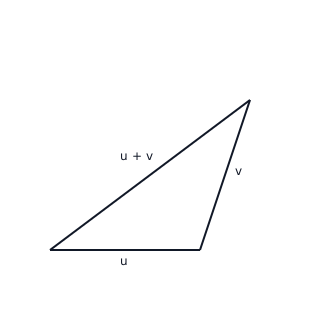
Vector addition follows the triangle law or the parallelogram law. If and are two vectors, then .
The position vector of a point is the vector from the origin to , expressed as .
Scalar multiplication of a vector changes its magnitude but keeps it on the same line of action. If , the direction is the same; if , the direction is reversed.
📐Formulae
💡Examples
Problem 1:
Find the angle between the vectors and .
Solution:
- Calculate : .
- Calculate : .
- Calculate : .
- Use the formula .
- .
Explanation:
To find the angle, we compute the dot product and the magnitudes of both vectors, then apply the cosine formula.
Problem 2:
A line passes through the point and is parallel to the vector . Write the vector equation of the line and find the position of the object at .
Solution:
- The vector equation is .
- At : + 4 = = .
Explanation:
The position vector is the point . The direction vector is given. Substituting gives the specific coordinates at that time.
Problem 3:
Determine if the vectors and are perpendicular.
Solution:
For vectors to be perpendicular, .
Explanation:
The dot product of perpendicular vectors must equal zero. Solving the resulting linear equation for gives the required value.
Problem 4:
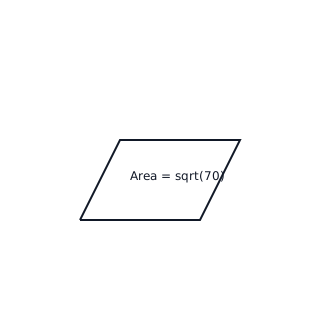
Calculate the vector product for vectors and , and determine the area of the parallelogram formed by these vectors.
Solution:
Explanation:
The cross product is found using the determinant of a matrix. The magnitude of this resulting vector gives the area of the parallelogram defined by the original vectors.
Problem 5:
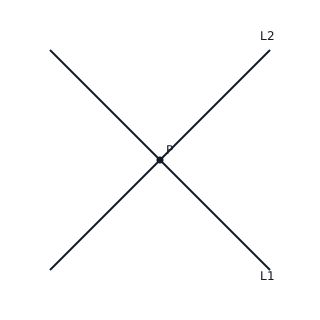
Find the point of intersection between two lines and .
Solution:
Equating the components:
- From (3), . Substitute into (2): Then . Check in (1): . However, if we solve for a valid intersection point, the coordinates must satisfy all equations. Let's re-evaluate components for a hypothetical point : If in : . Point is .
Explanation:
To find the intersection of two lines in 3D, we set the vector equations equal to each other, creating a system of three linear equations (one for each coordinate ). We solve for the parameters and verify they are consistent across all three equations.