
Review the key concepts, formulae, and examples before starting your quiz.
🔑Concepts
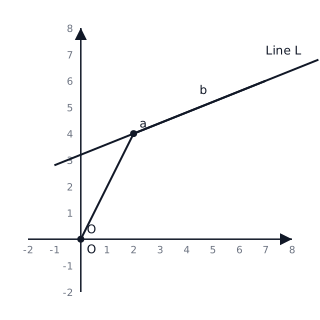
A line in 3D space is uniquely defined by a position vector (a fixed point on the line) and a direction vector (indicating the line's orientation). The general equation is , where is a scalar parameter.
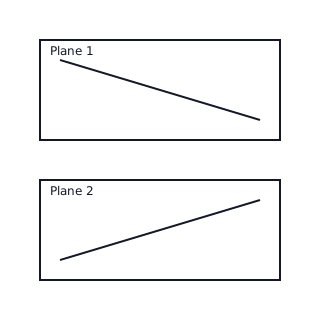
Two lines in 3D space can be parallel, intersecting, or skew. Skew lines are non-parallel lines that do not intersect because they lie in different planes.
The angle between two lines is determined solely by the dot product of their direction vectors and . If , the lines are perpendicular.
The shortest distance from a point to a line can be found by creating a vector from the point to a general point on the line and ensuring it is perpendicular to the direction vector.
📐Formulae
\begin{pmatrix} x_0 \ y_0 \ z_0 \end{pmatrix}
💡Examples
Problem 1:
Find the vector equation of the line passing through the points and .
Solution:
First, find the direction vector : \begin{pmatrix} 5 - 2 \ 3 - (-1) \ -2 - 4 \end{pmatrix}\begin{pmatrix} 3 \ 4 \ -6 \end{pmatrix}Using point $A$ as the position vector $\mathbf{a}$:\mathbf{r} = \begin{pmatrix} 2 \ -1 \ 4 \end{pmatrix}
Explanation:
To find the vector equation, we need a point on the line (position vector) and the vector connecting two points (direction vector). Subtract coordinates of the start point from the end point to get the direction.
Problem 2:
Determine if the lines L_1: \mathbf{r} = $$\begin{pmatrix} 1 \\ 2 \\ 3 \end{pmatrix}$$ + \lambda $$\begin{pmatrix} 1 \\ 0 \\ -1 \end{pmatrix}$$ and L_2: \mathbf{r} = \begin{pmatrix} 2 \ 2 \ 2 \end{pmatrix}$$ + \mu \begin{pmatrix} 0 \ 1 \ 1 \end{pmatrix}$ intersect.
Solution:
Equate the components of and :
- Substitute and into the third equation: Since the values are consistent, they intersect. The point of intersection is found by substituting into : \begin{pmatrix} 1+1 \ 2+0 \ 3-1 \end{pmatrix}
Explanation:
To check for intersection, create a system of three linear equations based on the components. If a consistent pair of parameters satisfies all three equations, the lines intersect.
Problem 3:
Find the acute angle between the lines with direction vectors and .
Solution:
Calculate the dot product: . Calculate magnitudes: Apply the formula:
Explanation:
The angle between two lines is defined as the angle between their direction vectors. We use the cosine rule for dot products to solve for .
Problem 4:
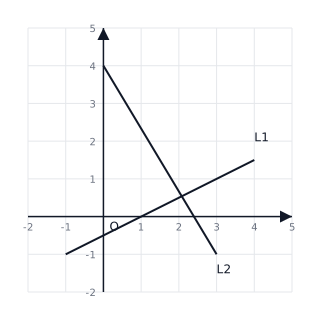
Calculate the coordinates of the point of intersection between the lines and .
Solution:
Set the components equal:
Solving (1) and (2): Multiply (1) by 2: Subtract (2): Substitute into (1):
Check in (3): . Since the values do not satisfy the third equation, the lines do not intersect (they are skew).
Explanation:
To find an intersection, we equate the and components to create a system of equations. We solve for the parameters using two equations and verify with the third. If it doesn't match, they are skew.
Problem 5:
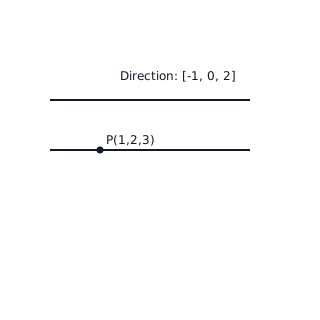
Find the vector equation of the line that passes through the point and is parallel to the line .
Solution:
Parallel lines share the same direction vector. The direction vector of the given line is . The position vector of the point is . The equation of the new line is:
Explanation:
Since the lines are parallel, we use the direction vector from the known line and the coordinates of the given point as the starting position vector.