
Review the key concepts, formulae, and examples before starting your quiz.
🔑Concepts
The Cosine Rule is used to relate the side lengths and angles of any triangle (not just right-angled ones). It is essentially a generalization of the Pythagorean theorem. In any triangle with side lengths opposite to angles , the rule provides a way to find a third side if two sides and the included angle (SAS) are known.
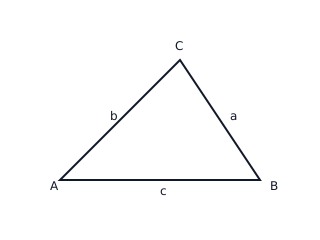
To find an unknown side, use the standard form: . This is applicable when you have the lengths of two sides and the size of the angle trapped between them.
To find an unknown angle, use the rearranged form: . This is applicable when the lengths of all three sides (SSS) are known.
When calculating angles, if is negative, the angle is obtuse (between and ). The calculator's function will automatically provide the correct obtuse angle.
📐Formulae
💡Examples
Problem 1:
In triangle , side , side , and . Calculate the length of side correct to 3 significant figures.
Solution:
Using the Cosine Rule:
Explanation:
We identify this as a Side-Angle-Side (SAS) problem. We substitute the known values into the side-finding version of the formula and take the square root to find .
Problem 2:
A triangle has sides of length , , and . Find the size of the largest angle in the triangle.
Solution:
The largest angle is opposite the longest side. Let , , and . We need to find :
Explanation:
Since all three sides are known (SSS), we use the rearranged formula to find the angle. The longest side (11) must be to find the largest angle .
Problem 3:
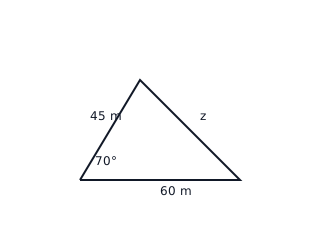
A surveyor measures two sides of a triangular plot of land. Side is and side is . The angle between these two sides is . Find the length of the third side to 2 decimal places.
Solution:
- Identify the given values: , , and included angle .
- Apply the Cosine Rule formula for the side length:
- Calculate the squares and product:
- Take the square root:
Explanation:
Since we have two sides and the included angle (SAS), we use the side-length version of the Cosine Rule to find the side opposite the given angle.
Problem 4:
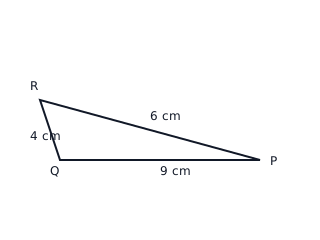
In triangle , the side lengths are , , and . Find the size of the angle to the nearest tenth of a degree.
Solution:
- Let (side opposite ), (side opposite ), and (side opposite ).
- We need to find angle , so use the rearranged Cosine Rule:
- Substitute the values:
- Calculate the inverse cosine:
- Rounding to 1 decimal place, .
Explanation:
With three sides known (SSS), the Cosine Rule allows us to solve for any angle. A negative cosine value correctly indicates that the angle is obtuse.