krit.club logo

Geometry and Trigonometry - Trigonometric ratios

Grade 11IB_AI

Review the key concepts, formulae, and examples before starting your quiz.

🔑Concepts

•

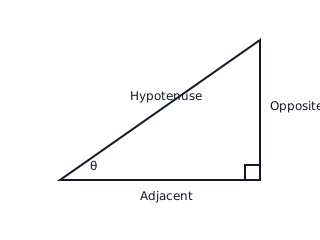
The Sine, Cosine, and Tangent ratios are defined for a right-angled triangle relative to a given angle θ\theta. These ratios relate the lengths of the sides: Opposite (OO), Adjacent (AA), and Hypotenuse (HH).

Right-angled triangle showing labeling of Opposite, Adjacent, and Hypotenuse relative to angle theta.
•

The Sine Rule connects the sides and angles of any non-right-angled triangle: asin⁡A=bsin⁡B=csin⁡C\frac{a}{\sin A} = \frac{b}{\sin B} = \frac{c}{\sin C}. It is most useful when you know a side-angle opposite pair.

•

The Cosine Rule, a2=b2+c2−2bccos⁡Aa^2 = b^2 + c^2 - 2bc \cos A, is used to find a third side when two sides and the included angle (SAS) are known, or to find an angle when all three sides (SSS) are known.
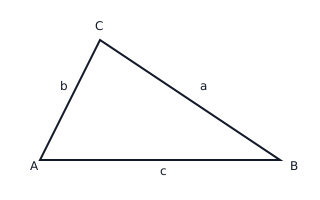
Generic triangle ABC with sides a, b, c labeled opposite to their respective angles.
•

The area of any triangle can be calculated using the formula Area=12absin⁡C\text{Area} = \frac{1}{2}ab \sin C, where aa and bb are two sides and CC is the angle between them.

•

Angles of elevation and depression are measured from a horizontal line. The angle of elevation is measured upwards to an object, while the angle of depression is measured downwards.

📐Formulae

sin⁡θ=OH,cos⁡θ=AH,tan⁡θ=OA\sin \theta = \frac{\text{O}}{\text{H}}, \quad \cos \theta = \frac{\text{A}}{\text{H}}, \quad \tan \theta = \frac{\text{O}}{\text{A}}

asin⁡A=bsin⁡B=csin⁡C\frac{a}{\sin A} = \frac{b}{\sin B} = \frac{c}{\sin C}

a2=b2+c2−2bccos⁡Aa^2 = b^2 + c^2 - 2bc \cos A

cos⁡A=b2+c2−a22bc\cos A = \frac{b^2 + c^2 - a^2}{2bc}

Area=12absin⁡C\text{Area} = \frac{1}{2}ab \sin C

💡Examples

Problem 1:

In triangle ABCABC, AB=7AB = 7 cm, BC=9BC = 9 cm, and angle ABC=48∘ABC = 48^{\circ}. Find the length of side ACAC.

Solution:

Using the Cosine Rule: b2=a2+c2−2accos⁡Bb^2 = a^2 + c^2 - 2ac \cos B b2=92+72−2(9)(7)cos⁡48∘b^2 = 9^2 + 7^2 - 2(9)(7) \cos 48^{\circ} b2=81+49−126(0.6691...)b^2 = 81 + 49 - 126(0.6691...) b2=130−84.306...b^2 = 130 - 84.306... b2=45.693...b^2 = 45.693... b=45.693...≈6.76 cmb = \sqrt{45.693...} \approx 6.76 \text{ cm}

Explanation:

Since we are given two sides and the included angle (SAS), the Cosine Rule is the most direct method to find the third side.

Problem 2:

Find the area of a triangle with sides 88 m and 1212 m and an included angle of 30∘30^{\circ}.

Solution:

Area=12absin⁡C\text{Area} = \frac{1}{2}ab \sin C Area=12(8)(12)sin⁡30∘\text{Area} = \frac{1}{2}(8)(12) \sin 30^{\circ} Area=48×0.5\text{Area} = 48 \times 0.5 Area=24 m2\text{Area} = 24 \text{ m}^2

Explanation:

Apply the area formula for triangles using the two given sides and the sine of the angle between them.

Problem 3:

In triangle PQRPQR, PQ=10PQ = 10, angle P=40∘P = 40^{\circ}, and angle Q=75∘Q = 75^{\circ}. Find the length of QRQR.

Solution:

First, find angle RR: R=180∘−(40∘+75∘)=65∘R = 180^{\circ} - (40^{\circ} + 75^{\circ}) = 65^{\circ} Now use the Sine Rule: QRsin⁡40∘=10sin⁡65∘\frac{QR}{\sin 40^{\circ}} = \frac{10}{\sin 65^{\circ}} QR=10×sin⁡40∘sin⁡65∘QR = \frac{10 \times \sin 40^{\circ}}{\sin 65^{\circ}} QR≈10×0.64280.9063≈7.09QR \approx \frac{10 \times 0.6428}{0.9063} \approx 7.09

Explanation:

Calculate the third angle using the sum of angles in a triangle, then use the Sine Rule to relate the known side and its opposite angle to the unknown side.

Problem 4:

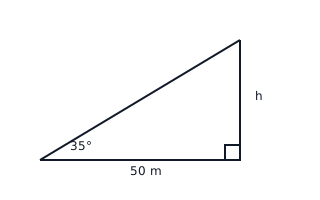
A surveyor stands 5050 m from the base of a vertical tower. The angle of elevation to the top of the tower is 35∘35^{\circ}. Calculate the height of the tower.

Diagram showing a right-angled triangle representing the surveyor and the tower.

Solution:

  1. Identify the given values: Adjacent side A=50A = 50 m, Angle θ=35∘\theta = 35^{\circ}.
  2. Use the tangent ratio: tan⁡35∘=height50\tan 35^{\circ} = \frac{\text{height}}{50}.
  3. Rearrange to solve for height: height=50×tan⁡35∘\text{height} = 50 \times \tan 35^{\circ}.
  4. Calculate: height≈50×0.7002=35.01\text{height} \approx 50 \times 0.7002 = 35.01 m.

Explanation:

Since we are given the horizontal distance (adjacent) and need the vertical height (opposite), the tangent ratio is the most direct method.

Problem 5:

In triangle XYZXYZ, XY=12XY = 12 cm, YZ=15YZ = 15 cm, and XZ=18XZ = 18 cm. Find the size of the largest angle in the triangle.
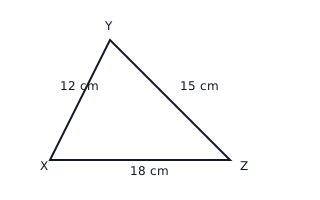
Triangle XYZ with side lengths 12, 15, and 18 labeled.

Solution:

  1. The largest angle is opposite the longest side (XZ=18XZ = 18 cm), which is angle YY.
  2. Use the Cosine Rule: cos⁡Y=122+152−1822×12×15\cos Y = \frac{12^2 + 15^2 - 18^2}{2 \times 12 \times 15}.
  3. cos⁡Y=144+225−324360=45360=0.125\cos Y = \frac{144 + 225 - 324}{360} = \frac{45}{360} = 0.125.
  4. Y=cos⁡−1(0.125)≈82.8∘Y = \cos^{-1}(0.125) \approx 82.8^{\circ}.

Explanation:

To find an angle when all three sides are known, we apply the Cosine Rule rearranged for the angle.