
Review the key concepts, formulae, and examples before starting your quiz.
🔑Concepts
The Sine Rule: Used to find missing sides or angles in non-right-angled triangles when we know either two angles and one side (AAS/ASA) or two sides and a non-included angle (SSA). The formula is .
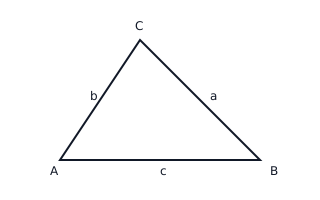
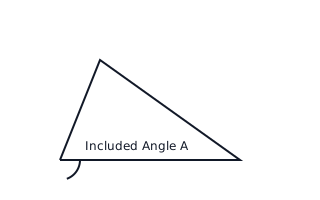
The Cosine Rule: Used to find a third side when two sides and the included angle (SAS) are known, or to find an angle when all three sides (SSS) are known. Formula: .
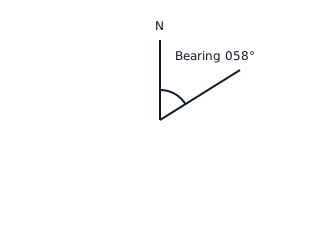
Bearings: These are angles measured clockwise from North (). They are always written with three digits (e.g., for North-East).
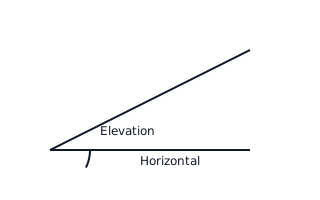
Angles of Elevation and Depression: These are measured from a horizontal line of sight looking up or down at an object.
📐Formulae
💡Examples
Problem 1:
In triangle , side cm, side cm, and angle . Calculate the length of side .
Solution:
Using the Cosine Rule:
Explanation:
Since we have two sides and the included angle (SAS), the Cosine Rule is the appropriate formula to find the missing side opposite the given angle.
Problem 2:
A surveyor at point observes the top of a building with an angle of elevation of . If the surveyor is m away from the base of the building, find the height of the building.
Solution:
Explanation:
Using the tangent ratio in a right-angled triangle where the horizontal distance is the adjacent side and the height is the opposite side.
Problem 3:
Calculate the area of a sector with a radius of cm and a central angle of .
Solution:
Explanation:
The sector area is a fraction of the total circle area, determined by the ratio of the central angle to .
Problem 4:
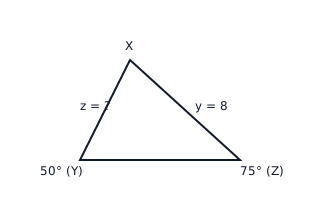
In triangle , angle , angle , and side cm. Find the length of side .
Solution:
- Identify that we have two angles and one side (AAS), so use the Sine Rule:
- Substitute the values:
- Rearrange to solve for :
- Calculate:
Explanation:
Because we are given two angles and a side opposite one of them, the Sine Rule is the most direct method to find the other side.
Problem 5:
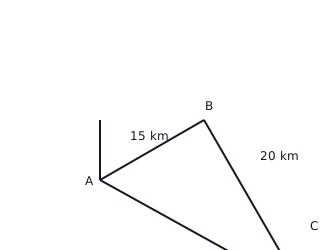
A ship sails km on a bearing of from port to point . It then sails km on a bearing of to point . Calculate the distance directly.
Solution:
- Determine the internal angle at . The angle between the path and the North line is . Using alternate angles, the angle from to South is . The bearing from to leaves an angle of from the South line (). Total angle .
- Since it is a right-angled triangle, use Pythagoras:
Explanation:
By breaking down the bearings, we found that the internal angle at point B is , allowing us to use the Pythagorean theorem for the distance calculation.