krit.club logo

Geometry and Trigonometry - Radian measure (HL)

Grade 11IB_AI

Review the key concepts, formulae, and examples before starting your quiz.

🔑Concepts

•

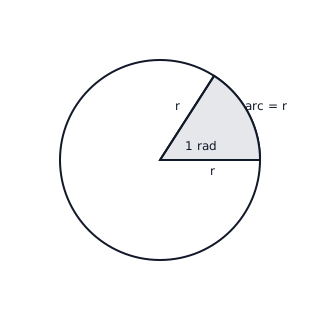
A radian is defined as the angle subtended at the center of a circle by an arc whose length is equal to the radius of the circle. Since the circumference of a circle is 2πr2\pi r, there are 2π2\pi radians in a full turn (360∘360^{\circ}).

Diagram showing 1 radian where arc length equals radius
•

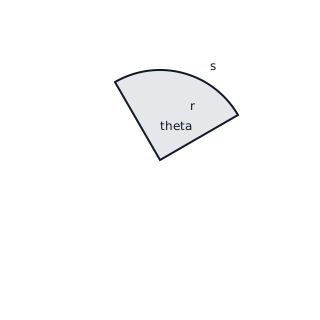
Arc length (ss) and Sector Area (AA) are directly proportional to the angle θ\theta (in radians). These are given by s=rθs = r\theta and A=12r2θA = \frac{1}{2}r^2\theta.

Geometry of a circular sector showing radius, arc length and angle theta
•

The area of a segment is found by subtracting the area of the triangle formed by the two radii and the chord from the area of the sector: Area=12r2(θ−sin⁡θ)\text{Area} = \frac{1}{2}r^2(\theta - \sin\theta).

•

Conversions between degrees and radians use the equivalence π rad=180∘\pi \text{ rad} = 180^{\circ}. Multiply degrees by π180\frac{\pi}{180} to get radians, and radians by 180π\frac{180}{\pi} to get degrees.

📐Formulae

Angle in radians=Angle in degrees×π180\text{Angle in radians} = \text{Angle in degrees} \times \frac{\pi}{180}

s=rθs = r\theta

A=12r2θA = \frac{1}{2}r^2\theta

Area of segment=12r2(θ−sin⁡θ)\text{Area of segment} = \frac{1}{2}r^2(\theta - \sin\theta)

Chord length=2rsin⁡(θ2)\text{Chord length} = 2r\sin\left(\frac{\theta}{2}\right)

💡Examples

Problem 1:

A sector of a circle has a radius of 8 cm8 \text{ cm} and an arc length of 12 cm12 \text{ cm}. Find the angle θ\theta in radians and the area of the sector.

Solution:

s=rθ  ⟹  12=8θ  ⟹  θ=1.5 rads = r\theta \implies 12 = 8\theta \implies \theta = 1.5 \text{ rad} A=12r2θ=12(82)(1.5)=12(64)(1.5)=48 cm2A = \frac{1}{2}r^2\theta = \frac{1}{2}(8^2)(1.5) = \frac{1}{2}(64)(1.5) = 48 \text{ cm}^2

Explanation:

First, use the arc length formula s=rθs = r\theta to solve for θ\theta. Then, substitute the radius and the calculated angle into the sector area formula.

Problem 2:

Convert 210∘210^\circ into radians, leaving your answer in terms of π\pi.

Solution:

Angle in radians=210×π180=210π180=7π6\text{Angle in radians} = 210 \times \frac{\pi}{180} = \frac{210\pi}{180} = \frac{7\pi}{6}

Explanation:

To convert degrees to radians, multiply the degree value by π180\frac{\pi}{180} and simplify the fraction.

Problem 3:

A circle has a radius of 10 cm10 \text{ cm}. A chord subtends an angle of 1.2 rad1.2 \text{ rad} at the center. Calculate the area of the minor segment.

Solution:

Area=12r2(θ−sin⁡θ)\text{Area} = \frac{1}{2}r^2(\theta - \sin\theta) Area=12(102)(1.2−sin⁡(1.2))\text{Area} = \frac{1}{2}(10^2)(1.2 - \sin(1.2)) Area=50(1.2−0.93203...)\text{Area} = 50(1.2 - 0.93203...) Area≈13.4 cm2\text{Area} \approx 13.4 \text{ cm}^2

Explanation:

The area of a segment is found by subtracting the triangle area 12r2sin⁡θ\frac{1}{2}r^2\sin\theta from the sector area 12r2θ\frac{1}{2}r^2\theta. Ensure the calculator is in Radian mode when calculating sin⁡(1.2)\sin(1.2).

Problem 4:

A windshield wiper of length 40 cm40 \text{ cm} rotates through an angle of 2π3\frac{2\pi}{3} radians. Calculate the area of the glass cleaned by the wiper, assuming it sweeps a full sector.
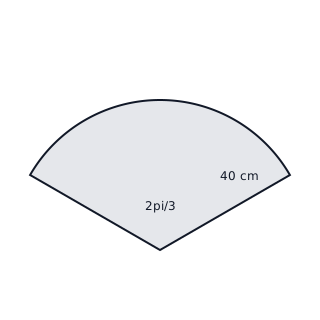
Sector representing a windshield wiper sweep of 120 degrees

Solution:

r=40r = 40 θ=2π3\theta = \frac{2\pi}{3} A=12r2θA = \frac{1}{2}r^2\theta A=12×402×2π3A = \frac{1}{2} \times 40^2 \times \frac{2\pi}{3} A=800×2π3=1600π3A = 800 \times \frac{2\pi}{3} = \frac{1600\pi}{3} A≈1675.5 cm2A \approx 1675.5 \text{ cm}^2

Explanation:

Identify the radius as the length of the wiper and the angle as the sweep. Use the sector area formula A=12r2θA = \frac{1}{2}r^2\theta because the angle is already in radians.

Problem 5:

An arc of a circle with radius r=6 cmr = 6 \text{ cm} has a length of 9 cm9 \text{ cm}. Find the perimeter of the sector and the length of the chord connecting the endpoints of the arc.
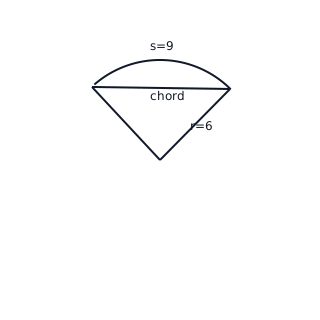
Sector showing the chord connecting the two endpoints of the arc

Solution:

Perimeter=s+2r=9+2(6)=21 cm\text{Perimeter} = s + 2r = 9 + 2(6) = 21 \text{ cm} θ=sr=96=1.5 rad\theta = \frac{s}{r} = \frac{9}{6} = 1.5 \text{ rad} Chord length=2rsin⁡(θ2)\text{Chord length} = 2r\sin\left(\frac{\theta}{2}\right) Chord length=2(6)sin⁡(0.75)\text{Chord length} = 2(6)\sin(0.75) Chord length≈12×0.6816=8.18 cm\text{Chord length} \approx 12 \times 0.6816 = 8.18 \text{ cm}

Explanation:

The perimeter is the sum of the arc length and the two bounding radii. To find the chord length, first determine the central angle θ\theta in radians, then apply the chord formula.

Radian measure (HL) Grade 11 Notes & Examples | IB AI Maths