
Review the key concepts, formulae, and examples before starting your quiz.
🔑Concepts
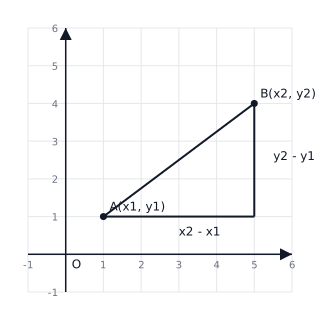
The distance between two points and is the length of the hypotenuse of a right-angled triangle formed by the horizontal and vertical differences.
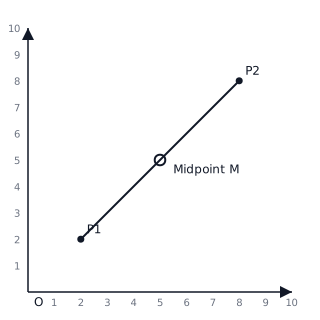
The midpoint of a line segment is the average of the -coordinates and the average of the -coordinates of the endpoints.
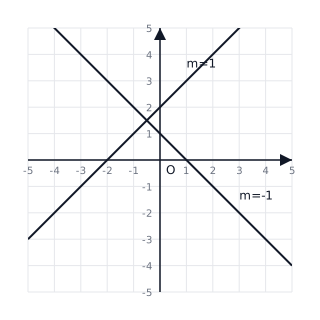
Parallel lines have identical gradients (), while perpendicular lines have gradients that are negative reciprocals ().
In 3D coordinate geometry, points are defined by . Formulas for distance and midpoint extend logically to include the component.
📐Formulae
💡Examples
Problem 1:
Find the equation of the perpendicular bisector of the line segment joining and .
Solution:
- Find the midpoint of : 2. Find the gradient of : 3. Find the perpendicular gradient: 4. Use the point-gradient formula with :
Explanation:
A perpendicular bisector must pass through the midpoint of the segment and have a gradient that is the negative reciprocal of the original line's gradient.
Problem 2:
Calculate the distance between the points and in 3D space.
Solution:
Using the 3D distance formula:
Explanation:
The distance is found by applying the Pythagorean theorem to the differences in , , and coordinates. Since the -coordinates are the same, the distance is effectively calculated in the -plane.
Problem 3:
A Voronoi diagram has two sites at and . Determine the equation of the edge that separates these two sites.
Solution:
The edge between two sites in a Voronoi diagram is the perpendicular bisector of the segment connecting them.
- Midpoint of :
- Gradient of :
- Since the line is horizontal (), the perpendicular bisector must be a vertical line passing through the -coordinate of the midpoint. Equation:
Explanation:
In a Voronoi diagram, the boundary between two sites is equidistant from both. For sites and , the vertical line splits the plane such that any point on the left is closer to and any point on the right is closer to .
Problem 4:
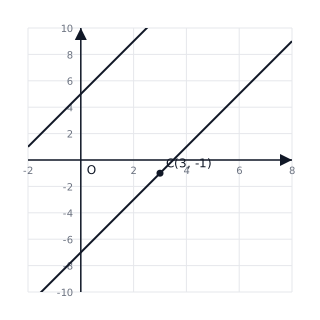
Find the equation of the line passing through point that is parallel to the line .
Solution:
- Identify the gradient of the given line: .
- Since the lines are parallel, the gradient of the new line is also .
- Use the point-gradient form with :
Explanation:
Parallel lines must have the same slope to ensure they never meet. We use the given point and this slope to find the unique intercept.
Problem 5:
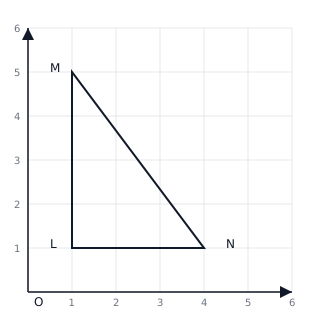
A triangle has vertices at , , and . Calculate the perimeter of triangle .
Solution:
Explanation:
Since all points have the same -coordinate (), this triangle lies on a horizontal plane. We calculate the lengths of , , and using the 3D distance formula and sum them.