krit.club logo

Trigonometric Functions - Trigonometric Functions of Sum and Difference of Two Angles

Grade 11CBSE

Review the key concepts, formulae, and examples before starting your quiz.

πŸ”‘Concepts

β€’

The addition and subtraction formulas for sine and cosine are derived using a unit circle. For any two angles AA and BB, the position of points on the circle's circumference relates to their sum or difference.
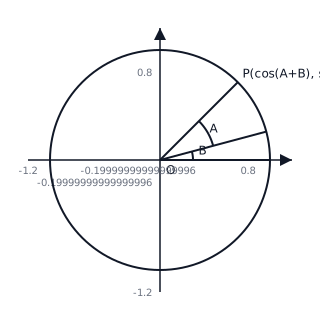
Unit circle showing angles A and B to represent the sum of angles.
β€’

The tan⁑(A+B)\tan(A + B) formula is particularly useful for finding the slope of a line that is the resultant of two other slopes, or for calculating angles between lines in a coordinate plane.

β€’

When A=BA = B, these sum formulas simplify into double angle formulas, which are the foundation for higher-order trigonometric identities.

β€’

The sign of the terms in the expansion depends on the quadrant of the angles, following the 'All Silver Tea Cups' (ASTC) rule.

πŸ“Formulae

sin⁑(A+B)=sin⁑Acos⁑B+cos⁑Asin⁑B\sin(A + B) = \sin A \cos B + \cos A \sin B

sin⁑(Aβˆ’B)=sin⁑Acos⁑Bβˆ’cos⁑Asin⁑B\sin(A - B) = \sin A \cos B - \cos A \sin B

cos⁑(A+B)=cos⁑Acos⁑Bβˆ’sin⁑Asin⁑B\cos(A + B) = \cos A \cos B - \sin A \sin B

cos⁑(Aβˆ’B)=cos⁑Acos⁑B+sin⁑Asin⁑B\cos(A - B) = \cos A \cos B + \sin A \sin B

tan⁑(A+B)=tan⁑A+tan⁑B1βˆ’tan⁑Atan⁑B\tan(A + B) = \frac{\tan A + \tan B}{1 - \tan A \tan B}

tan⁑(Aβˆ’B)=tan⁑Aβˆ’tan⁑B1+tan⁑Atan⁑B\tan(A - B) = \frac{\tan A - \tan B}{1 + \tan A \tan B}

cot⁑(A+B)=cot⁑Acot⁑Bβˆ’1cot⁑B+cot⁑A\cot(A + B) = \frac{\cot A \cot B - 1}{\cot B + \cot A}

cot⁑(Aβˆ’B)=cot⁑Acot⁑B+1cot⁑Bβˆ’cot⁑A\cot(A - B) = \frac{\cot A \cot B + 1}{\cot B - \cot A}

πŸ’‘Examples

Problem 1:

Find the exact value of sin⁑15∘\sin 15^\circ.

Solution:

Step 1: Express 15∘15^\circ as a difference of two standard angles: 15∘=45βˆ˜βˆ’30∘15^\circ = 45^\circ - 30^\circ. \nStep 2: Use the formula sin⁑(Aβˆ’B)=sin⁑Acos⁑Bβˆ’cos⁑Asin⁑B\sin(A - B) = \sin A \cos B - \cos A \sin B. \nStep 3: Substitute A=45∘A = 45^\circ and B=30∘B = 30^\circ: sin⁑(45βˆ˜βˆ’30∘)=sin⁑45∘cos⁑30βˆ˜βˆ’cos⁑45∘sin⁑30∘\sin(45^\circ - 30^\circ) = \sin 45^\circ \cos 30^\circ - \cos 45^\circ \sin 30^\circ \nStep 4: Plug in the standard values: sin⁑15∘=(12)(32)βˆ’(12)(12)\sin 15^\circ = \left(\frac{1}{\sqrt{2}}\right) \left(\frac{\sqrt{3}}{2}\right) - \left(\frac{1}{\sqrt{2}}\right) \left(\frac{1}{2}\right) \nStep 5: Simplify the expression: sin⁑15∘=322βˆ’122=3βˆ’122\sin 15^\circ = \frac{\sqrt{3}}{2\sqrt{2}} - \frac{1}{2\sqrt{2}} = \frac{\sqrt{3} - 1}{2\sqrt{2}}

Explanation:

This approach decomposes a non-standard angle into standard angles whose trigonometric values are known from the unit circle, then applies the sine difference identity.

Problem 2:

Prove that cos⁑11∘+sin⁑11∘cos⁑11βˆ˜βˆ’sin⁑11∘=tan⁑56∘\frac{\cos 11^\circ + \sin 11^\circ}{\cos 11^\circ - \sin 11^\circ} = \tan 56^\circ.

Solution:

Step 1: Take the Left Hand Side (LHS) and divide both numerator and denominator by cos⁑11∘\cos 11^\circ: LHS=cos⁑11∘cos⁑11∘+sin⁑11∘cos⁑11∘cos⁑11∘cos⁑11βˆ˜βˆ’sin⁑11∘cos⁑11∘\text{LHS} = \frac{\frac{\cos 11^\circ}{\cos 11^\circ} + \frac{\sin 11^\circ}{\cos 11^\circ}}{\frac{\cos 11^\circ}{\cos 11^\circ} - \frac{\sin 11^\circ}{\cos 11^\circ}} \nStep 2: Simplify using tan⁑θ=sin⁑θcos⁑θ\tan \theta = \frac{\sin \theta}{\cos \theta}: LHS=1+tan⁑11∘1βˆ’tan⁑11∘\text{LHS} = \frac{1 + \tan 11^\circ}{1 - \tan 11^\circ} \nStep 3: Recognize that 1=tan⁑45∘1 = \tan 45^\circ. Substitute this into the expression: LHS=tan⁑45∘+tan⁑11∘1βˆ’(tan⁑45∘)(tan⁑11∘)\text{LHS} = \frac{\tan 45^\circ + \tan 11^\circ}{1 - (\tan 45^\circ)(\tan 11^\circ)} \nStep 4: Observe that this matches the form tan⁑A+tan⁑B1βˆ’tan⁑Atan⁑B=tan⁑(A+B)\frac{\tan A + \tan B}{1 - \tan A \tan B} = \tan(A + B). \nStep 5: Therefore, LHS=tan⁑(45∘+11∘)=tan⁑56∘\text{LHS} = \tan(45^\circ + 11^\circ) = \tan 56^\circ. \nStep 6: LHS = RHS. Proved.

Explanation:

This example uses the tangent sum formula in reverse. By dividing by cos⁑A\cos A, we transform a sine-cosine fraction into a tangent expression, which is a common technique in trigonometric proofs.

Problem 3:

Evaluate cos⁑75∘\cos 75^\circ using the sum of two known angles.

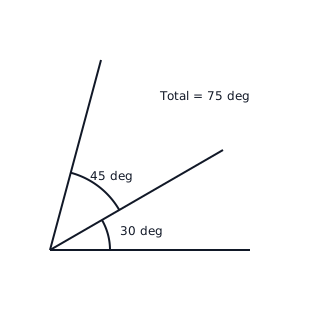
Geometry diagram showing an angle of 75 degrees split into 30 and 45 degrees.

Solution:

We can write 75∘75^\circ as 45∘+30∘45^\circ + 30^\circ. Using the formula: cos⁑(A+B)=cos⁑Acos⁑Bβˆ’sin⁑Asin⁑B\cos(A + B) = \cos A \cos B - \sin A \sin B Substitute A=45∘A = 45^\circ and B=30∘B = 30^\circ: cos⁑(45∘+30∘)=cos⁑45∘cos⁑30βˆ˜βˆ’sin⁑45∘sin⁑30∘\cos(45^\circ + 30^\circ) = \cos 45^\circ \cos 30^\circ - \sin 45^\circ \sin 30^\circ Substitute the standard values: cos⁑75∘=(12)(32)βˆ’(12)(12)\cos 75^\circ = \left(\frac{1}{\sqrt{2}}\right) \left(\frac{\sqrt{3}}{2}\right) - \left(\frac{1}{\sqrt{2}}\right) \left(\frac{1}{2}\right) cos⁑75∘=3βˆ’122\cos 75^\circ = \frac{\sqrt{3} - 1}{2\sqrt{2}} To rationalize the denominator: cos⁑75∘=6βˆ’24\cos 75^\circ = \frac{\sqrt{6} - \sqrt{2}}{4}

Explanation:

This example demonstrates how to decompose a non-standard angle into the sum of two standard angles (30∘30^\circ, 45∘45^\circ) to apply the cosine addition formula.

Problem 4:

Calculate the value of tan⁑105∘\tan 105^\circ.

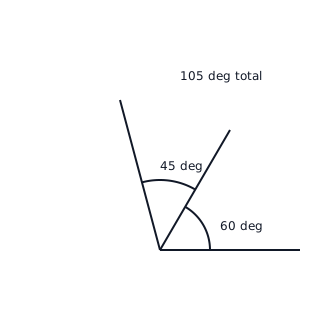
Diagram showing the angle 105 degrees as a combination of 60 degrees and 45 degrees.

Solution:

We can express 105∘105^\circ as 60∘+45∘60^\circ + 45^\circ. Using the formula: tan⁑(A+B)=tan⁑A+tan⁑B1βˆ’tan⁑Atan⁑B\tan(A + B) = \frac{\tan A + \tan B}{1 - \tan A \tan B} Substitute A=60∘A = 60^\circ and B=45∘B = 45^\circ: tan⁑(60∘+45∘)=tan⁑60∘+tan⁑45∘1βˆ’tan⁑60∘tan⁑45∘\tan(60^\circ + 45^\circ) = \frac{\tan 60^\circ + \tan 45^\circ}{1 - \tan 60^\circ \tan 45^\circ} Since tan⁑60∘=3\tan 60^\circ = \sqrt{3} and tan⁑45∘=1\tan 45^\circ = 1: tan⁑105∘=3+11βˆ’3(1)\tan 105^\circ = \frac{\sqrt{3} + 1}{1 - \sqrt{3}(1)} tan⁑105∘=3+11βˆ’3\tan 105^\circ = \frac{\sqrt{3} + 1}{1 - \sqrt{3}} Multiplying numerator and denominator by (1+3)(1 + \sqrt{3}): tan⁑105∘=(3+1)21βˆ’3=3+1+23βˆ’2\tan 105^\circ = \frac{(\sqrt{3} + 1)^2}{1 - 3} = \frac{3 + 1 + 2\sqrt{3}}{-2} tan⁑105∘=4+23βˆ’2=βˆ’(2+3)\tan 105^\circ = \frac{4 + 2\sqrt{3}}{-2} = -(2 + \sqrt{3})

Explanation:

By breaking 105∘105^\circ into two special angles, we can use the tangent sum identity and rationalize the resulting radical expression.

Trigonometric Functions of Sum and Difference of Two Angles Class 11 Notes & Examples