
Review the key concepts, formulae, and examples before starting your quiz.
🔑Concepts
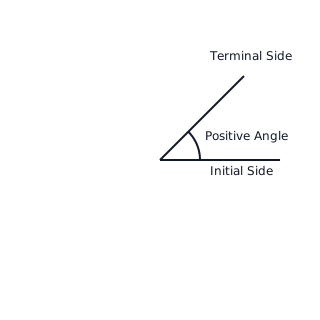
An angle is formed by the rotation of a ray from an initial side to a terminal side. Rotation in the anti-clockwise direction is considered positive, while clockwise rotation is negative.
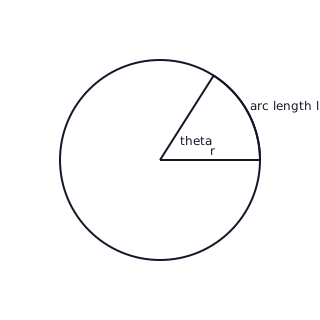
The Radian Measure of an angle is defined by the ratio of the arc length to the radius of the circle, given by . One radian is the angle subtended at the center of a circle by an arc of length equal to the radius.
In the Degree System, a complete revolution is divided into equal parts called degrees (). Further divisions include minutes () and seconds ().
To convert degrees to radians, multiply by . To convert radians to degrees, multiply by . Note that radians corresponds to .
📐Formulae
(1 degree = 60 minutes)
(1 minute = 60 seconds)
where is the angle in radians, is arc length, and is radius
💡Examples
Problem 1:
Convert into radian measure.
Solution:
Step 1: Convert the minutes into degrees. Since , then . Step 2: Add this to the whole degrees: . Step 3: Convert degrees to radians using the formula . Step 4: Calculation: radians.
Explanation:
To convert a degree measure containing minutes or seconds, first convert the entire expression into a decimal or fractional degree before applying the conversion factor .
Problem 2:
Find the radius of a circle in which a central angle of intercepts an arc of length cm (Use ).
Solution:
Step 1: Convert the angle from degrees to radians. radians. Step 2: Use the formula or . Step 3: Substitute the given values: and . . Step 4: Substitute : cm.
Explanation:
When using the arc length formula , the angle must always be in radians. If given in degrees, the conversion step is mandatory before calculation.
Problem 3:
Find the degree measure corresponding to radians (Use ).
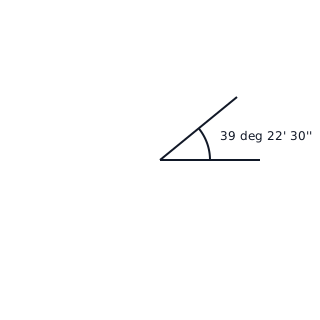
Solution:
Final Answer: .
Explanation:
We use the conversion formula from radians to degrees. After getting the fractional degree, we convert the remainder into minutes and then into seconds by multiplying by 60 at each step.
Problem 4:
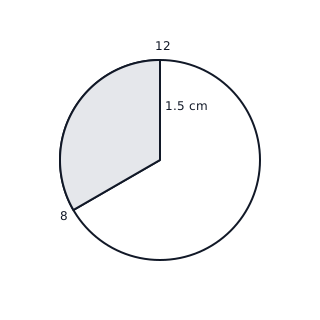
The minute hand of a clock is cm long. How far does its tip move in minutes? (Use )
Solution:
- In minutes, the minute hand completes one full revolution, which is or radians.
- Angle swept in minutes, radians.
- The length of the minute hand is the radius, cm.
- The distance moved by the tip is the arc length .
- Using the formula :
- Substituting :
The tip of the minute hand moves cm.
Explanation:
To find the distance moved by the tip, we treat the movement as an arc on a circle where the minute hand is the radius. We first find the angle covered in radians (since the formula requires radians) and then calculate the arc length.