
Review the key concepts, formulae, and examples before starting your quiz.
🔑Concepts
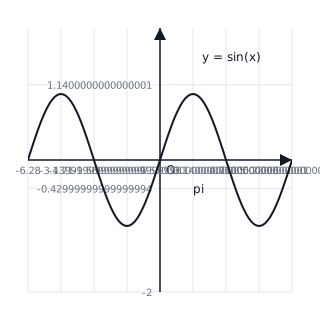
The sine function, , is defined for all real numbers. Geometrically, on a unit circle, it represents the -coordinate of a point. Its values oscillate between and , inclusive. This is visualized by its wave-like periodic graph.
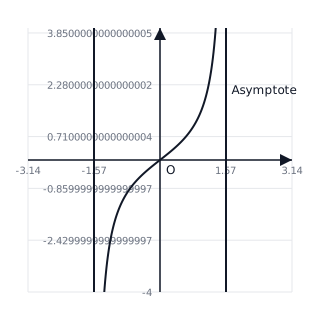
The tangent function, , is undefined where . These points occur at odd multiples of , such as . Consequently, the domain is .
The range of and is determined by the reciprocal relationship with and . Since and , the absolute values of their reciprocals must be greater than or equal to . Thus, Range .
Domain constraints for arise where . This occurs at integral multiples of , specifically . The graph shows that as approaches these values, the function tends toward infinity.
📐Formulae
💡Examples
Problem 1:
Find the range of the function .
Solution:
- We know the fundamental range of is .
- Multiply the inequality by . Note that multiplying by a negative number reverses the inequality: , which simplifies to .
- Add to all parts of the inequality: .
- This yields .
- Therefore, the range is .
Explanation:
The range of a transformed cosine function is determined by scaling the basic range by the amplitude and then shifting it vertically by the constant term.
Problem 2:
Find the domain of the function .
Solution:
- The function is undefined when the denominator is zero: .
- The general solution for is , where .
- Here, .
- Dividing by , we get .
- The domain is the set of all real numbers excluding these values: .
Explanation:
For rational trigonometric functions, we must exclude any values from the domain that cause the denominator to become zero. We solve the trigonometric equation to find those excluded points.
Problem 3:
Find the range of the function .
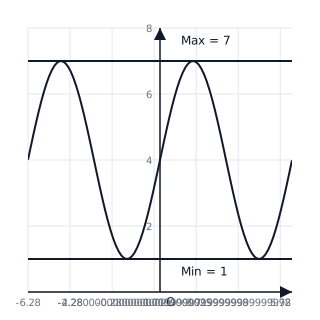
Solution:
- We know the range of is .
- Multiplying by : , so .
- Adding to all parts: .
- This simplifies to .
- Range .
Explanation:
The range is found by applying transformations to the basic sine function. The amplitude increases to , and the entire graph shifts upward by units.
Problem 4:
Determine the domain of the function .
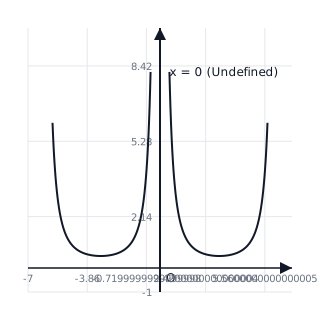
Solution:
- The function is undefined when the denominator is zero: .
- This implies .
- The cosine function equals at .
- In general form, where .
- Therefore, Domain .
Explanation:
The domain excludes points where the denominator vanishes. For , these are the peaks of the cosine wave.