
Review the key concepts, formulae, and examples before starting your quiz.
🔑Concepts
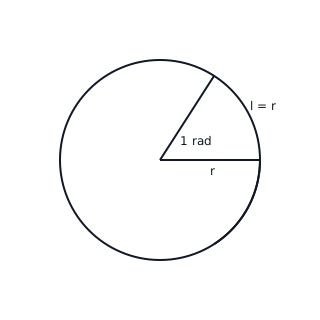
The Radian is the measure of an angle subtended at the center of a circle by an arc whose length is equal to the radius of the circle. This relationship is defined by the formula , where is the angle in radians, is the arc length, and is the radius.
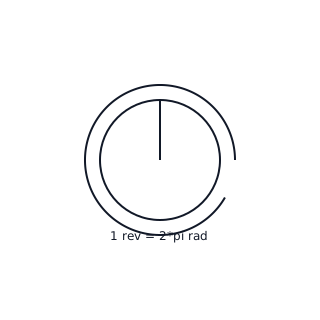
One complete revolution of a circle corresponds to an angle of or radians. Therefore, the conversion identity is .
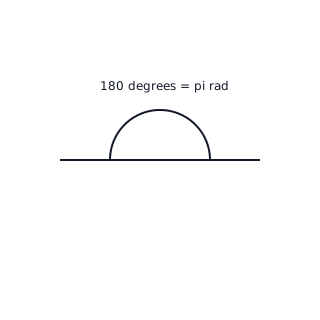
Degrees are further divided into minutes and seconds: (minutes) and (seconds). When converting fractional degrees to radians, it is essential to convert the minutes and seconds into decimal degrees first.
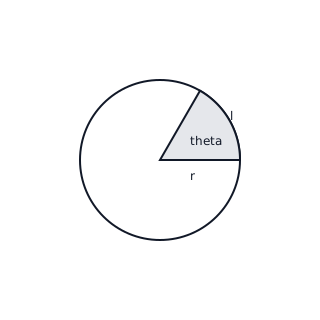
The length of an arc in a circle of radius subtending an angle at the center is given by , provided is measured in radians.
📐Formulae
💡Examples
Problem 1:
Convert into radian measure.
Solution:
. Since radians, then radians.
Explanation:
First, convert the minutes into a fraction of a degree. Then, use the conversion formula by multiplying the total degrees by .
Problem 2:
Find the degree measure of radians (use ).
Solution:
. To convert the fraction: . Then . Final answer: .
Explanation:
Multiply radians by . Convert the fractional part of the degree into minutes by multiplying by , and the fractional part of the minute into seconds by multiplying by again.
Problem 3:
Find the radius of the circle in which a central angle of intercepts an arc of length cm (use ).
Solution:
Given and . Convert to radians: radians. Using :
Explanation:
The formula only works when is in radians. First convert to radians before calculating .
Problem 4:
A wheel makes revolutions in one minute. Through how many radians does it turn in one second?
Solution:
Explanation:
First, find the number of revolutions per second. Since one full revolution equals radians, multiply the number of revolutions by to find the total radian measure.
Problem 5:
Find the degree measure of the angle subtended at the center of a circle of radius cm by an arc of length cm (Use ).
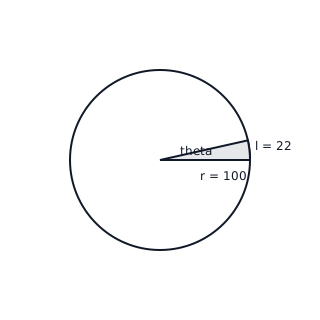
Solution:
Explanation:
Use the formula to find the angle in radians. Then convert the radians to degrees by multiplying with . Finally, convert the decimal part of the degrees into minutes.