
Review the key concepts, formulae, and examples before starting your quiz.
🔑Concepts
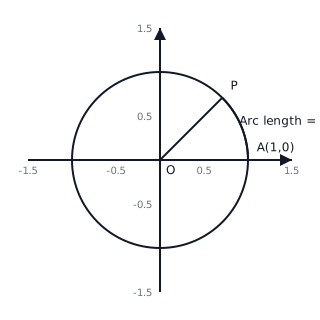
The relationship between real numbers and radian measures is established using a unit circle (radius ) centered at the origin . For any real number , we can associate it with a point on the unit circle such that the length of the arc is exactly units, where is the point . This demonstrates that a real number can be viewed as the radian measure of the angle it subtends at the center.
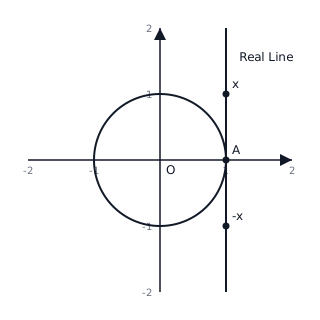
Consider a vertical number line (the real line) tangent to the unit circle at point . If we 'wrap' this number line around the circle, every real number on the line coincides with a unique point on the circle. Positive real numbers wrap in the counter-clockwise direction, while negative real numbers wrap in the clockwise direction.
Due to this wrapping property, the set of real numbers and radian measures are essentially the same. For any real number , the angle subtended at the center of the unit circle has a measure of radians. Therefore, 'radian measure' and 'real number' can be used interchangeably in trigonometric contexts.
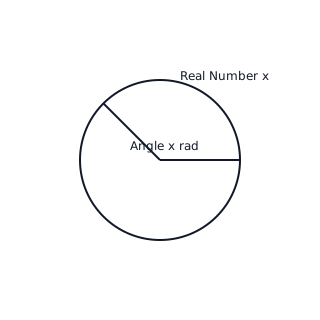
In a unit circle, the circumference is . This means one complete revolution corresponds to the real number (approx ). Consequently, any real number can be reduced to a value within to find its position on the circle by taking .
📐Formulae
💡Examples
Problem 1:
Given a unit circle, if a real number is mapped onto the circle starting from in the counter-clockwise direction, find the radian measure of the angle subtended at the center.
Solution:
In a unit circle, the radius . The real number corresponds to the arc length . Therefore, . Using the formula , we get radians.
Explanation:
Because the radius is 1, the numerical value of the real number on the number line is identical to the radian measure of the angle it subtends at the center.
Problem 2:
If the real number is wrapped around a unit circle, what is the final position on the coordinate plane?
Solution:
The length of the arc is . Since the circumference of a unit circle is , a distance of represents one full revolution. The negative sign indicates a clockwise direction. Starting from and moving clockwise for brings us back to .
Explanation:
The real number corresponds to an angle of radians, which is a complete rotation, returning the point to the starting position on the x-axis.
Problem 3:
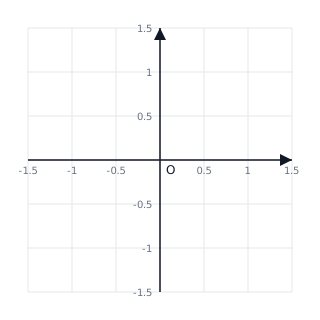
Determine the coordinates of the point on the unit circle corresponding to the real number .
Solution:
- In a unit circle, the real number corresponds to an angle radians.
- Here, radians.
- Convert to degrees: .
- The coordinates of a point on the unit circle are .
- -coordinate = .
- -coordinate = .
- Coordinates are .
Explanation:
Since the radius is 1, the arc length is equivalent to the central angle in radians. We use the standard trigonometric ratios for to find the point on the coordinate plane.
Problem 4:
If a real number is represented on the unit circle, find the length of the chord joining the starting point and the point corresponding to .
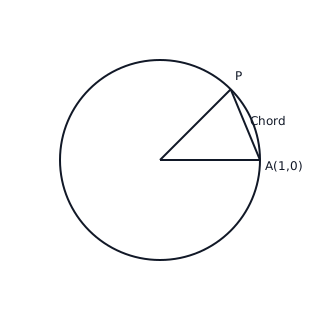
Solution:
- The real number corresponds to an angle of at the center.
- Point is .
- Point is .
- Distance
- .
Explanation:
We first identify the position of the real number on the circle as a coordinate point and then use the distance formula to find the chord length.