krit.club logo

Trigonometric Functions - Trigonometric Functions and Signs

Grade 11CBSE

Review the key concepts, formulae, and examples before starting your quiz.

🔑Concepts

•

The unit circle is defined by the equation x2+y2=1x^2 + y^2 = 1. For any point P(a,b)P(a, b) on the circle making an angle xx with the positive x-axis, we define cos⁡x=a\cos x = a and sin⁡x=b\sin x = b. This allows trigonometric functions to be defined for any real number angle.
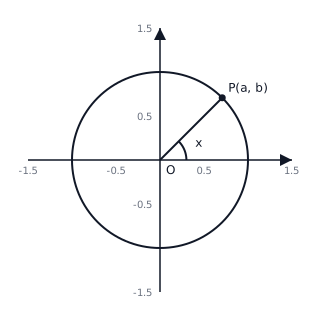
A unit circle showing point P with coordinates (a, b) representing (cos x, sin x).
•

The signs of trigonometric functions depend on the quadrant in which the angle xx terminates. In Quadrant I (All positive), Quadrant II (Sine/Cosecant positive), Quadrant III (Tangent/Cotangent positive), and Quadrant IV (Cosine/Secant positive). This is often remembered by the mnemonic 'All Silver Tea Cups'.
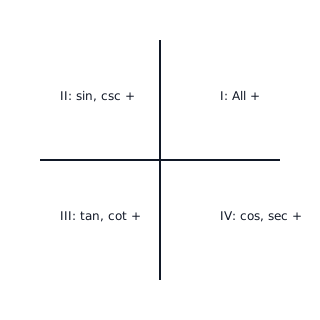
Quadrant chart showing which trigonometric functions are positive in each of the four quadrants.
•

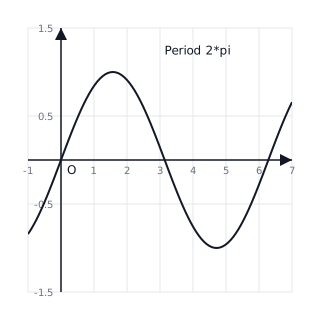
The values of sin⁡x\sin x and cos⁡x\cos x repeat after an interval of 2π2\pi. Therefore, sin⁡(2nπ+x)=sin⁡x\sin(2n\pi + x) = \sin x and cos⁡(2nπ+x)=cos⁡x\cos(2n\pi + x) = \cos x for any integer nn. However, tan⁡x\tan x and cot⁡x\cot x have a period of π\pi.

Graph of sin(x) showing its periodic nature over 2*pi.
•

Domain and Range: For sin⁡x\sin x and cos⁡x\cos x, the domain is the set of all real numbers R\mathbb{R}, and the range is the closed interval [−1,1][-1, 1]. For tan⁡x\tan x, the domain excludes odd multiples of π2\frac{\pi}{2} where the function is undefined (vertical asymptotes).
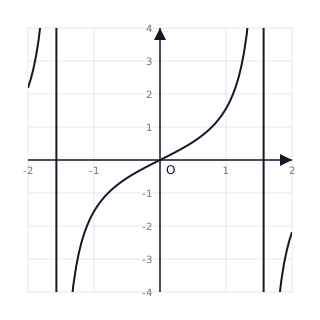
Graph of tan(x) showing vertical asymptotes at pi/2 and -pi/2.

📐Formulae

sin⁡2x+cos⁡2x=1\sin^2 x + \cos^2 x = 1

1+tan⁡2x=sec⁡2x1 + \tan^2 x = \sec^2 x

1+cot⁡2x=csc⁡2x1 + \cot^2 x = \csc^2 x

tan⁡x=sin⁡xcos⁡x,x≠(2n+1)π2\tan x = \frac{\sin x}{\cos x}, x \neq (2n+1)\frac{\pi}{2}

cot⁡x=cos⁡xsin⁡x,x≠nπ\cot x = \frac{\cos x}{\sin x}, x \neq n\pi

sin⁡(2nπ+x)=sin⁡x,n∈Z\sin(2n\pi + x) = \sin x, n \in Z

cos⁡(2nπ+x)=cos⁡x,n∈Z\cos(2n\pi + x) = \cos x, n \in Z

sin⁡x=0  ⟹  x=nπ,n∈Z\sin x = 0 \implies x = n\pi, n \in Z

cos⁡x=0  ⟹  x=(2n+1)π2,n∈Z\cos x = 0 \implies x = (2n+1)\frac{\pi}{2}, n \in Z

💡Examples

Problem 1:

If cos⁡x=−35\cos x = -\frac{3}{5} and xx lies in the third quadrant, find the values of the other five trigonometric functions.

Solution:

  1. Use the identity sin⁡2x+cos⁡2x=1\sin^2 x + \cos^2 x = 1: sin⁡2x=1−(−35)2=1−925=1625\sin^2 x = 1 - (-\frac{3}{5})^2 = 1 - \frac{9}{25} = \frac{16}{25}.
  2. In the third quadrant, sin⁡x\sin x is negative. Therefore, sin⁡x=−1625=−45\sin x = -\sqrt{\frac{16}{25}} = -\frac{4}{5}.
  3. Calculate tan⁡x=sin⁡xcos⁡x=−4/5−3/5=43\tan x = \frac{\sin x}{\cos x} = \frac{-4/5}{-3/5} = \frac{4}{3}.
  4. Calculate cot⁡x=1tan⁡x=34\cot x = \frac{1}{\tan x} = \frac{3}{4}.
  5. Calculate sec⁡x=1cos⁡x=−53\sec x = \frac{1}{\cos x} = -\frac{5}{3}.
  6. Calculate csc⁡x=1sin⁡x=−54\csc x = \frac{1}{\sin x} = -\frac{5}{4}.

Explanation:

The solution involves finding sin⁡x\sin x using the Pythagorean identity and then determining the correct sign based on the quadrant (Quadrant III: tan⁡\tan and cot⁡\cot are positive; others are negative). Once sin⁡\sin and cos⁡\cos are known, the reciprocal and quotient identities are used for the rest.

Problem 2:

Find the value of sin⁡31π3\sin \frac{31\pi}{3}.

Solution:

  1. Express the angle in terms of multiples of 2π2\pi: 31π3=(10π+π3)\frac{31\pi}{3} = (10\pi + \frac{\pi}{3}).
  2. Note that 10π10\pi is 5×2π5 \times 2\pi. Since the period of sin⁡\sin is 2π2\pi, sin⁡(2nπ+θ)=sin⁡θ\sin(2n\pi + \theta) = \sin \theta.
  3. Therefore, sin⁡(10π+π3)=sin⁡π3\sin(10\pi + \frac{\pi}{3}) = \sin \frac{\pi}{3}.
  4. The value of sin⁡π3\sin \frac{\pi}{3} is 32\frac{\sqrt{3}}{2}.

Explanation:

This approach uses the periodicity of trigonometric functions. By breaking down a large angle into a multiple of 2π2\pi plus a remainder, we can reduce the problem to finding the value of a standard acute angle.

Problem 3:

If sin⁡x=1213\sin x = \frac{12}{13} and xx lies in the second quadrant, find the value of sec⁡x+tan⁡x\sec x + \tan x.

Reference triangle in the second quadrant with side lengths -5, 12, and 13

Solution:

  1. Since xx is in the second quadrant, cos⁡x\cos x and tan⁡x\tan x will be negative.
  2. We know cos⁡2x=1−sin⁡2x=1−(1213)2=1−144169=25169\cos^2 x = 1 - \sin^2 x = 1 - (\frac{12}{13})^2 = 1 - \frac{144}{169} = \frac{25}{169}.
  3. Since xx is in QII, cos⁡x=−25169=−513\cos x = -\sqrt{\frac{25}{169}} = -\frac{5}{13}.
  4. Then sec⁡x=1cos⁡x=−135\sec x = \frac{1}{\cos x} = -\frac{13}{5}.
  5. tan⁡x=sin⁡xcos⁡x=12/13−5/13=−125\tan x = \frac{\sin x}{\cos x} = \frac{12/13}{-5/13} = -\frac{12}{5}.
  6. Therefore, sec⁡x+tan⁡x=−135−125=−255=−5\sec x + \tan x = -\frac{13}{5} - \frac{12}{5} = -\frac{25}{5} = -5.

Explanation:

In Quadrant II, only sine is positive. We use the identity sin⁡2x+cos⁡2x=1\sin^2 x + \cos^2 x = 1 and choose the negative root for cosine.

Problem 4:

Find the value of tan⁡(−15π4)\tan \left(-\frac{15\pi}{4}\right).

Unit circle showing pi/4 angle which is coterminal to -15pi/4

Solution:

  1. tan⁡(−θ)=−tan⁡θ\tan(-\theta) = -\tan \theta. So, tan⁡(−15π4)=−tan⁡(15π4)\tan(-\frac{15\pi}{4}) = -\tan(\frac{15\pi}{4}).
  2. Divide 15π/415\pi/4 by 2π2\pi to find the number of full rotations: 15π4=4π−π4\frac{15\pi}{4} = 4\pi - \frac{\pi}{4}.
  3. Since tan⁡(x)\tan(x) has a period of π\pi, tan⁡(4π−π4)=tan⁡(−π4)\tan(4\pi - \frac{\pi}{4}) = \tan(-\frac{\pi}{4}).
  4. tan⁡(−π4)=−tan⁡(π4)=−1\tan(-\frac{\pi}{4}) = -\tan(\frac{\pi}{4}) = -1.
  5. Therefore, the original value is −(−1)=1-(-1) = 1.

Explanation:

We use the periodicity of the tangent function and the property of negative angles to simplify the expression to a known value.