krit.club logo

Trigonometric Functions - Trigonometric Equations

Grade 11CBSE

Review the key concepts, formulae, and examples before starting your quiz.

🔑Concepts

•

Trigonometric equations involve unknown angles represented as trigonometric functions. The values of xx in the interval [0,2π)[0, 2\pi) that satisfy the equation are called Principal Solutions.
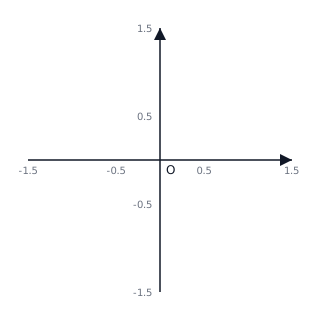
Unit circle showing four quadrants for identifying principal solutions.
•

The General Solution of a trigonometric equation is an expression involving an integer nn (where n∈Zn \in \mathbb{Z}) that represents all possible solutions due to the periodicity of trigonometric functions.
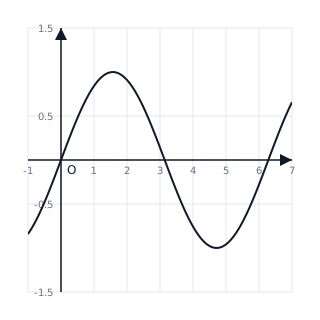
Sine wave showing periodic intersection points with a horizontal line y = k.
•

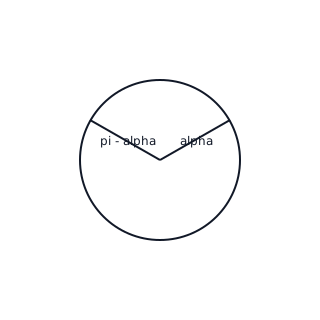
Equations of the form sin⁡x=sin⁡α\sin x = \sin \alpha yield solutions x=nπ+(−1)nαx = n\pi + (-1)^n \alpha. This accounts for the symmetry of the sine function across the yy-axis in the unit circle.

Symmetry of sine values in the first and second quadrants.
•

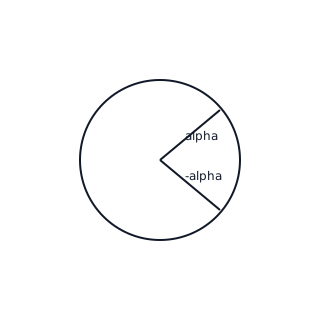
For cos⁡x=cos⁡α\cos x = \cos \alpha, the general solution is x=2nπ±αx = 2n\pi \pm \alpha, reflecting the cosine function's symmetry about the xx-axis (even function property).

Symmetry of cosine values in the first and fourth quadrants.

📐Formulae

sin⁡x=0  ⟹  x=nπ, where n∈Z\sin x = 0 \implies x = n\pi, \text{ where } n \in \mathbb{Z}

cos⁡x=0  ⟹  x=(2n+1)π2, where n∈Z\cos x = 0 \implies x = (2n + 1)\frac{\pi}{2}, \text{ where } n \in \mathbb{Z}

tan⁡x=0  ⟹  x=nπ, where n∈Z\tan x = 0 \implies x = n\pi, \text{ where } n \in \mathbb{Z}

sin⁡x=sin⁡α  ⟹  x=nπ+(−1)nα, where n∈Z\sin x = \sin \alpha \implies x = n\pi + (-1)^n \alpha, \text{ where } n \in \mathbb{Z}

cos⁡x=cos⁡α  ⟹  x=2nπ±α, where n∈Z\cos x = \cos \alpha \implies x = 2n\pi \pm \alpha, \text{ where } n \in \mathbb{Z}

tan⁡x=tan⁡α  ⟹  x=nπ+α, where n∈Z\tan x = \tan \alpha \implies x = n\pi + \alpha, \text{ where } n \in \mathbb{Z}

💡Examples

Problem 1:

Find the principal and general solutions of the equation sin⁡x=32\sin x = \frac{\sqrt{3}}{2}.

Solution:

Step 1: We know that sin⁡π3=32\sin \frac{\pi}{3} = \frac{\sqrt{3}}{2}. Since 32\frac{\sqrt{3}}{2} is positive, sin⁡x\sin x is positive in the I and II quadrants. Step 2: In Quadrant I, x=π3x = \frac{\pi}{3}. Step 3: In Quadrant II, x=π−π3=2π3x = \pi - \frac{\pi}{3} = \frac{2\pi}{3}. Step 4: Therefore, the principal solutions are x=π3x = \frac{\pi}{3} and x=2π3x = \frac{2\pi}{3}. Step 5: For the general solution, use the formula x=nπ+(−1)nαx = n\pi + (-1)^n \alpha with α=π3\alpha = \frac{\pi}{3}. Result: x=nπ+(−1)nπ3,n∈Zx = n\pi + (-1)^n \frac{\pi}{3}, n \in \mathbb{Z}.

Explanation:

Identify the base angle α\alpha in the first quadrant, then use the quadrant rules to find principal solutions within [0,2π)[0, 2\pi), and finally apply the general formula for sine.

Problem 2:

Solve cos⁡2x=cos⁡x\cos 2x = \cos x.

Solution:

Step 1: Use the general solution formula for cos⁡θ=cos⁡α\cos \theta = \cos \alpha, which is θ=2nπ±α\theta = 2n\pi \pm \alpha. Step 2: Here, θ=2x\theta = 2x and α=x\alpha = x. So, 2x=2nπ±x2x = 2n\pi \pm x. Step 3: Case 1: 2x=2nπ+x  ⟹  x=2nπ2x = 2n\pi + x \implies x = 2n\pi. Step 4: Case 2: 2x=2nπ−x  ⟹  3x=2nπ  ⟹  x=2nπ32x = 2n\pi - x \implies 3x = 2n\pi \implies x = \frac{2n\pi}{3}. Step 5: Combining these, the general solution is x=2nπx = 2n\pi or x=2nπ3,n∈Zx = \frac{2n\pi}{3}, n \in \mathbb{Z}.

Explanation:

Instead of converting to a quadratic, applying the general solution formula directly is more efficient. We split the equation into two cases based on the plus-minus sign.

Problem 3:

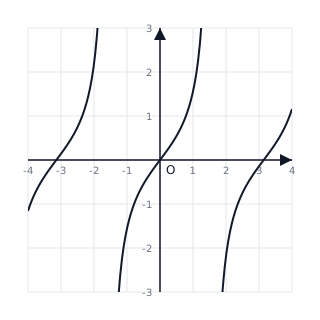
Find the general solution of the equation tan⁡3x=−3\tan 3x = -\sqrt{3}.

Graph of tan(x) intersecting with y = -sqrt(3).

Solution:

  1. We know that tan⁡π3=3\tan \frac{\pi}{3} = \sqrt{3}.
  2. Since tan⁡x\tan x is negative in the 2nd quadrant, we find the principal value: tan⁡3x=−tan⁡π3=tan⁡(π−π3)=tan⁡2π3\tan 3x = -\tan \frac{\pi}{3} = \tan\left(\pi - \frac{\pi}{3}\right) = \tan \frac{2\pi}{3}
  3. The general solution for tan⁡θ=tan⁡α\tan \theta = \tan \alpha is θ=nπ+α\theta = n\pi + \alpha.
  4. Here, 3x=nπ+2π33x = n\pi + \frac{2\pi}{3}.
  5. Dividing by 3, we get x=nπ3+2π9x = \frac{n\pi}{3} + \frac{2\pi}{9}, where n∈Zn \in \mathbb{Z}.

Explanation:

To solve tan⁡θ=k\tan \theta = k, find the smallest positive angle α\alpha for which tan⁡α=k\tan \alpha = k. Use the formula x=nπ+αx = n\pi + \alpha. Since the tangent function repeats every π\pi radians, the solution involves nπn\pi.

Problem 4:

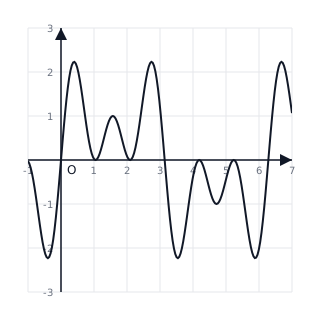
Find the general solution for the equation sin⁡x+sin⁡3x+sin⁡5x=0\sin x + \sin 3x + \sin 5x = 0.

Graph of sin(x) + sin(3x) + sin(5x) showing multiple roots on the x-axis.

Solution:

  1. Rearrange the terms: (sin⁡5x+sin⁡x)+sin⁡3x=0(\sin 5x + \sin x) + \sin 3x = 0.
  2. Apply the sum-to-product formula sin⁡A+sin⁡B=2sin⁡A+B2cos⁡A−B2\sin A + \sin B = 2 \sin \frac{A+B}{2} \cos \frac{A-B}{2}: 2sin⁡3xcos⁡2x+sin⁡3x=02 \sin 3x \cos 2x + \sin 3x = 0
  3. Factor out sin⁡3x\sin 3x: sin⁡3x(2cos⁡2x+1)=0\sin 3x (2 \cos 2x + 1) = 0
  4. Case 1: sin⁡3x=0  ⟹  3x=nπ  ⟹  x=nπ3\sin 3x = 0 \implies 3x = n\pi \implies x = \frac{n\pi}{3}.
  5. Case 2: 2cos⁡2x+1=0  ⟹  cos⁡2x=−122 \cos 2x + 1 = 0 \implies \cos 2x = -\frac{1}{2}.
  6. Since cos⁡2π3=−12\cos \frac{2\pi}{3} = -\frac{1}{2}, we have 2x=2nπ±2π32x = 2n\pi \pm \frac{2\pi}{3}.
  7. Dividing by 2, x=nπ±π3x = n\pi \pm \frac{\pi}{3}.
  8. Final General Solution: x=nπ3x = \frac{n\pi}{3} or x=nπ±π3x = n\pi \pm \frac{\pi}{3}, n∈Zn \in \mathbb{Z}.

Explanation:

Using transformation formulae (sum-to-product) allows factoring the equation. Each factor set to zero provides a branch of the general solution.