
Review the key concepts, formulae, and examples before starting your quiz.
🔑Concepts
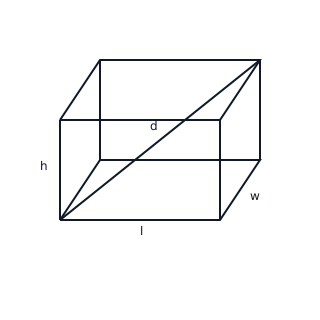
3D Pythagoras' Theorem: To find the distance between opposite corners of a cuboid (the space diagonal), we extend the 2D theorem to three dimensions: . This is equivalent to finding the diagonal of the base first, then using that as a side in a second right-angled triangle with the height.
The Angle between a Line and a Plane: To find the angle between a line (like a sloped edge) and a plane (like a base), project the line onto the plane. The angle is formed between the original line and its projection on the plane. This always creates a right-angled triangle where the height is the perpendicular distance from the top point to the plane.
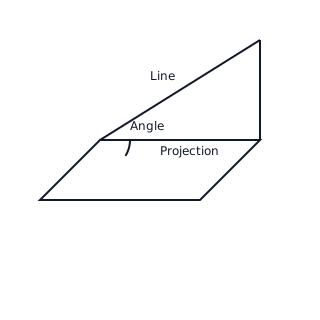
Standard Right-Angled Trigonometry in 3D: Once a 3D problem is broken down into 2D right-angled triangles, use SOH CAH TOA: , , and . Identifying the correct right angle is the most critical step.
Angle between two Planes: This is the angle between two lines, one in each plane, that meet at right angles to the line of intersection of the two planes.
📐Formulae
(Pythagoras' Theorem in 3D)
💡Examples
Problem 1:
A cuboid has dimensions cm, cm, and height cm. Calculate the length of the space diagonal .
Solution:
cm.
Explanation:
To find the diagonal of a cuboid, apply the 3D version of Pythagoras' Theorem using the length, width, and height.
Problem 2:
A square-based pyramid has a base side of 10 cm and a vertical height of 12 cm. Find the angle between a sloped edge and the base.
Solution:
- Find half the diagonal of the base: Diagonal . Half diagonal cm.
- In the right-angled triangle formed by the height () and : .
- .
Explanation:
The angle between an edge and the base is found by creating a right-angled triangle using the vertical height of the pyramid and the distance from the center of the base to a corner.
Problem 3:
In a cuboid where cm, cm, and height cm, find the angle the diagonal makes with the base . (Assume is above ).
Solution:
- Find the length of the base diagonal cm.
- The height cm.
- In : .
- .
Explanation:
The angle between a line (BH) and a plane (the base) is the angle between the line and its projection on that plane (BD).
Problem 4:
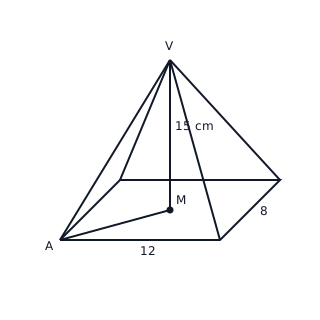
A right pyramid has a rectangular base with cm and cm. The vertex is directly above the center of the base. The vertical height is 15 cm. Calculate the angle between the edge and the base .
Solution:
- Find the distance . is the diagonal of the base: cm.
- is the midpoint of , so cm.
- In right-angled triangle , is the required angle.
- .
- .
Explanation:
To find the angle between a sloped edge and the base, we use the right-angled triangle formed by the edge (hypotenuse), the vertical height, and the distance from the vertex's projection to the corner.
Problem 5:
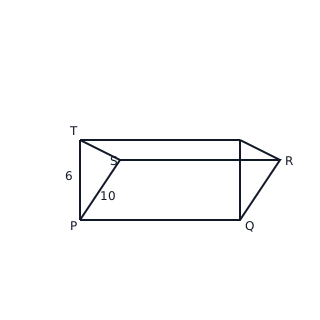
A wedge-shaped block has a horizontal rectangular base where cm and cm. The vertical face is a rectangle with height cm. Calculate the angle between the plane and the base .
Solution:
- The angle between the planes is the angle between two lines perpendicular to the intersection . The line is in the base and . The line is in the sloped plane and (as is a rectangle and is vertical).
- The required angle is in the right-angled triangle .
- cm (Opposite) and cm (Adjacent).
- .
- .
Explanation:
To find the angle between two planes, identify the line of intersection () and find two lines meeting it at right angles ( and ).