
Review the key concepts, formulae, and examples before starting your quiz.
🔑Concepts
Bearings are measured from the North line, clockwise, and must always be written with three digits (e.g., instead of ).
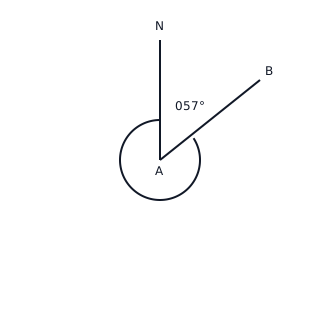
The bearing from to and the bearing from to (Back Bearing) are related by . Since North lines are parallel, interior angles sum to .
To solve complex bearing problems involving non-right-angled triangles, the Sine Rule and Cosine Rule are essential.
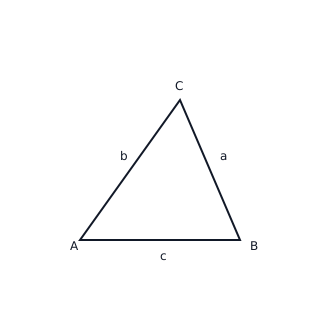
Always draw a fresh North line at every point where a direction change occurs to accurately identify angles.
📐Formulae
💡Examples
Problem 1:
A ship sails 12 km East and then 9 km North. Calculate the bearing of the ship from its starting point.
Solution:
- Represent movement as a right-angled triangle. (East), (North).
- Calculate the internal angle from the North line: .
- .
- Since the movement is North then East, the angle is measured clockwise from North. Bearing = .
Explanation:
We use the tangent ratio because we have the opposite (Eastward distance) and adjacent (Northward distance) sides relative to the North line at the starting point.
Problem 2:
Point B is on a bearing of from Point A. Find the bearing of Point A from Point B.
Solution:
- Given bearing .
- Since , add .
- .
Explanation:
To find a back bearing (the direction to return to the start), add if the original bearing is less than , or subtract if it is greater.
Problem 3:
A plane flies from airport P for 200 km on a bearing of to point Q. It then changes course and flies 150 km on a bearing of to point R. Find the distance PR.
Solution:
- Draw a sketch. Angle is needed.
- North line at Q: Interior angle with P is .
- Angle around Q: .
- Using Pythagoras (): km.
Explanation:
By using the properties of parallel North lines, we determined the internal angle between the two paths was , allowing us to use the Pythagorean theorem to find the direct distance.
Problem 4:
Town is km from Town on a bearing of . Calculate how far South Town is from Town .
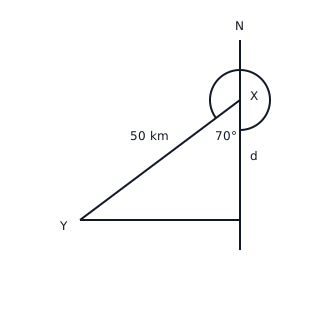
Solution:
- Draw the North line at . The bearing is in the 3rd quadrant.
- The angle measured clockwise from North is .
- The angle inside the right-angled triangle between the West line and the path is is not ideal; instead, use the angle from the South line: .
- Let the southward distance be . In the triangle:
Explanation:
We use the definition of bearings to create a right-angled triangle. By finding the angle relative to the South line (), we use the cosine ratio to find the vertical (South) component.
Problem 5:
A hiker walks km on a bearing of from to , and then km on a bearing of from to . Find the distance .
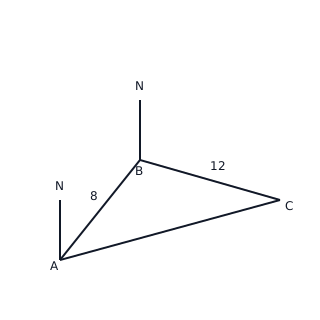
Solution:
- At point , draw a North line. The interior angle between the North line at and the segment is (using parallel lines/consecutive interior angles).
- The angle is the difference between the full rotation () and the sum of the back-bearing angle and the new bearing: Angle . Alternatively, using North lines: The angle between South and is (not useful) or simply realize the angle inside the triangle at is .
- Use the Cosine Rule:
Explanation:
To find the distance between two points after a turn, we determine the interior angle of the triangle formed by the paths. Here, we calculate using parallel North lines and then apply the Cosine Rule.