
Review the key concepts, formulae, and examples before starting your quiz.
🔑Concepts
Pythagoras' Theorem only applies to right-angled triangles, which are triangles containing one angle. The longest side, located directly opposite the right angle, is called the hypotenuse (). The two shorter sides ( and ) meet at the right angle.
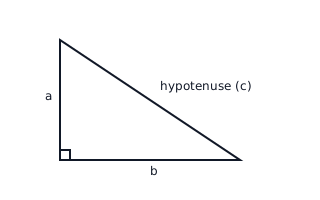
The theorem states that in any right-angled triangle, the area of the square on the hypotenuse is equal to the sum of the areas of the squares on the other two sides: .
To find the hypotenuse , you must add the squares of the other two sides and then take the square root: .
To find a shorter side (e.g., ), you must subtract the square of the known shorter side from the square of the hypotenuse and then take the square root: .
The Converse of Pythagoras' Theorem: If the sum of the squares of the two shorter sides equals the square of the longest side, then the triangle must be right-angled.
📐Formulae
(where is the hypotenuse)
💡Examples
Problem 1:
A right-angled triangle has two shorter sides of length and . Calculate the length of the hypotenuse.
Solution:
Explanation:
Using the formula , we substitute the values: . Taking the square root, .
Problem 2:
The hypotenuse of a right-angled triangle is and one of the other sides is . Find the length of the third side.
Solution:
Explanation:
Using the rearranged formula , we substitute: . Taking the square root, .
Problem 3:
A ladder of length is leaned against a vertical wall. If the base of the ladder is away from the wall, how high up the wall does the ladder reach?
Solution:
Explanation:
The ladder forms a right-angled triangle where the ladder is the hypotenuse () and the distance from the wall is the base (). We need to find the height (). . Therefore, .
Problem 4:
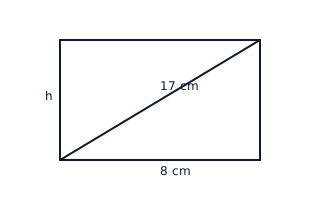
A rectangle has a width of and a diagonal of . Calculate the height of the rectangle.
Solution:
Explanation:
In a rectangle, the diagonal forms a right-angled triangle with the adjacent sides. We use the subtraction form of Pythagoras' Theorem because we are finding a shorter side.
Problem 5:
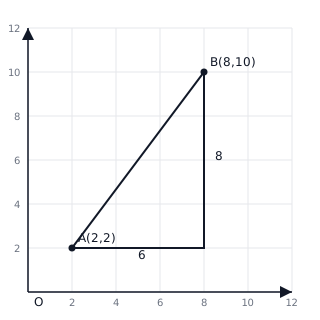
Calculate the distance between point and point on a coordinate plane.
Solution:
Explanation:
The distance between two points can be found by creating a right-angled triangle where the horizontal change is the base and the vertical change is the height. The distance is the hypotenuse.