
Review the key concepts, formulae, and examples before starting your quiz.
🔑Concepts
Labeling a Right-Angled Triangle: Before applying SOHCAHTOA, identify the sides relative to the given angle . The Hypotenuse () is opposite the right angle, the Opposite () is across from , and the Adjacent () is next to .
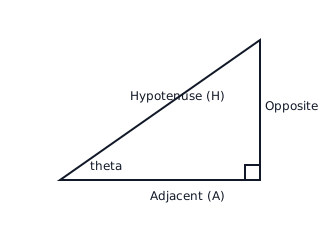
SOH: . Use this ratio when you are given or need to find the opposite side and the hypotenuse.
CAH: . Use this ratio when you are given or need to find the adjacent side and the hypotenuse.
TOA: . Use this ratio when dealing with the two legs of the triangle (opposite and adjacent) without involving the hypotenuse.
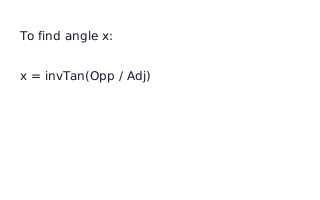
Inverse Trigonometry: When finding an unknown angle, use the inverse functions , , or on your calculator.
📐Formulae
💡Examples
Problem 1:
In a right-angled triangle, the angle is and the hypotenuse is cm. Find the length of the opposite side .
Solution:
cm
Explanation:
Identify the knowns: Hypotenuse = 15, Angle = 32°. We need the Opposite side. SOH tells us to use Sine. . Multiplying both sides by 15 gives .
Problem 2:
A ladder m long leans against a vertical wall. The base of the ladder is m away from the wall. Calculate the angle the ladder makes with the ground.
Solution:
Explanation:
The ladder represents the Hypotenuse (5m) and the distance from the wall is the Adjacent side (3m). CAH tells us to use Cosine: . To find the angle, use the inverse cosine function.
Problem 3:
Find the length of the adjacent side if the opposite side is cm and the angle is .
Solution:
cm
Explanation:
We have the opposite side and need the adjacent side. TOA tells us to use Tangent. . Rearranging for 'adj' gives .
Problem 4:
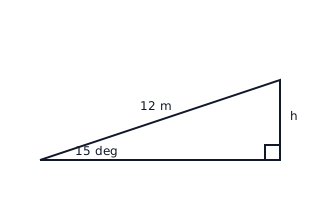
A ramp is m long and makes an angle of with the horizontal ground. Calculate the vertical height of the ramp.
Solution:
Explanation:
We are given the hypotenuse ( m) and the angle (). We need to find the opposite side (). Therefore, we use the Sine ratio (SOH).
Problem 5:
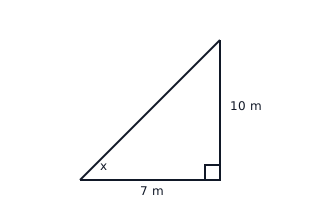
A flagpole casts a shadow m long on the ground. If the flagpole is m tall, calculate the angle of elevation of the sun.
Solution:
Explanation:
We are given the opposite side (height of pole = m) and the adjacent side (shadow length = m). We need to find the angle , so we use the inverse Tangent ratio (TOA).