krit.club logo

Trigonometry - Sine and Cosine Rules

Grade 9IGCSE

Review the key concepts, formulae, and examples before starting your quiz.

πŸ”‘Concepts

β€’

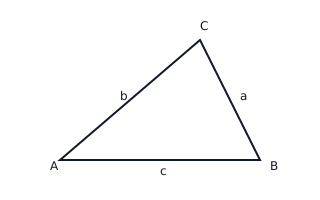
Labeling a Non-Right-Angled Triangle: In trigonometry, we use capital letters (AA, BB, CC) for the vertices/angles and lowercase letters (aa, bb, cc) for the sides opposite those angles. Side aa is opposite ∠A\angle A, side bb is opposite ∠B\angle B, and side cc is opposite ∠C\angle C.

Standard labeling of a triangle ABC with sides a, b, c opposite their respective angles.
β€’

The Sine Rule: Use this when you have a 'known pair' of one angle and its opposite side, plus one other piece of information. It relates the ratio of sides to the sines of their opposite angles: asin⁑A=bsin⁑B=csin⁑C\frac{a}{\sin A} = \frac{b}{\sin B} = \frac{c}{\sin C}

β€’

The Cosine Rule: Use this when dealing with three sides (SSS) or two sides and the included angle (SAS). It acts like a generalized Pythagorean theorem: a2=b2+c2βˆ’2bccos⁑Aa^2 = b^2 + c^2 - 2bc \cos A

β€’

The Sine Formula for Area: The area of any triangle can be calculated if two sides and the angle between them (the included angle) are known: Area=12absin⁑C\text{Area} = \frac{1}{2}ab \sin C
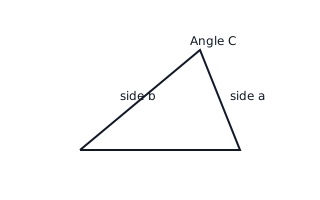
Triangle highlighting two sides and the included angle for area calculation.

πŸ“Formulae

Sine Rule (to find a side): asin⁑A=bsin⁑B=csin⁑C\frac{a}{\sin A} = \frac{b}{\sin B} = \frac{c}{\sin C}

Sine Rule (to find an angle): sin⁑Aa=sin⁑Bb=sin⁑Cc\frac{\sin A}{a} = \frac{\sin B}{b} = \frac{\sin C}{c}

Cosine Rule (to find a side): a2=b2+c2βˆ’2bccos⁑Aa^2 = b^2 + c^2 - 2bc \cos A

Cosine Rule (to find an angle): cos⁑A=b2+c2βˆ’a22bc\cos A = \frac{b^2 + c^2 - a^2}{2bc}

Area of a Triangle: Area=12absin⁑C\text{Area} = \frac{1}{2}ab \sin C

πŸ’‘Examples

Problem 1:

In triangle ABC, angle A = 40Β°, angle B = 60Β°, and side a = 12 cm. Calculate the length of side b.

Solution:

  1. Use the Sine Rule: bsin⁑60∘=12sin⁑40∘\frac{b}{\sin 60^\circ} = \frac{12}{\sin 40^\circ}
  2. Rearrange: b=12Γ—sin⁑60∘sin⁑40∘b = \frac{12 \times \sin 60^\circ}{\sin 40^\circ}
  3. Calculate: b=12Γ—0.86600.6428β‰ˆ16.17b = \frac{12 \times 0.8660}{0.6428} \approx 16.17 cm.

Explanation:

We use the Sine Rule because we have a known angle-side pair (A and a) and we are looking for a side opposite a known angle (B).

Problem 2:

In triangle PQR, PQ = 7 cm, QR = 10 cm, and the angle PQR = 75Β°. Find the length of side PR.

Solution:

  1. Let p=10p=10, r=7r=7, and angle Q=75∘Q=75^\circ. Use Cosine Rule: q2=p2+r2βˆ’2prcos⁑Qq^2 = p^2 + r^2 - 2pr \cos Q
  2. Substitute: q2=102+72βˆ’2(10)(7)cos⁑75∘q^2 = 10^2 + 7^2 - 2(10)(7) \cos 75^\circ
  3. q2=100+49βˆ’140(0.2588)=149βˆ’36.23=112.77q^2 = 100 + 49 - 140(0.2588) = 149 - 36.23 = 112.77
  4. q=112.77β‰ˆ10.62q = \sqrt{112.77} \approx 10.62 cm.

Explanation:

We use the Cosine Rule because we have two sides and the 'included' angle (SAS). This configuration does not provide a complete angle-side pair for the Sine Rule.

Problem 3:

A triangle has sides of length 5 cm, 8 cm, and 9 cm. Calculate the size of the smallest angle.

Solution:

  1. The smallest angle is opposite the shortest side (5 cm). Let a=5,b=8,c=9a=5, b=8, c=9.
  2. Use Cosine Rule for angle A: cos⁑A=82+92βˆ’522(8)(9)\cos A = \frac{8^2 + 9^2 - 5^2}{2(8)(9)}
  3. cos⁑A=64+81βˆ’25144=120144=0.8333\cos A = \frac{64 + 81 - 25}{144} = \frac{120}{144} = 0.8333
  4. A=cosβ‘βˆ’1(0.8333)β‰ˆ33.6∘A = \cos^{-1}(0.8333) \approx 33.6^\circ.

Explanation:

When three sides are given (SSS), the Cosine Rule is required to find any interior angle.

Problem 4:

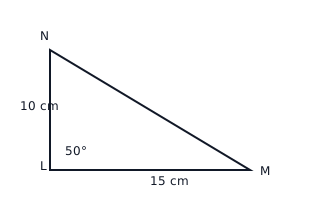
In triangle LMNLMN, LM=15 cmLM = 15\text{ cm}, LN=10 cmLN = 10\text{ cm} and ∠MLN=50∘\angle MLN = 50^{\circ}. Calculate the area of the triangle.

Triangle LMN with LN=10, LM=15 and angle L=50 degrees.

Solution:

Area=12Γ—LMΓ—LNΓ—sin⁑(∠MLN)\text{Area} = \frac{1}{2} \times LM \times LN \times \sin(\angle MLN) Area=12Γ—15Γ—10Γ—sin⁑(50∘)\text{Area} = \frac{1}{2} \times 15 \times 10 \times \sin(50^{\circ}) Area=75Γ—0.7660...\text{Area} = 75 \times 0.7660... Areaβ‰ˆ57.45Β cm2\text{Area} \approx 57.45\text{ cm}^2

Explanation:

To find the area of a non-right-angled triangle, use the sine area formula with two sides and the included angle. Here, the angle at LL is between the sides LMLM and LNLN.

Problem 5:

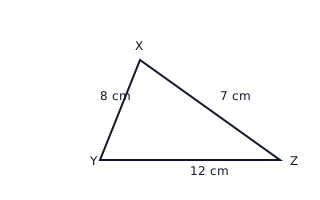
In triangle XYZXYZ, XY=8Β cmXY = 8\text{ cm}, YZ=12Β cmYZ = 12\text{ cm}, and XZ=7Β cmXZ = 7\text{ cm}. Calculate the size of angle XYZXYZ.

Triangle XYZ with sides 8, 12, and 7.

Solution:

Let y=7y = 7 (side XZXZ), x=12x = 12 (side YZYZ), and z=8z = 8 (side XYXY). cos⁑Y=x2+z2βˆ’y22xz\cos Y = \frac{x^2 + z^2 - y^2}{2xz} cos⁑Y=122+82βˆ’722Γ—12Γ—8\cos Y = \frac{12^2 + 8^2 - 7^2}{2 \times 12 \times 8} cos⁑Y=144+64βˆ’49192\cos Y = \frac{144 + 64 - 49}{192} cos⁑Y=159192\cos Y = \frac{159}{192} Y=cosβ‘βˆ’1(0.8281...)Y = \cos^{-1}(0.8281...) Yβ‰ˆ34.1∘Y \approx 34.1^{\circ}

Explanation:

Since all three sides are known (SSS), the Cosine Rule is used to find the missing angle. We rearrange the rule to solve for cos⁑(Y)\cos(Y).