
Review the key concepts, formulae, and examples before starting your quiz.
🔑Concepts
The area of any triangle can be calculated using the lengths of two sides and the sine of the included angle (the angle between those two sides).
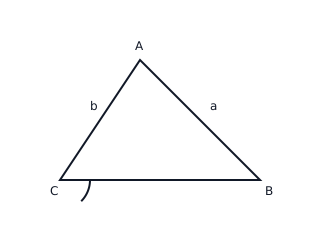
The formula is particularly useful when the perpendicular height of the triangle is not known, as it replaces the need for .
Always ensure your calculator is in 'Degree' mode when working with angles in degrees for IGCSE Trigonometry.
If you are given the area and need to find an angle, remember that . A positive sine value can refer to either an acute or an obtuse angle; check the question for constraints.
📐Formulae
💡Examples
Problem 1:
In triangle ABC, side , side , and angle . Calculate the area of the triangle correct to 3 significant figures.
Solution:
Explanation:
Identify the two sides () and the included angle (). Substitute these values into the formula and calculate.
Problem 2:
A triangle has an area of . Two of its sides are and . Find the size of the acute angle between these two sides.
Solution:
Explanation:
Rearrange the area formula to solve for the unknown angle . Divide the area by the product of and the two sides, then use the inverse sine () function.
Problem 3:
Calculate the area of an equilateral triangle with side lengths of .
Solution:
Explanation:
In an equilateral triangle, all sides are equal () and all internal angles are . Using and allows the use of the sine area formula.
Problem 4:
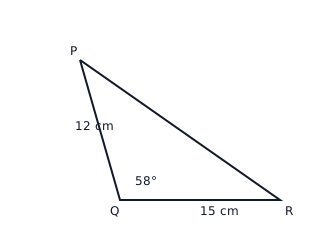
In , side , side , and . Calculate the area of the triangle to 1 decimal place.
Solution:
Explanation:
Identify the two sides ( and ) and the angle trapped between them (). Substitute these into the formula .
Problem 5:
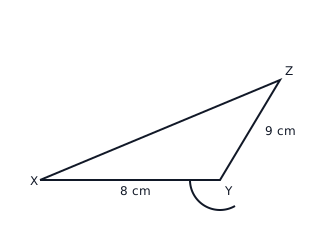
A triangle has an area of . Given and , find the obtuse angle correct to the nearest degree.
Solution:
Explanation:
Rearrange the area formula to solve for . After finding the inverse sine, subtract the result from because the question specifies the angle is obtuse.