
Review the key concepts, formulae, and examples before starting your quiz.
🔑Concepts
The Side-Angle-Side (SAS) Congruency Rule: If two sides and the included angle of one triangle are equal to two sides and the included angle of another triangle, the triangles are congruent. This ensures that the triangles are identical in shape and size.
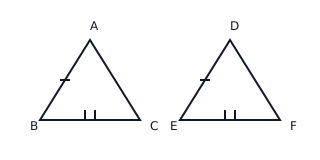
Properties of an Isosceles Triangle: In a triangle where two sides are equal, the angles opposite to those sides are also equal. Conversely, if two angles are equal, the sides opposite them are equal. The altitude from the vertex angle bisects the base.
Triangle Inequalities: In any triangle, the side opposite to the greater angle is longer, and the angle opposite to the longer side is greater. Furthermore, the sum of any two sides must be strictly greater than the third side.
RHS (Right-Angle Hypotenuse Side) Rule: Two right-angled triangles are congruent if the hypotenuse and one side of one triangle are respectively equal to the hypotenuse and the corresponding side of the other triangle.
📐Formulae
Angle Sum Property:
Triangle Inequality: , , and
Difference Inequality:
Exterior Angle Theorem:
Isosceles Property: If
💡Examples
Problem 1:
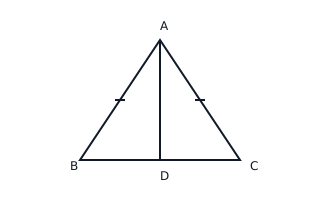
In , and is the bisector of meeting at . Prove that and hence show .
Solution:
- In and :
- (Given)
- (Since bisects )
- (Common side)
- Therefore, by the (Side-Angle-Side) criterion.
- Since the triangles are congruent, by (Corresponding Parts of Congruent Triangles are Congruent).
Explanation:
We use the given side equality and the angle bisector property to identify two sides and an included angle that match, satisfying the SAS rule. CPCTC then allows us to conclude the remaining sides are equal.
Problem 2:
In , if and , identify the longest and shortest sides of the triangle.
Solution:
- First, find the third angle using the Angle Sum Property:
- Compare the angles: .
- According to the Side-Angle relationship:
- The side opposite the largest angle () is . So, is the longest side.
- The side opposite the smallest angle () is . So, is the shortest side.
Explanation:
The problem applies the Triangle Inequality/Relationship concept where side length is directly proportional to the size of the opposite angle. We must calculate all interior angles before comparing.
Problem 3:
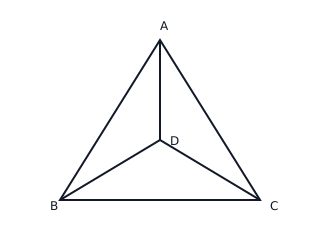
In the given figure, and is a point in the interior of such that . Prove that and .
Solution:
In and :
- (Given)
- (Given)
- (Common side) By SSS Congruency Rule, . Since the triangles are congruent, their corresponding parts are equal. Therefore, (CPCT).
Explanation:
We use the SSS (Side-Side-Side) rule because all three pairs of corresponding sides are given or shared. CPCT stands for 'Corresponding Parts of Congruent Triangles'.
Problem 4:
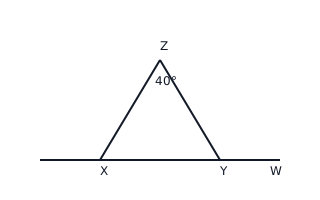
In , side is produced to . If and , find the measure of exterior angle .
Solution:
In , given . Therefore, (Angles opposite to equal sides). Let . By Angle Sum Property: . Since is a straight line, (Linear pair). .
Explanation:
First, use isosceles triangle properties to find the base angles, then use the property of linear pairs to find the exterior angle.