
Review the key concepts, formulae, and examples before starting your quiz.
🔑Concepts
The Mid-point Theorem states that the line segment joining the mid-points of any two sides of a triangle is parallel to the third side and equal to half of it. In , if and are mid-points of and respectively, then and .
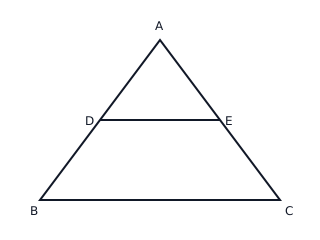
The Converse of the Mid-point Theorem states that the line drawn through the mid-point of one side of a triangle, parallel to another side, bisects the third side. In , if is the mid-point of and , then is the mid-point of (i.e., ).
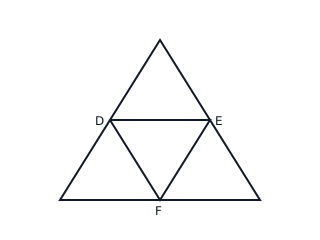
The Medial Triangle is the triangle formed by joining the mid-points of the three sides of a triangle. This divides the original triangle into four congruent triangles. The area of the medial triangle is exactly of the area of the original triangle.
For any quadrilateral, the figure formed by joining the mid-points of its consecutive sides is always a parallelogram.
📐Formulae
If and are mid-points of and , then
Length of segment:
In , if and , then
💡Examples
Problem 1:
In , the mid-points of sides and are and respectively. If and , find the perimeter of .
Solution:
- According to the Mid-point Theorem, the segment joining the mid-points of two sides is half the third side.
- Therefore, .
- Similarly, .
- And .
- Perimeter of .
Explanation:
We use the Mid-point Theorem property where each side of the inner triangle is half the length of the side it is parallel to in the outer triangle.
Problem 2:
In , is the median to . is the mid-point of . is produced to meet at . Prove that .
Solution:
- Draw meeting at .
- In , is the mid-point of and . By the Converse of Mid-point Theorem, is the mid-point of . Thus, ... (i)
- In , is the mid-point of (since is a median) and . By the Converse of Mid-point Theorem, is the mid-point of . Thus, ... (ii)
- From (i) and (ii), .
- Since , we have , which means .
Explanation:
This problem uses the Converse of the Mid-point Theorem twice. By constructing a parallel line , we create two triangles where the theorem can be applied to show that is divided into three equal segments.
Problem 3:
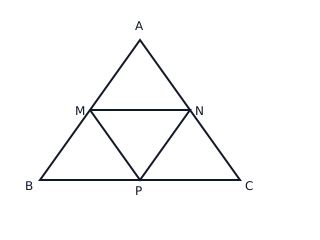
In the figure, and are the mid-points of and respectively. If and , calculate the perimeter of .
Solution:
By the Mid-point Theorem:
- Perimeter of Perimeter
Explanation:
We use the Mid-point Theorem which states that a segment joining mid-points is half the length of the parallel side. We multiply each medial segment by 2 to find the lengths of the outer triangle's sides.
Problem 4:
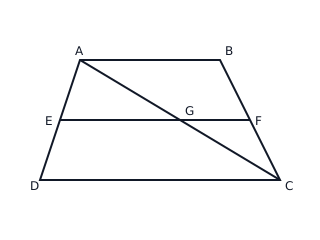
In a trapezium , . is the mid-point of . A line through parallel to meets at . Show that is the mid-point of .
Solution:
Join letting it intersect at . In : is the mid-point of (given). (since and ). By the Converse of Mid-point Theorem, must be the mid-point of . Now in : is the mid-point of (proved above). (given ). By the Converse of Mid-point Theorem, is the mid-point of .
Explanation:
To prove is a mid-point, we construct a diagonal to create two triangles. Applying the Converse of the Mid-point Theorem sequentially in both triangles confirms the result.