krit.club logo

Geometry - Theorems on Area

Grade 9ICSE

Review the key concepts, formulae, and examples before starting your quiz.

🔑Concepts

•

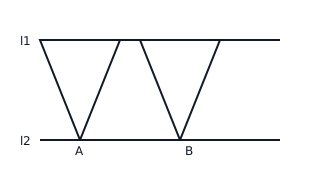
Parallelograms on the same base and between the same parallels are equal in area. This means if two parallelograms share a common base ABAB and their opposite sides lie on a line parallel to ABAB, their areas are identical.

Two parallelograms on common base AB between parallel lines l1 and l2.
•

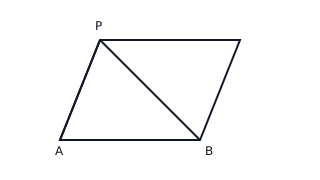
The area of a triangle is half the area of a parallelogram if they stand on the same base and between the same parallels. Mathematically, Area(△ABC)=12×Area(Parallelogram ABCD)Area(\triangle ABC) = \frac{1}{2} \times Area(Parallelogram \ ABCD) if DD lies on the line parallel to ABAB passing through CC.

Triangle ABP inside parallelogram ABCD sharing base AB.
•

Triangles on the same base (or equal bases) and between the same parallels are equal in area. This is because they share the same base length bb and the same perpendicular height hh.

•

A median of a triangle divides it into two triangles of equal area. If ADAD is a median of △ABC\triangle ABC, then Area(△ABD)=Area(△ACD)=12Area(△ABC)Area(\triangle ABD) = Area(\triangle ACD) = \frac{1}{2} Area(\triangle ABC).

📐Formulae

Area of Parallelogram=base×heightArea \text{ of Parallelogram} = \text{base} \times \text{height}

Area of Triangle=12×base×heightArea \text{ of Triangle} = \frac{1}{2} \times \text{base} \times \text{height}

Area of Trapezium=12×(sum of parallel sides)×heightArea \text{ of Trapezium} = \frac{1}{2} \times (\text{sum of parallel sides}) \times \text{height}

Area of Rhombus=12×d1×d2Area \text{ of Rhombus} = \frac{1}{2} \times d_1 \times d_2

Area of Equilateral Triangle=34×side2Area \text{ of Equilateral Triangle} = \frac{\sqrt{3}}{4} \times \text{side}^2

💡Examples

Problem 1:

In △ABC\triangle ABC, ADAD is the median. If EE is any point on the median ADAD, prove that Area(△ABE)=Area(△ACE)Area(\triangle ABE) = Area(\triangle ACE).

Solution:

  1. In △ABC\triangle ABC, ADAD is the median. Since a median divides a triangle into two triangles of equal area, Area(△ABD)=Area(△ACD)Area(\triangle ABD) = Area(\triangle ACD).
  2. Now, consider △EBC\triangle EBC. EDED is the median of this triangle because DD is the midpoint of BCBC. Therefore, Area(△EBD)=Area(△ECD)Area(\triangle EBD) = Area(\triangle ECD).
  3. Subtracting the area of the smaller triangles from the larger ones: Area(△ABD)−Area(△EBD)=Area(△ACD)−Area(△ECD)Area(\triangle ABD) - Area(\triangle EBD) = Area(\triangle ACD) - Area(\triangle ECD).
  4. This leaves us with Area(△ABE)=Area(△ACE)Area(\triangle ABE) = Area(\triangle ACE).

Explanation:

This solution applies the median property twice—first for the large triangle and then for the smaller triangle formed within it—and uses the subtraction method to isolate the desired areas.

Problem 2:

A triangle PABPAB and a parallelogram ABCDABCD are on the same base ABAB and between the same parallels ABAB and CDCD. If the area of the triangle is 24.5cm224.5 cm^2, find the area of the parallelogram.

Solution:

  1. Let the area of the parallelogram ABCDABCD be XX.
  2. According to the theorem, if a triangle and a parallelogram are on the same base and between the same parallels, Area(△)=12×Area(Parallelogram)Area(\triangle) = \frac{1}{2} \times Area(\text{Parallelogram}).
  3. Given Area(△PAB)=24.5cm2Area(\triangle PAB) = 24.5 cm^2.
  4. Substituting into the formula: 24.5=12×X24.5 = \frac{1}{2} \times X.
  5. X=24.5×2=49cm2X = 24.5 \times 2 = 49 cm^2.
  6. Therefore, the area of the parallelogram ABCDABCD is 49cm249 cm^2.

Explanation:

The problem uses the direct relationship between triangles and parallelograms sharing the same base and parallels, where the parallelogram's area is exactly double that of the triangle.

Problem 3:

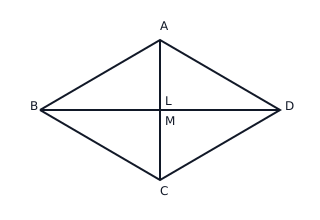
In the given figure, ABCDABCD is a quadrilateral and BDBD is a diagonal. AL⊥BDAL \perp BD and CM⊥BDCM \perp BD. If BD=12cmBD = 12 cm, AL=7cmAL = 7 cm and CM=5cmCM = 5 cm, find the area of the quadrilateral ABCDABCD.

Quadrilateral ABCD with diagonal BD and perpendiculars AL and CM.

Solution:

The area of quadrilateral ABCDABCD is the sum of the areas of △ABD\triangle ABD and △BCD\triangle BCD.

Area(△ABD)=12×base×height=12×BD×ALArea(\triangle ABD) = \frac{1}{2} \times \text{base} \times \text{height} = \frac{1}{2} \times BD \times AL Area(△ABD)=12×12×7=42cm2Area(\triangle ABD) = \frac{1}{2} \times 12 \times 7 = 42 cm^2

Area(△BCD)=12×base×height=12×BD×CMArea(\triangle BCD) = \frac{1}{2} \times \text{base} \times \text{height} = \frac{1}{2} \times BD \times CM Area(△BCD)=12×12×5=30cm2Area(\triangle BCD) = \frac{1}{2} \times 12 \times 5 = 30 cm^2

TotalArea=Area(△ABD)+Area(△BCD)Total Area = Area(\triangle ABD) + Area(\triangle BCD) TotalArea=42+30=72cm2Total Area = 42 + 30 = 72 cm^2

Explanation:

To find the area of a general quadrilateral, we split it into two triangles using a diagonal. The area is the sum of the areas of these two triangles, using the diagonal as a common base.

Problem 4:

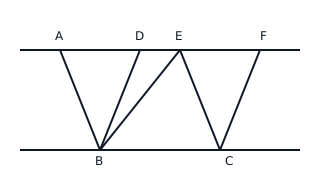
Two parallelograms ABCDABCD and EBCFEBCF are on the same base BCBC and between the same parallels BCBC and AFAF. If the area of ABCDABCD is 40cm240 cm^2, find the area of the triangle EBCEBC.

Parallelograms ABCD and EBCF on base BC with triangle EBC shown.

Solution:

Given that ABCDABCD and EBCFEBCF are parallelograms on the same base BCBC and between the same parallels BCBC and AFAF. By theorem, Area(ABCD)=Area(EBCF)=40cm2Area(ABCD) = Area(EBCF) = 40 cm^2.

Now, △EBC\triangle EBC and parallelogram EBCFEBCF are on the same base BCBC and between the same parallels BCBC and EFEF. Therefore, Area(△EBC)=12×Area(EBCF)Area(\triangle EBC) = \frac{1}{2} \times Area(EBCF).

Area(△EBC)=12×40=20cm2Area(\triangle EBC) = \frac{1}{2} \times 40 = 20 cm^2

Explanation:

First, we use the property that parallelograms on the same base and between same parallels are equal in area. Then, we use the property that the area of a triangle is half the area of a parallelogram on the same base and between the same parallels.