
Review the key concepts, formulae, and examples before starting your quiz.
🔑Concepts
A quadrilateral is a closed figure with four sides. The Angle Sum Property states that the sum of the interior angles is always . For any quadrilateral , .
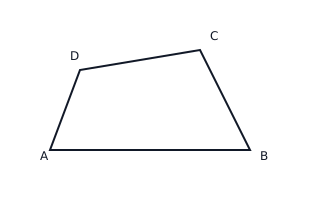
A Parallelogram is a quadrilateral where opposite sides are parallel and equal. Key properties include: (i) Opposite angles are equal, (ii) Diagonals bisect each other, and (iii) Adjacent angles are supplementary (sum to ).
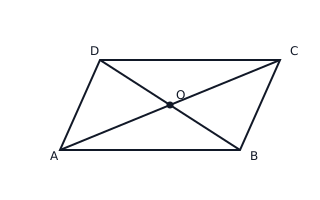
A Rhombus is a parallelogram with all four sides equal. Its diagonals bisect each other at right angles ().
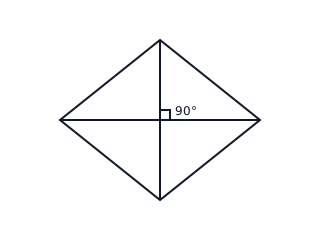
A Rectangle is a parallelogram with each angle equal to . Its diagonals are equal in length and bisect each other.

📐Formulae
Angle Sum Property:
Area of a Parallelogram:
Area of a Rhombus: (where and are lengths of diagonals)
Area of a Trapezium:
Perimeter of a Parallelogram: (where and are adjacent sides)
Pythagorean relationship in Rhombus side ():
💡Examples
Problem 1:
In a parallelogram , . Find the measure of all four angles.
Solution:
- Let the angles be and .
- In a parallelogram, adjacent angles are supplementary, so .
- .
- Therefore, and .
- Since opposite angles are equal: and .
Explanation:
This approach uses the property that consecutive interior angles between parallel lines (the sides of the parallelogram) sum to .
Problem 2:
The diagonals of a rhombus are and . Calculate the length of one side of the rhombus.
Solution:
- Let the diagonals be and .
- Diagonals of a rhombus bisect each other at .
- Half-lengths of the diagonals are and .
- These halves form the base and height of a right-angled triangle where the side () is the hypotenuse.
- Using Pythagoras Theorem: .
- .
Explanation:
This solution relies on the property that rhombus diagonals create four right-angled triangles at the center intersection.
Problem 3:
In the given figure, is a trapezium where . If and , find the measures of and .
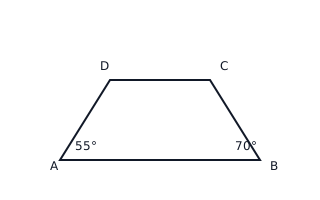
Solution:
- Since , and are interior angles on the same side of the transversal .
- Therefore, .
- .
- Similarly, and are interior angles on the same side of the transversal .
- .
Explanation:
In a trapezium, the pairs of angles between the parallel sides and a non-parallel side (consecutive interior angles) are supplementary.
Problem 4:
In a rectangle , the diagonals and intersect at . If , calculate and .
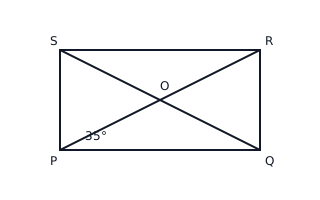
Solution:
- In rectangle , diagonals are equal and bisect each other, so .
- In , since , it is an isosceles triangle. Thus, .
- In , since , it is an isosceles triangle. Since , .
- Therefore, .
- Since , (Alternate Interior Angles).
Explanation:
This problem uses the property that the diagonals of a rectangle are equal and bisect each other, forming four isosceles triangles with the center point.