
Review the key concepts, formulae, and examples before starting your quiz.
🔑Concepts
The Pythagoras Theorem states that in a right-angled triangle, the square of the hypotenuse () is equal to the sum of the squares of the other two sides, namely the perpendicular () and the base (). The hypotenuse is always the side opposite the angle and is the longest side.
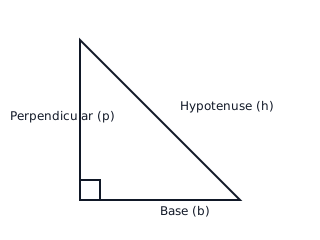
The Converse of Pythagoras Theorem states that if the square of the longest side of a triangle is equal to the sum of the squares of the other two sides, then the angle opposite the longest side is a right angle (). If , then the triangle is right-angled.
Pythagorean Triplets are sets of three positive integers that satisfy the rule . Common examples include , , and .
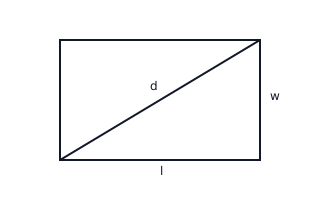
The theorem is used to find the length of the diagonal of a rectangle or square. For a rectangle with length and width , the diagonal creates two congruent right-angled triangles.
📐Formulae
Pythagoras Theorem:
Length of Hypotenuse:
Length of Perpendicular:
Length of Base:
Diagonal of a Rectangle:
Diagonal of a Square:
Condition for Pythagorean Triplet:
💡Examples
Problem 1:
A ladder m long reaches a window m above the ground. Find the distance of the foot of the ladder from the wall.
Solution:
Let the length of the ladder be the hypotenuse m. Let the height of the window be the perpendicular m. We need to find the base . Using Pythagoras Theorem: m.
Explanation:
In this real-world scenario, the wall, the ground, and the ladder form a right-angled triangle. The ladder represents the hypotenuse because it is leaning opposite the angle formed by the wall and the ground.
Problem 2:
Determine whether a triangle with sides cm, cm, and cm is a right-angled triangle.
Solution:
Let the sides be , , and the longest side . Calculate the sum of squares of the smaller sides: Calculate the square of the longest side: Since ()...
Explanation:
According to the Converse of Pythagoras Theorem, if the square of the longest side equals the sum of the squares of the other two sides, the triangle is right-angled. Since the values satisfy the equation, this is a right-angled triangle.
Problem 3:
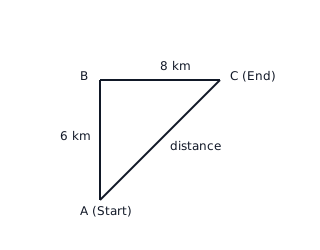
A man drives km North and then km East. Calculate the shortest distance from his starting point to his finishing point.
Solution:
Let be the starting point. The man moves km North to , and then km East to . In right , by Pythagoras Theorem: So, the shortest distance is km.
Explanation:
The North and East directions are perpendicular to each other, forming a right-angled triangle where the shortest distance is the hypotenuse.
Problem 4:
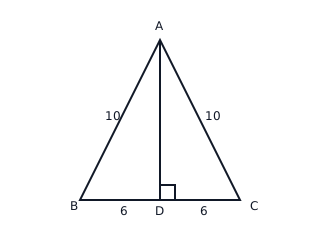
An isosceles triangle has equal sides of length cm each and a base of cm. Find the altitude (height) of the triangle drawn to the base.
Solution:
In an isosceles with cm and cm, let be the altitude to the base . In an isosceles triangle, the altitude to the base bisects the base. Therefore, cm. In right : Thus, the altitude is cm.
Explanation:
By dropping an altitude in an isosceles triangle, we create two congruent right-angled triangles. We then apply Pythagoras theorem to one of these triangles.