
Review the key concepts, formulae, and examples before starting your quiz.
🔑Concepts
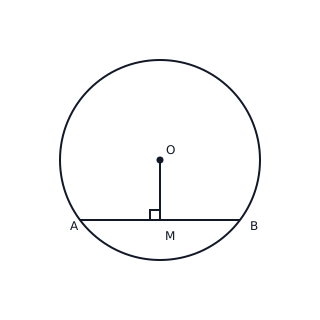
The perpendicular from the center of a circle to a chord bisects the chord. Conversely, the line joining the center of a circle to the midpoint of a chord is perpendicular to the chord. In the diagram, if , then .
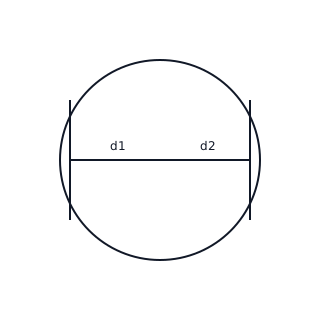
Equal chords of a circle are equidistant from the center. This means if two chords have the same length, their perpendicular distances from the center are equal.
The angle subtended by an arc at the center is double the angle subtended by it at any point on the remaining part of the circle. If is the central angle, then .
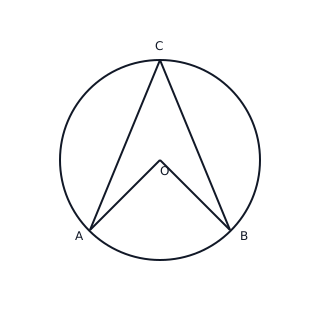
Angles in the same segment of a circle are equal. This implies that any two angles subtended by the same arc at the circumference are identical.
The angle in a semi-circle is a right angle (). Any triangle formed using the diameter as one side and a third point on the circumference is a right-angled triangle.
📐Formulae
Relationship between Radius (), Chord length (), and Perpendicular distance ():
Length of a chord:
Distance of chord from center:
Central Angle Theorem:
Sum of angles in a triangle (often used with isosceles triangles formed by radii):
💡Examples
Problem 1:
A chord of length is drawn in a circle of radius . Find the perpendicular distance of the chord from the center of the circle.
Solution:
- Let the chord be and the center be .
- Draw a perpendicular from to the chord . According to circle properties, bisects . Therefore, .
- In the right-angled triangle , the radius is the hypotenuse.
- Using Pythagoras theorem: .
- .
Explanation:
This problem uses the property that a perpendicular from the center bisects the chord, allowing us to use the Pythagoras theorem on the resulting right-angled triangle.
Problem 2:
In a circle with center , an arc subtends an angle of at the center. Find the measure of the angle subtended by the major arc at a point on the minor arc.
Solution:
- The angle subtended by the minor arc at the center is .
- The reflex angle (representing the major arc) is .
- According to the Central Angle Theorem, the angle subtended by an arc at the circumference is half the angle it subtends at the center.
- The angle at point on the minor arc is subtended by the major arc .
- Therefore, .
- .
Explanation:
The Central Angle Theorem applies to both minor and major arcs. When finding the angle at the circumference facing the center, we must use the corresponding central angle (reflex angle for the major arc).
Problem 3:
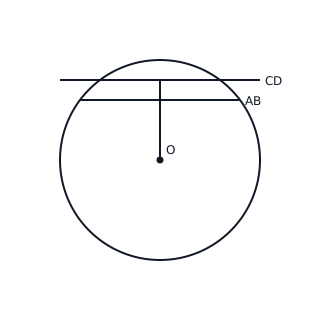
Two parallel chords of lengths and are on the same side of the center of a circle of radius . Find the distance between the two chords.
Solution:
Let the center of the circle be and the chords be and . Let and . and are midpoints, so and . In : In : Distance between chords .
Explanation:
We use the Pythagorean theorem in two right-angled triangles formed by the radii and the perpendiculars to the chords. Since the chords are on the same side, we subtract the distances from the center.
Problem 4:
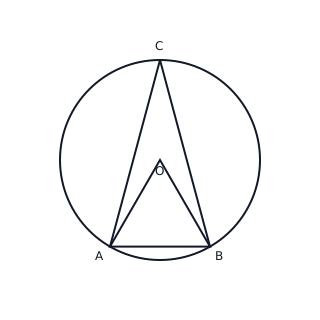
In a circle with center , the chord is equal to the radius of the circle. Find the angle subtended by this chord at a point on the major arc.
Solution:
In , (radii) and (given). Therefore, is an equilateral triangle. So, . Let be a point on the major arc. By the Central Angle Theorem: .
Explanation:
An equilateral triangle is formed when the chord length equals the radius. The angle at the center is , and the angle at the circumference is half of that.