krit.club logo

Mensuration: Area and Perimeter - Use Brahmagupta formula for cyclic quadrilaterals and connect it to Heron formula

Grade 9CBSE

Review the key concepts, formulae, and examples before starting your quiz.

🔑Concepts

•

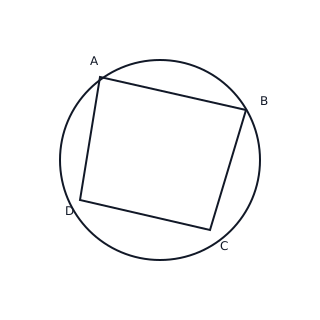
A cyclic quadrilateral is a quadrilateral whose all four vertices lie on the circumference of a circle. The sum of opposite angles in a cyclic quadrilateral is always 180∘180^\circ.

A cyclic quadrilateral ABCD inscribed in a circle.
•

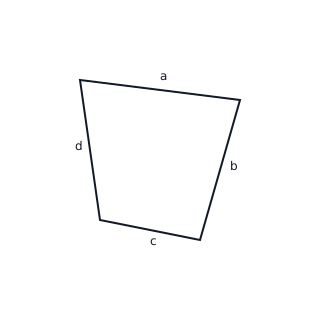
Brahmagupta's Formula is used to calculate the area of a cyclic quadrilateral given the lengths of its four sides a,b,c,da, b, c, d. The area is given by Area=(s−a)(s−b)(s−c)(s−d)Area = \sqrt{(s-a)(s-b)(s-c)(s-d)}, where ss is the semi-perimeter.

A quadrilateral with side lengths labeled a, b, c, and d.
•

The semi-perimeter ss of a cyclic quadrilateral is half the sum of its four sides: s=a+b+c+d2s = \frac{a+b+c+d}{2}. This value is critical for both Heron's and Brahmagupta's calculations.

Flowchart showing calculation of semi-perimeter from four sides.
•

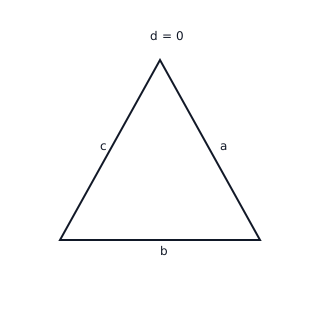
Brahmagupta's Formula is a generalization of Heron's Formula. If we consider one side of the quadrilateral to have length zero (d=0d = 0), the cyclic quadrilateral becomes a triangle, and the formula reduces to Heron's: Area=s(s−a)(s−b)(s−c)Area = \sqrt{s(s-a)(s-b)(s-c)}.

A triangle viewed as a quadrilateral where the fourth side d is zero.
•

To solve problems involving non-cyclic quadrilaterals where a diagonal is known, we split the figure into two triangles and apply Heron's Formula twice, summing the resulting areas.
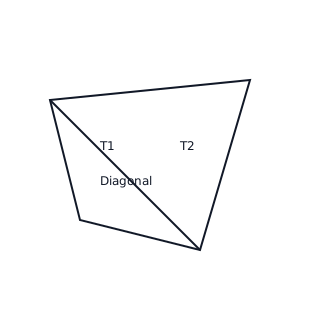
A quadrilateral divided into two triangles by a diagonal.

📐Formulae

Semi-perimeter of a triangle: s=a+b+c2s = \frac{a + b + c}{2}

Heron's Formula for Area of a Triangle: Area=s(s−a)(s−b)(s−c)Area = \sqrt{s(s-a)(s-b)(s-c)}

Area of Quadrilateral ABCDABCD: Area(△ABC)+Area(△ADC)Area(\triangle ABC) + Area(\triangle ADC)

Pythagoras Theorem (to find diagonal dd): d=side12+side22d = \sqrt{side_1^2 + side_2^2} (if ∠=90∘\angle = 90^\circ)

Area of a Right-angled Triangle: Area=12×base×heightArea = \frac{1}{2} \times base \times height

💡Examples

Problem 1:

Find the area of a quadrilateral ABCDABCD in which AB=3 cm,BC=4 cm,CD=4 cm,DA=5 cmAB = 3\text{ cm}, BC = 4\text{ cm}, CD = 4\text{ cm}, DA = 5\text{ cm} and AC=5 cmAC = 5\text{ cm}.

Solution:

Step 1: The quadrilateral ABCDABCD is divided into two triangles, △ABC\triangle ABC and △ADC\triangle ADC by diagonal ACAC. Step 2: For △ABC\triangle ABC, the sides are a=3,b=4,c=5a=3, b=4, c=5. Since 32+42=523^2 + 4^2 = 5^2 (9+16=259+16=25), it is a right-angled triangle. Area(△ABC)=12×3×4=6 cm2Area(\triangle ABC) = \frac{1}{2} \times 3 \times 4 = 6\text{ cm}^2. Step 3: For △ADC\triangle ADC, the sides are a=5,b=4,c=5a=5, b=4, c=5. s=5+4+52=142=7 cms = \frac{5+4+5}{2} = \frac{14}{2} = 7\text{ cm}. Area(△ADC)=7(7−5)(7−4)(7−5)=7×2×3×2=84≈9.17 cm2Area(\triangle ADC) = \sqrt{7(7-5)(7-4)(7-5)} = \sqrt{7 \times 2 \times 3 \times 2} = \sqrt{84} \approx 9.17\text{ cm}^2. Step 4: Total Area =Area(△ABC)+Area(△ADC)=6+9.17=15.17 cm2= Area(\triangle ABC) + Area(\triangle ADC) = 6 + 9.17 = 15.17\text{ cm}^2.

Explanation:

We divide the quadrilateral using the given diagonal ACAC. We use the simple right-angle area formula for one triangle and Heron's formula for the other, then add them together.

Problem 2:

A park is in the shape of a quadrilateral ABCDABCD has ∠C=90∘,AB=9 m,BC=12 m,CD=5 m\angle C = 90^\circ, AB = 9\text{ m}, BC = 12\text{ m}, CD = 5\text{ m} and AD=8 mAD = 8\text{ m}. How much area does it occupy?

Solution:

Step 1: Join BDBD to form two triangles. In right △BCD\triangle BCD, using Pythagoras: BD=BC2+CD2=122+52=144+25=169=13 mBD = \sqrt{BC^2 + CD^2} = \sqrt{12^2 + 5^2} = \sqrt{144 + 25} = \sqrt{169} = 13\text{ m}. Step 2: Area(△BCD)=12×12×5=30 m2Area(\triangle BCD) = \frac{1}{2} \times 12 \times 5 = 30\text{ m}^2. Step 3: For △ABD\triangle ABD, sides are a=9,b=8,c=13a=9, b=8, c=13. s=9+8+132=15 ms = \frac{9+8+13}{2} = 15\text{ m}. Area(△ABD)=15(15−9)(15−8)(15−13)=15×6×7×2=1260=635≈35.5 m2Area(\triangle ABD) = \sqrt{15(15-9)(15-8)(15-13)} = \sqrt{15 \times 6 \times 7 \times 2} = \sqrt{1260} = 6\sqrt{35} \approx 35.5\text{ m}^2. Step 4: Total Area =30+35.5=65.5 m2= 30 + 35.5 = 65.5\text{ m}^2.

Explanation:

Since one angle is 90∘90^\circ, we use Pythagoras to find the diagonal length BDBD. This diagonal allows us to split the quadrilateral into a right triangle and a general triangle, calculating their areas separately.

Problem 3:

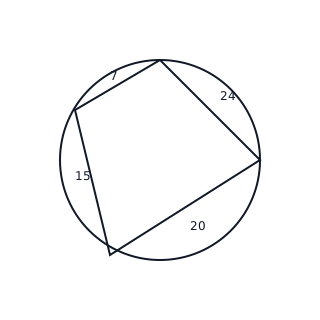
Calculate the area of a cyclic quadrilateral with sides a=7 cma = 7\text{ cm}, b=15 cmb = 15\text{ cm}, c=20 cmc = 20\text{ cm}, and d=24 cmd = 24\text{ cm}.

Cyclic quadrilateral with side lengths 7, 15, 20, 24.

Solution:

  1. Find the semi-perimeter ss: s=7+15+20+242=662=33 cms = \frac{7 + 15 + 20 + 24}{2} = \frac{66}{2} = 33\text{ cm}
  2. Apply Brahmagupta's Formula: Area=(33−7)(33−15)(33−20)(33−24)Area = \sqrt{(33-7)(33-15)(33-20)(33-24)} Area=26×18×13×9Area = \sqrt{26 \times 18 \times 13 \times 9}
  3. Simplify the expression: Area=(13×2)×(9×2)×13×9Area = \sqrt{(13 \times 2) \times (9 \times 2) \times 13 \times 9} Area=132×92×22Area = \sqrt{13^2 \times 9^2 \times 2^2} Area=13×9×2=234 cm2Area = 13 \times 9 \times 2 = 234\text{ cm}^2

Explanation:

To find the area of a cyclic quadrilateral, we first calculate the semi-perimeter ss. Then we use the product of the differences between ss and each side length under a square root.

Problem 4:

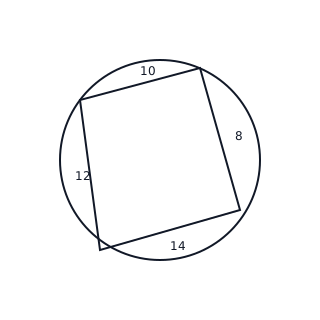
In a circle, a quadrilateral PQRSPQRS is inscribed such that PQ=10 cmPQ = 10\text{ cm}, QR=12 cmQR = 12\text{ cm}, RS=14 cmRS = 14\text{ cm}, and SP=8 cmSP = 8\text{ cm}. Find its area.

Cyclic quadrilateral PQRS with side lengths 10, 12, 14, 8.

Solution:

  1. Semi-perimeter ss: s=10+12+14+82=442=22 cms = \frac{10 + 12 + 14 + 8}{2} = \frac{44}{2} = 22\text{ cm}
  2. Area using Brahmagupta's Formula: Area=(22−10)(22−12)(22−14)(22−8)Area = \sqrt{(22-10)(22-12)(22-14)(22-8)} Area=12×10×8×14Area = \sqrt{12 \times 10 \times 8 \times 14}
  3. Calculate the product: Area=13440Area = \sqrt{13440}
  4. Simplify: Area=64×210=8210 cm2≈115.93 cm2Area = \sqrt{64 \times 210} = 8\sqrt{210}\text{ cm}^2 \approx 115.93\text{ cm}^2

Explanation:

Since the quadrilateral is inscribed in a circle, it is cyclic. We compute the semi-perimeter and then substitute the values into Brahmagupta's formula to find the area.