krit.club logo

Mensuration: Area and Perimeter - Interpret pi as irrational and use approximations for accurate computation

Grade 9CBSE

Review the key concepts, formulae, and examples before starting your quiz.

🔑Concepts

•

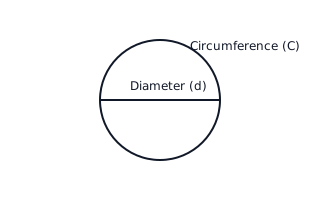
The constant π\pi is defined as the ratio of a circle's circumference to its diameter, expressed as π=Cd\pi = \frac{C}{d}. It is an irrational number, meaning its decimal expansion is non-repeating and non-terminating (3.14159...3.14159...).

Circle showing the relationship between circumference and diameter defining pi.
•

For practical computations, we use rational approximations: π≈227\pi \approx \frac{22}{7} (accurate to 2 decimal places) or π≈3.14\pi \approx 3.14 (accurate for basic metric calculations).
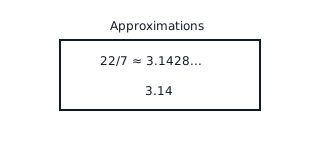
Box showing standard numerical approximations for pi.
•

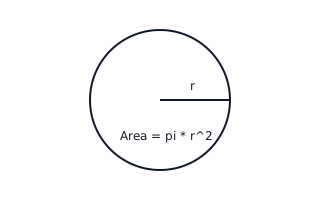
Area of a circle is the region enclosed within the boundary. It is calculated as A=πr2A = \pi r^2. If the diameter is given, use r=d2r = \frac{d}{2}.

A circle with radius r and the formula for its area.
•

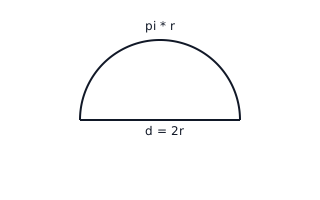
Perimeter of a semi-circle includes the curved arc and the straight diameter: P=πr+2rP = \pi r + 2r or r(π+2)r(\pi + 2).

A semi-circle highlighting the curved part and the diameter base.

📐Formulae

Circumference (C)=2πr\text{Circumference (C)} = 2\pi r

Circumference (C)=πd (where d=2r)\text{Circumference (C)} = \pi d \text{ (where } d = 2r\text{)}

Area (A)=πr2\text{Area (A)} = \pi r^2

Radius (r)=Aπ\text{Radius (r)} = \sqrt{\frac{A}{\pi}}

💡Examples

Problem 1:

A circular wire has a radius of 14 cm14\text{ cm}. Find its circumference using π=227\pi = \frac{22}{7}.

Solution:

C=2πrC = 2\pi r C=2×227×14C = 2 \times \frac{22}{7} \times 14 C=2×22×2C = 2 \times 22 \times 2 C=88 cmC = 88\text{ cm}

Explanation:

Since the radius 1414 is a multiple of 77, using the approximation 227\frac{22}{7} allows us to cancel the denominator, resulting in an accurate and quick computation.

Problem 2:

Find the area of a circle whose radius is 10 cm10\text{ cm}. (Use π=3.14\pi = 3.14)

Solution:

A=πr2A = \pi r^2 A=3.14×(10)2A = 3.14 \times (10)^2 A=3.14×100A = 3.14 \times 100 A=314 cm2A = 314\text{ cm}^2

Explanation:

When the radius is a power of 1010, using the decimal approximation 3.143.14 is more convenient for calculation than using the fraction 227\frac{22}{7}.

Problem 3:

The circumference of a circular sheet is 154 m154\text{ m}. Find its radius and area. (Use π=227\pi = \frac{22}{7})

Solution:

First, find the radius rr: 2πr=1542\pi r = 154 2×227×r=1542 \times \frac{22}{7} \times r = 154 r=154×72×22r = \frac{154 \times 7}{2 \times 22} r=7×72=24.5 mr = \frac{7 \times 7}{2} = 24.5\text{ m} Now, find the area AA: A=πr2A = \pi r^2 A=227×24.5×24.5A = \frac{22}{7} \times 24.5 \times 24.5 A=227×492×492A = \frac{22}{7} \times \frac{49}{2} \times \frac{49}{2} A=11×7×494=37732=1886.5 m2A = 11 \times 7 \times \frac{49}{4} = \frac{3773}{2} = 1886.5\text{ m}^2

Explanation:

We first use the circumference formula to isolate rr. Then, we substitute the value of rr into the area formula to find the total surface region.

Problem 4:

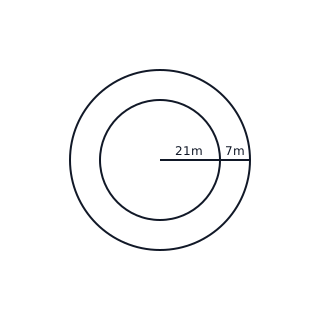
A circular garden is surrounded by a path of uniform width 7 m7\text{ m}. If the radius of the inner garden is 21 m21\text{ m}, find the area of the path. (Take π=227\pi = \frac{22}{7})

Concentric circles representing a garden and its surrounding path.

Solution:

  1. Inner radius (rr) = 21 m21\text{ m}
  2. Outer radius (RR) = 21+7=28 m21 + 7 = 28\text{ m}
  3. Area of path = Outer Area - Inner Area
  4. A=πR2−πr2=π(R2−r2)A = \pi R^2 - \pi r^2 = \pi(R^2 - r^2)
  5. A=227×(282−212)A = \frac{22}{7} \times (28^2 - 21^2)
  6. A=227×(28−21)(28+21)A = \frac{22}{7} \times (28 - 21)(28 + 21)
  7. A=227×7×49=22×49=1078 m2A = \frac{22}{7} \times 7 \times 49 = 22 \times 49 = 1078\text{ m}^2

Explanation:

To find the area of a ring (annulus), we subtract the area of the smaller circle from the larger circle. Using the identity a2−b2=(a−b)(a+b)a^2 - b^2 = (a-b)(a+b) simplifies the calculation when using π=227\pi = \frac{22}{7}.

Problem 5:

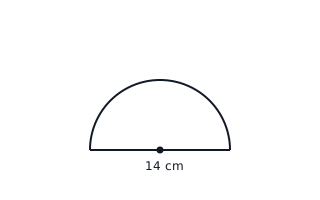
Calculate the perimeter of a protractor (semi-circle) whose diameter is 14 cm14\text{ cm}. (Use π=227\pi = \frac{22}{7})

A semi-circle representing a protractor with a marked diameter of 14 cm.

Solution:

  1. Diameter (dd) = 14 cm14\text{ cm}
  2. Radius (rr) = 142=7 cm\frac{14}{2} = 7\text{ cm}
  3. Perimeter = Curved Arc + Diameter
  4. P=πr+dP = \pi r + d
  5. P=(227×7)+14P = (\frac{22}{7} \times 7) + 14
  6. P=22+14=36 cmP = 22 + 14 = 36\text{ cm}

Explanation:

The perimeter of a semi-circular object like a protractor consists of the semi-circular arc length (12×2πr \frac{1}{2} \times 2\pi r) plus the straight base which is the diameter.