
Mensuration: Area and Perimeter - Calculate and compare areas of rectangles, parallelograms, and triangles
Review the key concepts, formulae, and examples before starting your quiz.
🔑Concepts
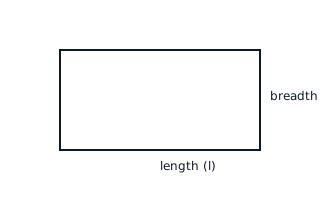
The area of a rectangle is the product of its length and breadth, while the perimeter is the total boundary length. For a rectangle with length and breadth , Area = and Perimeter = .
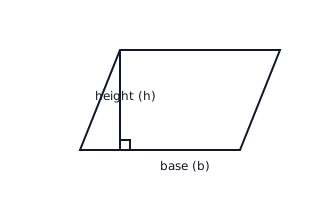
A parallelogram's area is determined by its base () and its vertical height (). Any side can be chosen as the base, but the height must be the perpendicular distance to that base: Area = .
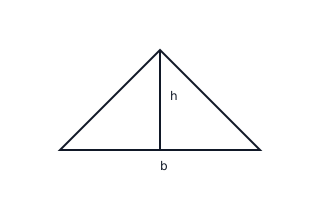
The area of a triangle is exactly half the area of a parallelogram with the same base and height. Formula: Area = . This applies to all triangles regardless of their shape.
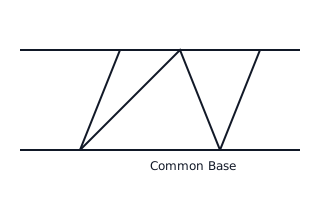
When a triangle and a parallelogram share the same base and lie between the same parallel lines, the area of the triangle is half the area of the parallelogram.
📐Formulae
💡Examples
Problem 1:
A rectangular field has a length of and a breadth of . Calculate the area of the field and the cost of fencing it at the rate of per meter.
Solution:
Length , Breadth . . . Cost of fencing = .
Explanation:
First, the area is found by multiplying dimensions. Then, the perimeter is calculated to find the total length of the fence, which is multiplied by the unit rate.
Problem 2:
A parallelogram and a triangle are on the same base of and between the same parallel lines. If the height of the parallelogram is , find the area of both shapes and compare them.
Solution:
Base , Height . . . Comparison: .
Explanation:
This demonstrates that for the same base and height, a triangle's area is exactly half that of a parallelogram.
Problem 3:
Find the area of a triangle whose sides are , , and using Heron's formula.
Solution:
Let .
Explanation:
When the height is unknown but all three sides are given, Heron's formula is used by first calculating the semi-perimeter and then the square root of the product of and its differences from each side.
Problem 4:
A square and a rectangle have the same perimeter. If the side of the square is and the length of the rectangle is , find the breadth of the rectangle and determine which shape has a larger area.
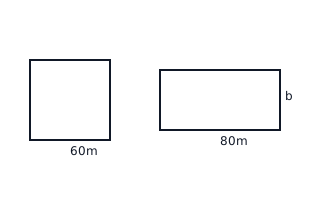
Solution:
- Perimeter of square = .
- Since perimeters are equal, Perimeter of rectangle = .
- .
- Area of square = .
- Area of rectangle = .
- Comparison: , so the square has a larger area.
Explanation:
Calculated the perimeter of the square first to find the missing breadth of the rectangle using the equality condition, then computed both areas to compare.
Problem 5:
A triangular park has sides , , and . Find the cost of leveling the park at per .
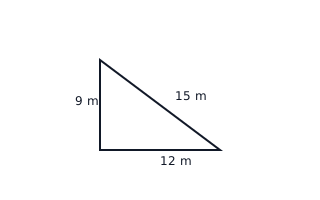
Solution:
- Calculate semi-perimeter .
- Use Heron's formula:
- .
- Cost = .
Explanation:
Since the height was not given, Heron's formula was used to find the area from the three sides, which was then multiplied by the unit rate to find total cost.