krit.club logo

Mensuration: Area and Perimeter - Compute arc length and apply to circular path and sector problems

Grade 9CBSE

Review the key concepts, formulae, and examples before starting your quiz.

🔑Concepts

•

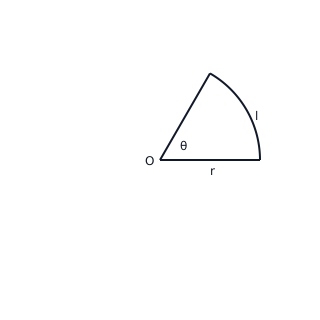
The arc length ll is the distance along the curved part of a sector, representing a fraction of the total circumference 2πr2\pi r proportional to the central angle θ\theta.

Diagram of a circular sector showing radius r, central angle theta, and arc length l.
•

The perimeter of a sector is not just the arc length; it includes the two radii that bound the sector, calculated as P=l+2rP = l + 2r.

•

For a circular path or a rotating wheel, the distance covered in nn revolutions is equal to the product of the number of revolutions and the circumference of the wheel: Distance=n×2πr\text{Distance} = n \times 2\pi r.

•

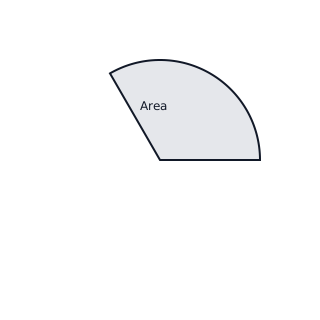
The area of a sector represents a fraction of the circle's total area πr2\pi r^2. It can also be expressed in terms of arc length as A=12lrA = \frac{1}{2}lr.

A shaded sector of a circle representing the area.

📐Formulae

l=θ360∘×2πrl = \frac{\theta}{360^\circ} \times 2\pi r

A=θ360∘×πr2A = \frac{\theta}{360^\circ} \times \pi r^2

P=l+2rP = l + 2r

Distance=n×2πr\text{Distance} = n \times 2\pi r

π≈227 or 3.14\pi \approx \frac{22}{7} \text{ or } 3.14

💡Examples

Problem 1:

Find the length of the arc and the area of a sector of a circle with radius r=21 cmr = 21\text{ cm} and a central angle θ=60∘\theta = 60^\circ. (Take π=227\pi = \frac{22}{7})

Solution:

  1. Length of arc l=θ360∘×2πrl = \frac{\theta}{360^\circ} \times 2\pi r l=60360×2×227×21l = \frac{60}{360} \times 2 \times \frac{22}{7} \times 21 l=16×2×22×3=22 cml = \frac{1}{6} \times 2 \times 22 \times 3 = 22\text{ cm}.

  2. Area of sector A=θ360∘×πr2A = \frac{\theta}{360^\circ} \times \pi r^2 A=60360×227×21×21A = \frac{60}{360} \times \frac{22}{7} \times 21 \times 21 A=16×22×3×21=231 cm2A = \frac{1}{6} \times 22 \times 3 \times 21 = 231\text{ cm}^2.

Explanation:

We use the central angle ratio 60360\frac{60}{360} and multiply by the circumference formula for arc length and the area formula for the sector area.

Problem 2:

A bicycle wheel of radius 35 cm35\text{ cm} is making revolutions to cover a distance of 110 m110\text{ m}. Calculate the number of revolutions.

Solution:

  1. Distance in cm: 110 m=11000 cm110\text{ m} = 11000\text{ cm}.
  2. Circumference C=2πr=2×227×35=220 cmC = 2\pi r = 2 \times \frac{22}{7} \times 35 = 220\text{ cm}.
  3. Number of revolutions n=Total DistanceCircumferencen = \frac{\text{Total Distance}}{\text{Circumference}}: 11000÷22050\begin{array}{r} 11000 \div 220 \\ \hline 50 \end{array} So, n=50n = 50.

Explanation:

The distance covered is the product of the number of revolutions and the circumference. We converted the units to be consistent (cm) before dividing.

Problem 3:

Find the perimeter of a sector of a circle with radius 10.5 cm10.5\text{ cm} and central angle 90∘90^\circ.

Solution:

  1. Arc length l=90360×2×227×10.5l = \frac{90}{360} \times 2 \times \frac{22}{7} \times 10.5 l=14×2×227×212=14×22×3=16.5 cml = \frac{1}{4} \times 2 \times \frac{22}{7} \times \frac{21}{2} = \frac{1}{4} \times 22 \times 3 = 16.5\text{ cm}.
  2. Perimeter P=l+2rP = l + 2r P=16.5+2(10.5)P = 16.5 + 2(10.5) 16.5+21.037.5\begin{array}{r} 16.5 \\ + 21.0 \\ \hline 37.5 \end{array} P=37.5 cmP = 37.5\text{ cm}.

Explanation:

The perimeter of a sector includes the curved arc and the two straight radii. First, calculate the arc length, then add twice the radius.

Problem 4:

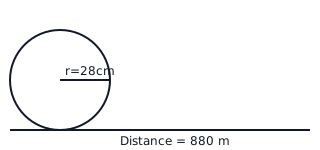
A car wheel has a diameter of 56 cm56\text{ cm}. How many complete revolutions must the wheel make to cover a distance of 880 m880\text{ m}? (Use π=227\pi = \frac{22}{7})

A wheel rolling along a straight path of 880 meters.

Solution:

Radius r=diameter2=562=28 cm\text{Radius } r = \frac{\text{diameter}}{2} = \frac{56}{2} = 28\text{ cm} Distance to cover=880 m=88000 cm\text{Distance to cover} = 880\text{ m} = 88000\text{ cm} Circumference C=2πr=2×227×28=2×22×4=176 cm\text{Circumference } C = 2 \pi r = 2 \times \frac{22}{7} \times 28 = 2 \times 22 \times 4 = 176\text{ cm} Number of revolutions n=Total DistanceCircumference\text{Number of revolutions } n = \frac{\text{Total Distance}}{\text{Circumference}} 88000/176500\begin{array}{r} 88000 / 176 \\ \hline 500 \end{array} n=500n = 500

Explanation:

First, find the radius and convert the total distance into the same units (cm). Then calculate the distance covered in one revolution (the circumference). Divide the total distance by the circumference to find the number of revolutions.

Problem 5:

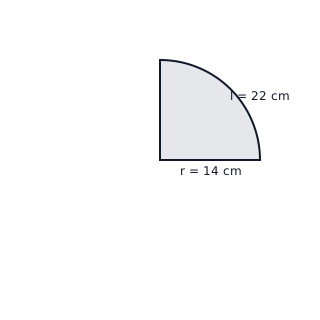
Find the area of a sector of a circle with radius 14 cm14\text{ cm} if the length of the corresponding arc is 22 cm22\text{ cm}.

A sector showing radius 14 cm and arc length 22 cm.

Solution:

Given: r=14 cm,l=22 cm\text{Given: } r = 14\text{ cm}, l = 22\text{ cm} Area of sector A=12×l×r\text{Area of sector } A = \frac{1}{2} \times l \times r A=12×22×14A = \frac{1}{2} \times 22 \times 14 A=11×14A = 11 \times 14 A=154 cm2A = 154\text{ cm}^2

Explanation:

When the arc length and radius are known, the simplest way to calculate the sector area is using the formula A=12lrA = \frac{1}{2}lr, which is derived from the relationship between arc length and circumference.