
Mensuration: Area and Perimeter - Calculate perimeters and circumference in real-life measurement contexts
Review the key concepts, formulae, and examples before starting your quiz.
🔑Concepts
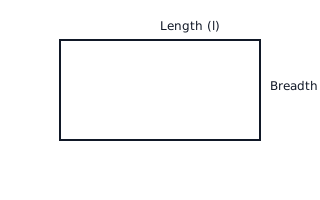
The perimeter of a rectilinear figure is the total length of its boundary. For a rectangle with length and breadth , the perimeter is . In real-world applications, this represents the total length of fencing or edging required for a rectangular plot.
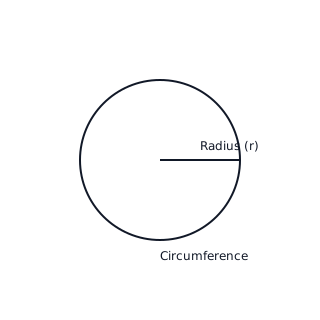
The circumference of a circle is the distance around it. For a circle with radius , the circumference is . This is used to calculate the distance traveled by a wheel in one rotation or the length of a circular track.
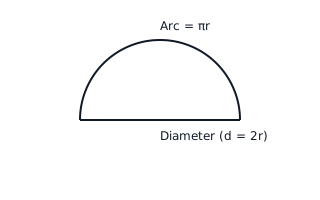
For a semicircle, the total perimeter includes the curved boundary (arc) and the straight boundary (diameter). The formula is . This is crucial for calculating materials for semi-circular windows or park sections.
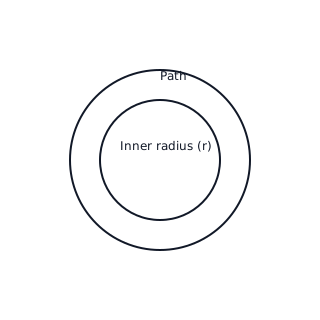
When a path is built around a circular region, two concentric circles are formed. The circumference of the outer circle and inner circle can be used to find the boundary lengths for curbing or railing.
📐Formulae
💡Examples
Problem 1:
A farmer wants to fence a rectangular field of length and breadth with three rounds of wire. Calculate the total length of wire required.
Solution:
First, calculate the perimeter of the field using . Since the farmer needs 3 rounds of wire, total length : The total wire required is .
Explanation:
The perimeter gives the length for one round. Multiplication by the number of rounds provides the total length.
Problem 2:
Find the distance covered by a wheel of radius in complete rotations. (Use )
Solution:
The distance covered in one rotation is equal to the circumference . Total distance for 20 rotations: Converting to meters: .
Explanation:
A wheel covers a distance equal to its circumference in one full turn.
Problem 3:
A wire in the shape of a square of side is bent into the form of a circle. Find the radius of the circle.
Solution:
The length of the wire remains constant. Thus, Perimeter of square = Circumference of circle. Let the radius of the circle be . Then:
Explanation:
When a shape is reshaped (bent), its perimeter/length remains the same.
Problem 4:
A gardener has of fencing material. He fences a circular garden and has some material left. If the garden circumference is , how much material is left?
Solution:
We subtract the used material from the total available: The gardener has of material left.
Explanation:
Simple subtraction in a vertical format is used to find the remaining length after application.
Problem 5:
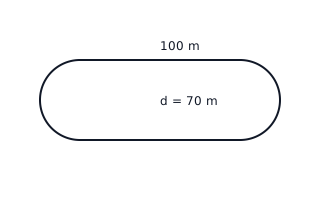
A running track consists of two parallel straight sides each of length and two semicircular ends with a diameter of . Find the total distance covered by an athlete in one complete lap around the inner edge of the track. (Use )
Solution:
- Identify components: The track has two straight lengths and two semicircular ends.
- Length of two straight sides = .
- The two semicircular ends together form one full circle with diameter .
- Circumference of the two ends = .
- Total distance = .
Explanation:
To find the total perimeter of a composite shape, we sum the lengths of all outer boundaries. Here, the two semicircles combine to form a full circle circumference, which is added to the straight edges.
Problem 6:
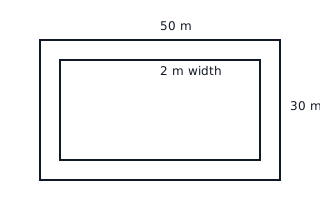
A rectangular park measures by . A path of uniform width is built inside the park along its boundary. Find the total length of the outer fence and the inner boundary of the path.
Solution:
- Outer Perimeter: .
- Inner Dimensions: The width is reduced by from both sides. Inner length = . Inner breadth = .
- Inner Perimeter: .
Explanation:
When a path is inside a rectangle, the inner dimensions are found by subtracting twice the path width from the original length and breadth.