
Mensuration: Area and Perimeter - Apply Heron formula to find triangle area from side lengths
Review the key concepts, formulae, and examples before starting your quiz.
🔑Concepts
Heron's Formula is used to calculate the area of a triangle when the lengths of all three sides are known. Unlike the standard formula , Heron's formula does not require the altitude of the triangle.
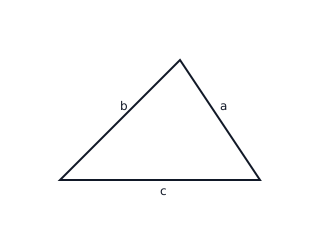
The first step is to calculate the semi-perimeter (), which is half the perimeter of the triangle: .
The Area () is then found using the semi-perimeter: . This is particularly useful for scalene triangles where heights are difficult to determine.
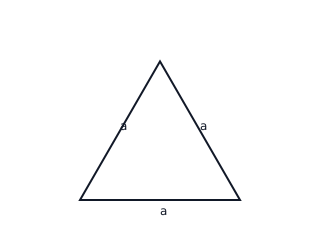
For equilateral triangles with all sides equal to , the formula simplifies significantly to .
📐Formulae
💡Examples
Problem 1:
Find the area of a triangle whose sides are , , and .
Solution:
- Calculate semi-perimeter :
- Apply Heron's Formula:
- Factorize to simplify: Grouping pairs: Result:
Explanation:
We first identify the three sides . We calculate the semi-perimeter , then find the differences between the semi-perimeter and each side. By substituting these into Heron's formula and using prime factorization, we find the area without needing the height.
Problem 2:
An isosceles triangle has a perimeter of and the ratio of its equal side to its base is . Find the area of the triangle.
Solution:
- Find side lengths: Let the sides be and . Sides are and .
- Find semi-perimeter :
- Apply Heron's Formula:
- Simplify: Result:
Explanation:
We use the given ratio and total perimeter to solve for the individual side lengths. After finding the sides, we calculate the semi-perimeter and apply Heron's formula, simplifying the final radical for the result.
Problem 3:
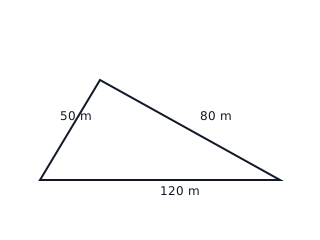
A triangular park has sides , , and . A gardener has to put a fence all around it and also plant grass inside. How much area does he need to plant?
Solution:
- Identify sides: , , .
- Calculate semi-perimeter ():
- Apply Heron's Formula:
Explanation:
To find the area for planting grass, we calculate the semi-perimeter first and then substitute the values into Heron's formula. Factoring the numbers inside the square root helps in simplifying the radical.
Problem 4:
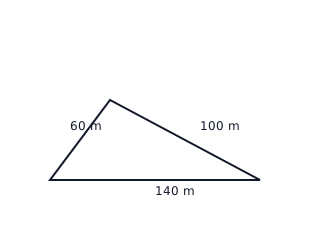
The sides of a triangular plot are in the ratio and its perimeter is . Find its area.
Solution:
- Let the sides be , , and .
- Given perimeter = :
- Find actual side lengths:
- Calculate semi-perimeter ():
- Apply Heron's Formula:
Explanation:
First, find the individual side lengths using the ratio and the perimeter. Once the side lengths are known, the semi-perimeter and Heron's formula can be used to determine the area of the plot.