
Review the key concepts, formulae, and examples before starting your quiz.
🔑Concepts
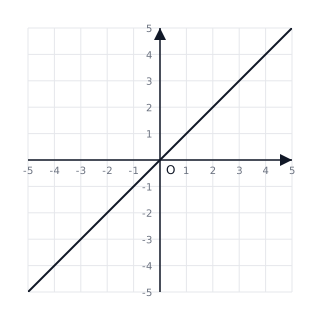
The parent linear function is , which passes through the origin with a slope of . All linear transformations are modifications of this base line.
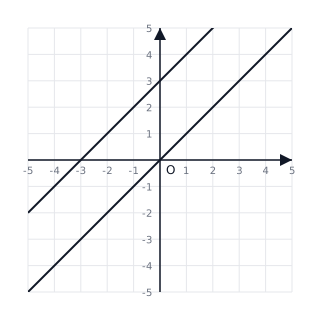
Vertical translations shift the graph up () or down (). This changes the -intercept but leaves the slope unchanged.
Vertical stretches and compressions change the steepness of the line. If , the line becomes steeper (stretch); if , the line becomes flatter (compression).
Reflections across the axes flip the graph. reflects the graph across the -axis, which for results in a line with a negative slope.
📐Formulae
💡Examples
Problem 1:
Given the function , find the new function after a vertical translation 4 units down.
Solution:
Explanation:
To translate a function vertically down by units, we subtract from the entire function. Here, , so .
Problem 2:
Let . Describe the transformations required to obtain .
Solution:
Explanation:
Comparing to the parent function : (stretch), (right shift), and (upward shift).
Problem 3:
Reflect the function across the x-axis.
Solution:
Explanation:
A reflection across the x-axis is achieved by multiplying the entire function by . This changes the signs of both the slope and the y-intercept.
Problem 4:
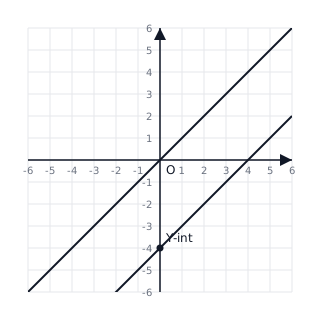
Graph the function and describe it as a transformation of the parent function .
Solution:
This is a vertical translation units downward. The -intercept changes from to .
Explanation:
To transform into , every point on the parent graph is shifted to .
Problem 5:
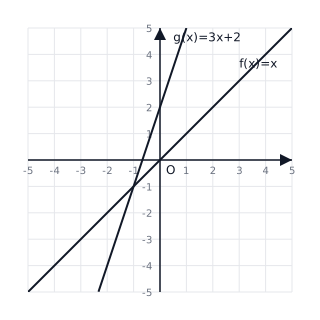
Given the parent linear function , determine the equation of the function that results from a vertical stretch by a factor of followed by a vertical translation units up. Graph both functions to visualize the transformation.
Solution:
- Start with the parent function: .
- Apply the vertical stretch by factor : .
- Apply the vertical translation up by : .
- The final equation is .
Explanation:
A vertical stretch by a factor of multiplies the output values of the function by , making the slope steeper (). A vertical translation of units up adds to the entire function, shifting the -intercept from to .