
Review the key concepts, formulae, and examples before starting your quiz.
🔑Concepts
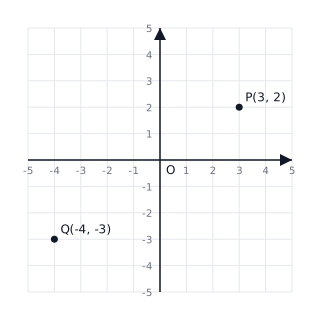
The Cartesian Plane consists of two perpendicular number lines: the horizontal -axis and the vertical -axis. Their intersection point is called the origin. Each point is identified by an ordered pair , where indicates horizontal distance and indicates vertical distance.
Linear graphs are straight lines represented by the equation . The coefficient represents the gradient (steepness), calculated as . The constant is the -intercept, where the line crosses the -axis.
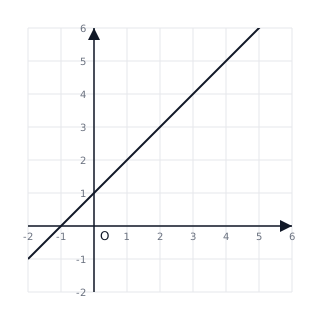
The gradient (slope) of a line determines its orientation. A positive gradient () slants upwards from left to right, while a negative gradient () slants downwards. A horizontal line has , and a vertical line has an undefined gradient.
To plot a linear graph from an equation, create a table of values for and solve for , then plot the resulting coordinate pairs and connect them with a straight line.
📐Formulae
💡Examples
Problem 1:
Find the gradient () and the -intercept () for the line given by the equation , and state the coordinates of the -intercept.
Solution:
- Rearrange the equation into the form by subtracting from both sides:
- Identify the coefficient of as the gradient:
- Identify the constant term as the -intercept:
- The coordinates of the -intercept are .
Explanation:
To identify key features of a linear graph, it is easiest to convert the equation into gradient-intercept form. The gradient tells us the line drops 3 units for every 1 unit it moves right.
Problem 2:
Calculate the gradient of the line passing through the points and .
Solution:
- Identify the coordinates: and .
- Use the gradient formula:
- Substitute the values:
- Simplify the numerator and denominator:
- Calculate the final result: .
Explanation:
The gradient is the ratio of the change in vertical height (rise) to the change in horizontal distance (run). A gradient of 2 means the line is rising.
Problem 3:
Identify the coordinates of the points and shown on the grid, and determine the gradient of the line segment .
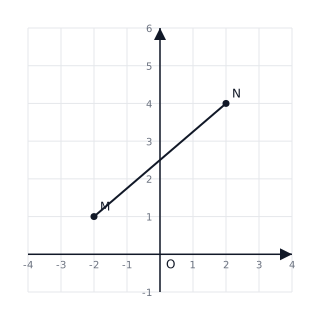
Solution:
- From the grid, point is at and point is at .
- Use the gradient formula: .
- .
- The gradient is .
Explanation:
The gradient represents how much the -value increases for every unit increase in . Here, for every units right, the line goes units up.
Problem 4:
Identify the -intercept and -intercept from the graph of the linear equation shown. Then, use these intercepts to calculate the gradient () of the line.
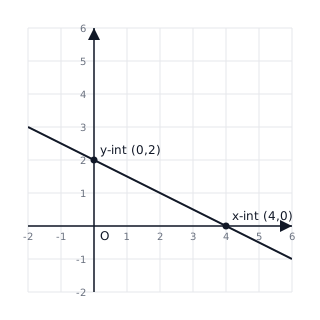
Solution:
-
Identify the Intercepts: From the graph, the line crosses the -axis at . Therefore, the -intercept is . The line crosses the -axis at . Therefore, the -intercept is .
-
Identify Coordinates: Let and .
-
Calculate Gradient: Using the formula :
The gradient of the line is .
Explanation:
The -intercept is the point where the graph intersects the -axis (), and the -intercept is where it intersects the -axis (). The gradient represents the rate of change, calculated as the change in over the change in . Since the line slopes downwards from left to right, the gradient is negative.